Cryptids & Animal Reports
The Beast of Bodmin Moor: Big-Cat Reports Without a Specimen
The Beast of Bodmin Moor is a cluster of reports rather than one identified animal. Escaped exotic cats are biologically possible in Britain, but the Bodmin evidence has not established a breeding population or individual specimen.
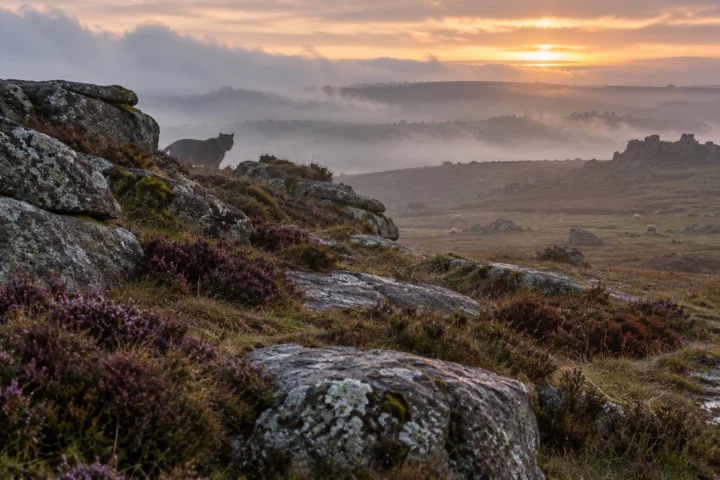
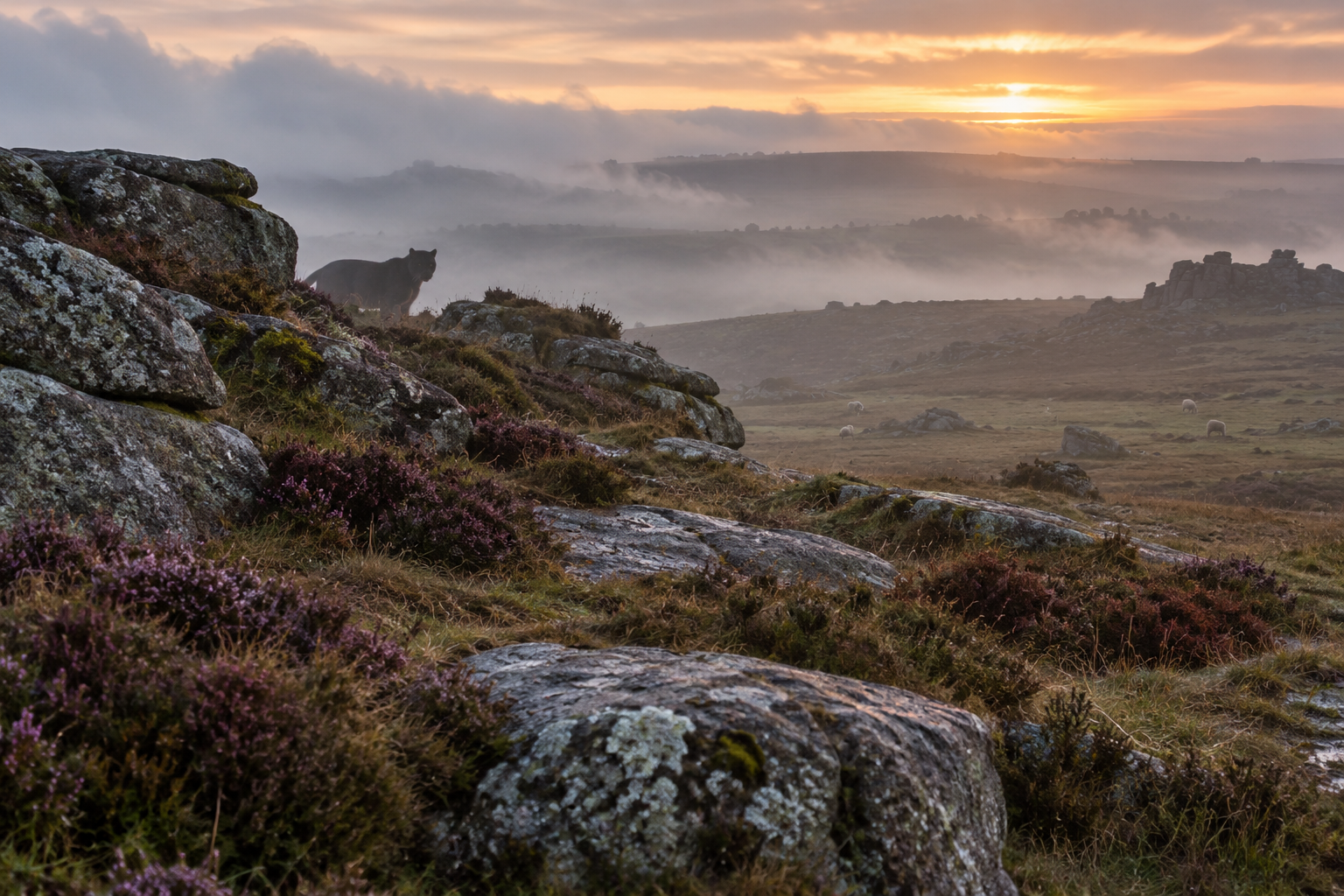
Bodmin Moor offers ideal conditions for ambiguous animal reports: broken granite, heather, mist, livestock and long sightlines without reliable scale. From the late twentieth century, witnesses increasingly described black or tawny cats larger than domestic animals. Newspapers gave the reports a single memorable owner, the Beast of Bodmin Moor.
Livestock deaths made the story more testable. In 1995 the Ministry of Agriculture, Fisheries and Food commissioned an investigation that reviewed alleged attacks, sightings and images. Its reported conclusion found no verifiable evidence of a large cat on the moor, while acknowledging that absence of evidence could not prove that no exotic animal ever passed through.
Britain has held pumas, leopards and other cats in private collections, and individual escapes or releases are plausible. That possibility is different from identifying a particular photograph, kill or footprint. Domestic cats photographed without scale can appear large, while dogs, foxes and scavenging after death complicate livestock evidence.
A leopard skull found near the moor briefly seemed decisive, but examination reportedly indicated it had been imported and prepared, not recently shed by a wild Cornish animal. A detached object without secure discovery context cannot establish a population.
The case should be compared with Britain’s broader moorland cat reports, the predator evidence in the Beast of Gévaudan, and the tissue analysis that resolved the Saint Augustine Monster.
Claim, Context and Cautions
One name, many observations
Reports separated by years cannot automatically describe the same animal. Coat colour, apparent size and behaviour vary, and the label encourages new witnesses to interpret any large feline silhouette as the established Beast. A real escaped cat could also coexist with domestic-cat mistakes and embellished stories.
The correct unit of analysis is each observation, with its date, distance, duration and physical trace, rather than the accumulated headline count.
What the 1995 inquiry could test
Investigators examined claimed kills and visual material but did not recover a carcass, verified scat, hair with a secure chain of custody or an unambiguous track sequence. The conclusion was appropriately narrower than saying large cats are impossible in Britain.
A short field inquiry also cannot continuously monitor a wide landscape. It can assess submitted evidence and the probability that documented attacks require a big cat.
Scale and livestock
A cat on a ridge can seem enormous when there is no adjacent object at the same distance. Zoom lenses flatten perspective, and black coats erase body detail. Tracks expand in soft ground or overlap. For a livestock carcass, tooth spacing, haemorrhage, feeding pattern and timing are more informative than dramatic wounds alone.
Scavengers can modify an animal after death, so predation must be distinguished from later feeding.
What would change the case
A body, high-quality multi-angle imagery, verified DNA from scat or repeated camera-trap records could establish species and perhaps individual identity. Evidence would need documented collection and controls against captive-animal material.
Until then, Bodmin remains unresolved at the level of occasional reports, not demonstrated at the level of a resident mystery beast. The cautious position allows that exotic cats have escaped in Britain while refusing to assign every distant shape to one enduring animal. Repeated reports justify careful wildlife monitoring, but repetition cannot substitute for a diagnostic trace.
Contextual glossary
Terms used in this entry
Definitions are offered as reading aids, not as conclusions about the case.
- Chain of custody
- The documented sequence showing who collected, stored, copied, tested and transferred an object or recording. Gaps make alteration, contamination or mistaken identity harder to rule out.
- Camera trap
- A remotely triggered camera used to record animals without an observer being present. Its evidential value depends on placement, trigger range, image quality, timestamps and secure retrieval of the original files.
Reference trail
Sources
- UK Parliament Hansard search, Beast of Bodmin Moor (opens in a new tab)Parliamentary record interface for official questions and government statements concerning the investigation.
- UPI archive, Beast of Bodmin Moor still a mystery (opens in a new tab)Contemporary report of the government inquiry, submitted evidence and its conclusion.
- University of Warwick, forensic tests for canids and big cats (opens in a new tab)University laboratory guidance on suitable samples, DNA testing and a claimed kill that yielded fox rather than big-cat evidence.
Case Book
Photographs, Maps and Supporting Images
Supporting images provide documentary, geographic or visual context. Read each caption for its date, source and evidential limits.

Continue researching
Follow the evidence, context and comparisons
Curated connections
Selected editorially for this entry.
A careful look at Britain and Ireland large-cat reports, where escaped-animal context, distance errors and local rumour overlap.
Curated connection · Case fileThe Beast of Gévaudan: Predators, Panic and the Making of a MonsterLethal attacks in Gévaudan prompted royal hunts and national coverage from 1764 to 1767. The deaths are historical; whether one unusual animal caused them is disputed.
Curated connection · Case fileThe Saint Augustine Monster: From Giant Octopus to Whale TissueThe Saint Augustine Monster was a real stranded carcass whose decayed form misled early observers. Preserved samples support degraded whale tissue, not a giant octopus.