UFOs & Aerial Phenomena
The Shag Harbour Incident: Lights Down in the Water
The Shag Harbour report generated RCMP and defence records because observers feared an aircraft crash. Searchers found no wreckage, missing aircraft or confirmed object.
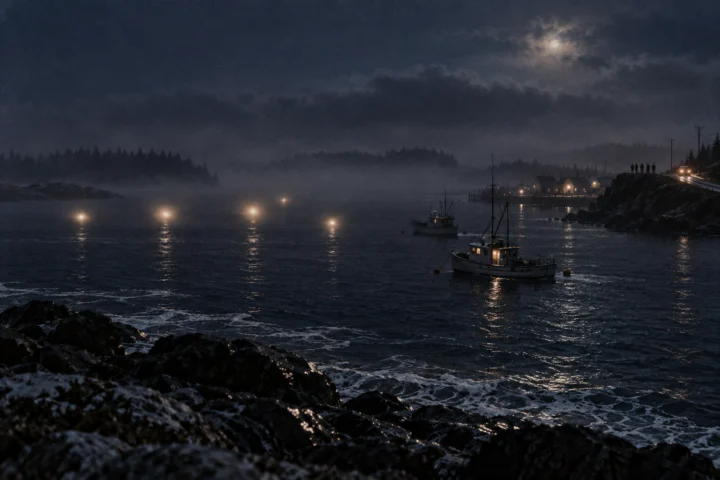
On the night of 4 October 1967, witnesses near Shag Harbour, Nova Scotia, saw a row or cluster of lights move low over the coast and apparently descend towards the water. Some thought an aircraft had crashed. Royal Canadian Mounted Police officers attended, and local boats joined a search around a reported patch of light or foam.
No civilian or military aircraft was reported missing. Canadian defence messages consequently used “UFO” in its literal administrative sense: the object or source remained unidentified. Divers and search personnel did not recover a wreck or material that established a vehicle.
Later accounts add underwater tracking, naval confrontation and a second object near Shelburne. Some material may derive from participants, but the public documentary chain is much weaker than for the initial Shag Harbour search. Those extensions should not be folded into the official record as settled fact.
The case can be compared with the documented uncertainty at Rendlesham Forest, the mass-witness problem of the Phoenix Lights, and the archive’s account of ordinary and extraordinary sky reports.
Claim, Context and Cautions
A possible crash seen from shore
Witnesses described multiple lights at low altitude, some at an angle, followed by disappearance at or beyond the waterline. Distances over dark water are hard to judge, so apparent contact with the sea cannot by itself establish impact.
The reports were credible enough as an emergency to prompt police and maritime response. That practical judgement did not identify the source.
Why official records exist
Authorities treated the event first as aviation safety and search-and-rescue. Messages checked for missing aircraft and passed the unresolved report through military channels. The label ‘UFO’ recorded an identification failure, not an official conclusion about extraterrestrial origin.
This administrative context is essential when reading the surviving files.
Search without a recovered craft
Local vessels and later search activity found no aircraft debris or bodies. Accounts mention foam or a yellowish light on the surface, but no preserved sample establishes fuel, biological material or an unknown substance.
Negative recovery weakens a conventional crash interpretation while also leaving no physical object for an extraordinary one.
The Shelburne extension
A more elaborate narrative describes an object travelling underwater towards a naval area, being monitored and joined by another craft. These claims became prominent in later books and interviews. Publicly accessible contemporary documentation is thinner and sometimes indirect.
They should be presented as later testimony, not as equivalent to dated RCMP and defence messages from the original night.
A durable unidentified event
Aircraft, meteors, flares, vessels and perceptual effects have been suggested. Each accounts for certain features and struggles with others because exact tracks, bearings and timings were not captured instrumentally.
The strongest conclusion is modest: multiple observers reported unusual lights, officials searched in good faith, and no source was confirmed. Unidentified is the result of the record, not a vehicle classification.
Contextual glossary
Terms used in this entry
Definitions are offered as reading aids, not as conclusions about the case.
- Uncertainty
- The stated limit on what a measurement, reconstruction or body of evidence can establish. Describing uncertainty is not indecision; it prevents a result from appearing more precise than the evidence allows.
- UFO
- Unidentified flying object, historically used for an aerial observation that remains unidentified at the time of reporting. In popular culture it often implies a spacecraft, which is a separate claim.
Reference trail
Sources
- Library and Archives Canada, Shag Harbour UFO collection (opens in a new tab)Primary Canadian archival collection of government records relating to the incident.
- Library and Archives Canada, UFO research guide (opens in a new tab)Official context for interpreting Canadian UFO files and administrative terminology.
- Library and Archives Canada, digitised Shag Harbour file item (opens in a new tab)Digitised primary record used for dated official reporting and search context.
- Trent University, A History of Canada’s UFO Investigation, 1950–1995 (opens in a new tab)Academic history situating Shag Harbour within Canadian military and civil investigation.
Case Book
Photographs, Maps and Supporting Images
Supporting images provide documentary, geographic or visual context. Read each caption for its date, source and evidential limits.


Continue researching
Follow the evidence, context and comparisons
Curated connections
Selected editorially for this entry.
Rendlesham remains one of the most famous UFO cases in Britain because it produced sightings, notes and later arguments in the shadow of a military base.
Curated connection · Case fileThe Phoenix Lights: Two Events, One NightOn 13 March 1997, reports of a moving light formation crossed Arizona before a separate row of lights appeared near Phoenix. One event has a strong military-flare explanation; the other remains disputed.
Curated connection · ArticleHow Ordinary Lights Become Extraordinary UFO ReportsAircraft, satellites, planets, drones and atmospheric effects can become strange when context is missing.
More through shared context
Additional routes based only on existing topics, themes and metadata.
The crew’s visual report was real and professionally documented. Radar returns were intermittent and disputed, while darkness, cloud and uncertain distance made size estimates especially fragile.
Same primary topic · Shared theme: Strange signals · Case fileLakenheath–Bentwaters: Radar, Interceptors and an Unresolved NightThe Lakenheath–Bentwaters incident combines multiple radar reports and an interceptor account, yet gaps in timing, weather and original records prevent a secure identification or extraordinary conclusion.