Hoaxes, Misidentifications & Media
The Max Headroom Broadcast Intrusion: Ninety Seconds Unsolved
The 22 November 1987 intrusions interrupted WGN briefly and WTTW for about ninety seconds. An attacker probably overpowered microwave programme links; the FCC inquiry found no culprit.
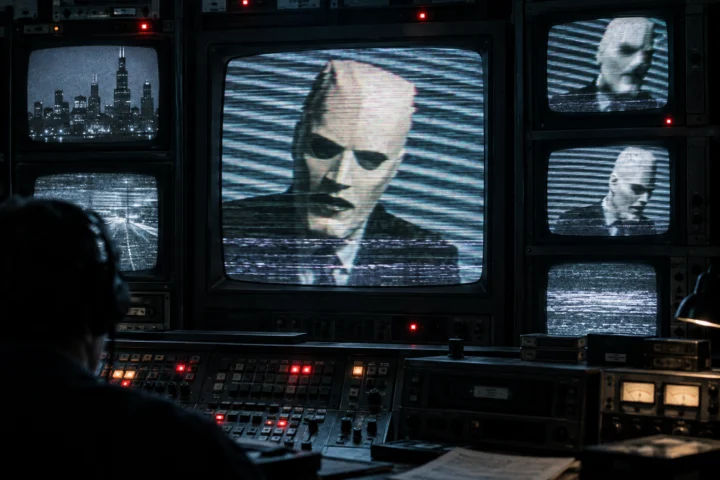
On 22 November 1987, viewers of Chicago station WGN saw sports presenter Dan Roan replaced for roughly twenty-five seconds by a masked figure against a moving corrugated background. Engineers restored their signal. About two hours later, the same figure interrupted WTTW’s broadcast of Doctor Who for about ninety seconds, with distorted speech and a chaotic closing scene.
The event is often called a “hack”, but no newsroom computer needed to be breached. Analogue broadcasters carried programmes from studios to transmitters by microwave links. A sufficiently strong, correctly aimed signal at the receiving site could override the legitimate feed.
The Federal Communications Commission investigated. Reproducing the attack required technical knowledge, access to microwave equipment and favourable geography, yet those requirements did not identify a person. No verified confession or prosecution followed.
The intrusion sits beside the media mechanics of the War of the Worlds broadcast, the spread of stories through mass media, and the archive’s test for evidence and attribution.
Claim, Context and Cautions
Two interruptions, one evening
The first intrusion reached WGN during a sports segment and ended when engineers changed the studio-to-transmitter link configuration. The second entered WTTW during a programme recorded for transmission; staff at the unmanned transmitter could not remove it quickly.
The matching masked performance and backdrop connect the two broadcasts more strongly than later anonymous claims do.
What viewers actually saw
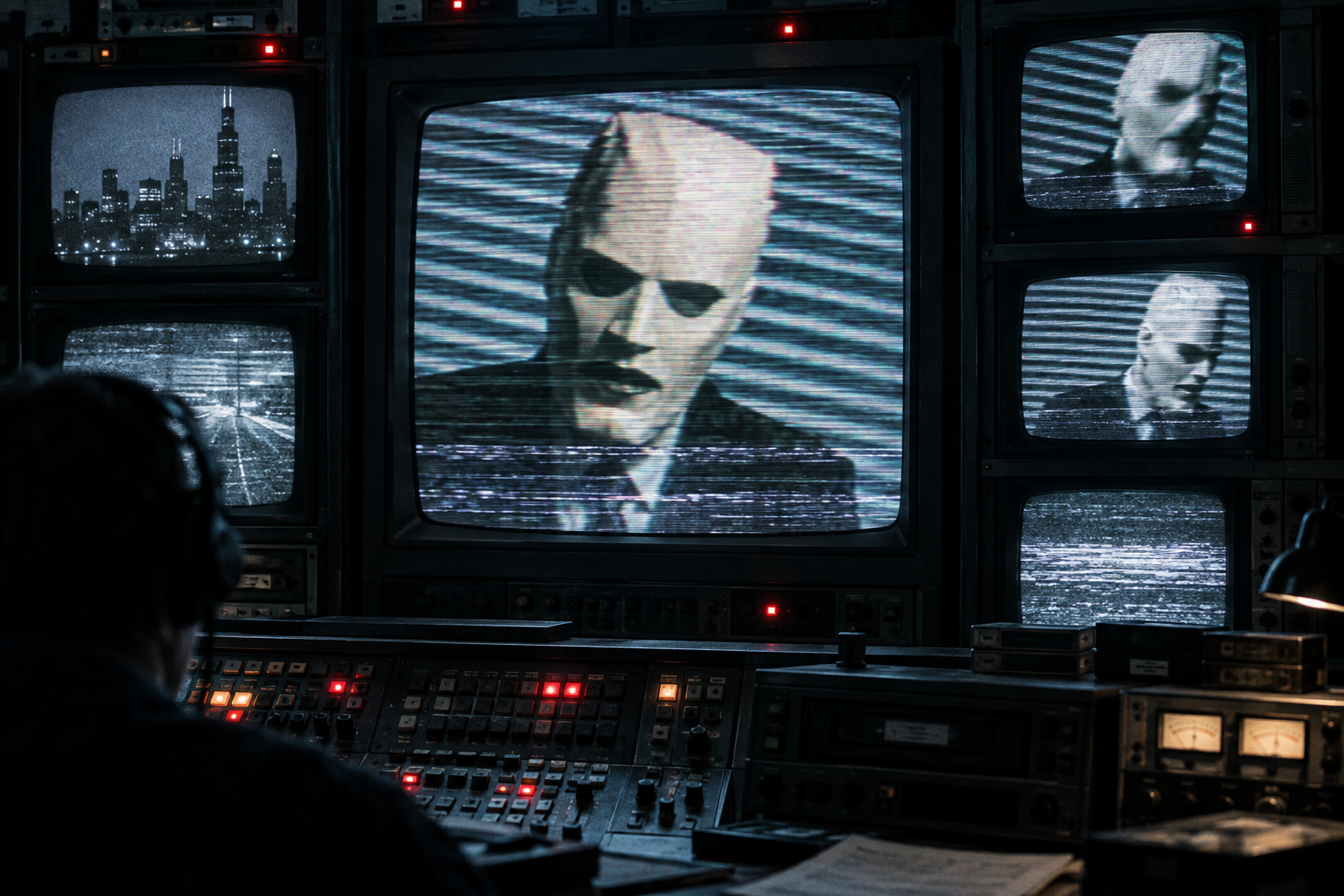
Recordings preserve the audiovisual event directly: a person in a rubber mask, a rotating or oscillating metal background, noisy audio and deliberate parody. They do not show the transmission site, equipment or participants outside the frame.
Transcript reconstructions differ because several lines are distorted. Uncertain words should not be turned into clues.
A signal path, not a computer break-in
The likely vulnerability lay in microwave studio-transmitter links. If an unauthorised transmitter delivered a stronger signal on the relevant frequency and bearing, the broadcast transmitter could relay it. WTTW's link conditions made manual recovery difficult.
This explanation is technically ordinary, though carrying it out covertly required skill and equipment.
The investigation and its limits
The FCC sought technical leads and threatened substantial penalties. Contemporary trade coverage emphasised the small pool of people likely to understand the system. That inference never produced publicly confirmed identities.
Later internet suspects and recollections lack the documentary chain needed to replace an official attribution.
Explained mechanism, unknown authors
The case contains no paranormal unknown. Its unresolved element is human identity and motive. The perpetrators probably intended disruption and performance rather than material gain, but even motive is inferred from the tape.
It is therefore both explained and unsolved: engineers can describe how an analogue feed could be seized, while the historical record cannot name who did it.
Contextual glossary
Terms used in this entry
Definitions are offered as reading aids, not as conclusions about the case.
- Bearing
- A direction measured clockwise from north, usually in degrees. A bearing gives a line of direction rather than a distance; two or more reliable bearings may help locate a source.
Reference trail
Sources
- WTTW, “The Max Headroom Attack” (opens in a new tab)Affected station’s account of the second interruption and broadcast context.
- United Press International, 24 November 1987 (opens in a new tab)Contemporary wire report on both intrusions and the FCC response.
- Electronic Media, 30 November 1987 issue (opens in a new tab)Contemporary broadcast-trade coverage of the intrusion and likely technical pathway.
- FCC FOIA logs, 2017–2020 (opens in a new tab)Federal record showing continuing public-record interest; used only for investigation provenance, not perpetrator claims.
Case Book
Photographs, Maps and Supporting Images
Supporting images provide documentary, geographic or visual context. Read each caption for its date, source and evidential limits.

Continue researching
Follow the evidence, context and comparisons
Curated connections
Selected editorially for this entry.
A classic media panic case showing how a drama, late tuning and newspaper repetition turned a radio play into a durable legend.
Curated connection · ArticleThe Role of Newspapers in Spreading Strange TalesOld newspapers preserved remarkable local reports, but they also shaped them for appetite, humour and alarm.
Curated connection · ArticleThe Difference Between Evidence, Testimony and LegendA field guide to three words that often get tangled in mystery research.
More through shared context
Additional routes based only on existing topics, themes and metadata.
Claims made after the Lutz family’s 1975 stay became a bestselling book and film franchise. The murders in the house were real; evidence for the subsequent haunting is not reliable.
Same primary topic · Shared theme: Media & rumour · Case fileThe Great Moon Hoax and the Machinery of WonderIn 1835, newspaper readers met moon forests, lunar animals and winged people in a celebrated lesson about media, science and appetite.