UFOs & Aerial Phenomena
The Kelly-Hopkinsville Encounter: A Farmhouse Under Siege
The Sutton and Lankford households reported a night-long confrontation near Kelly, Kentucky. Police found frightened witnesses and gunfire evidence, but no creature or trace that identified what they saw.
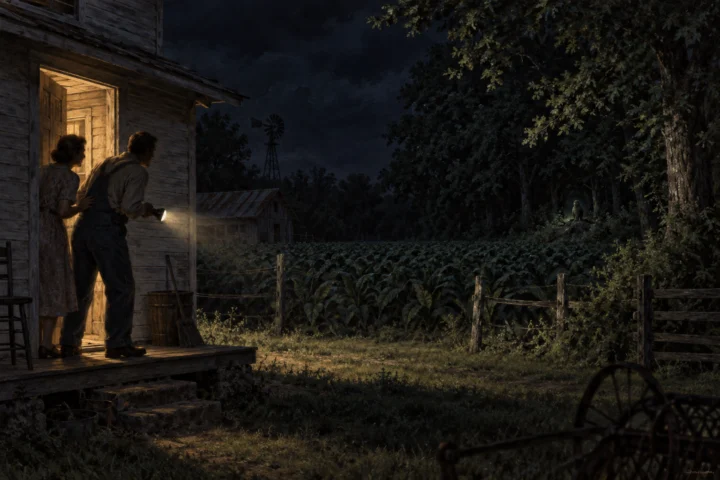
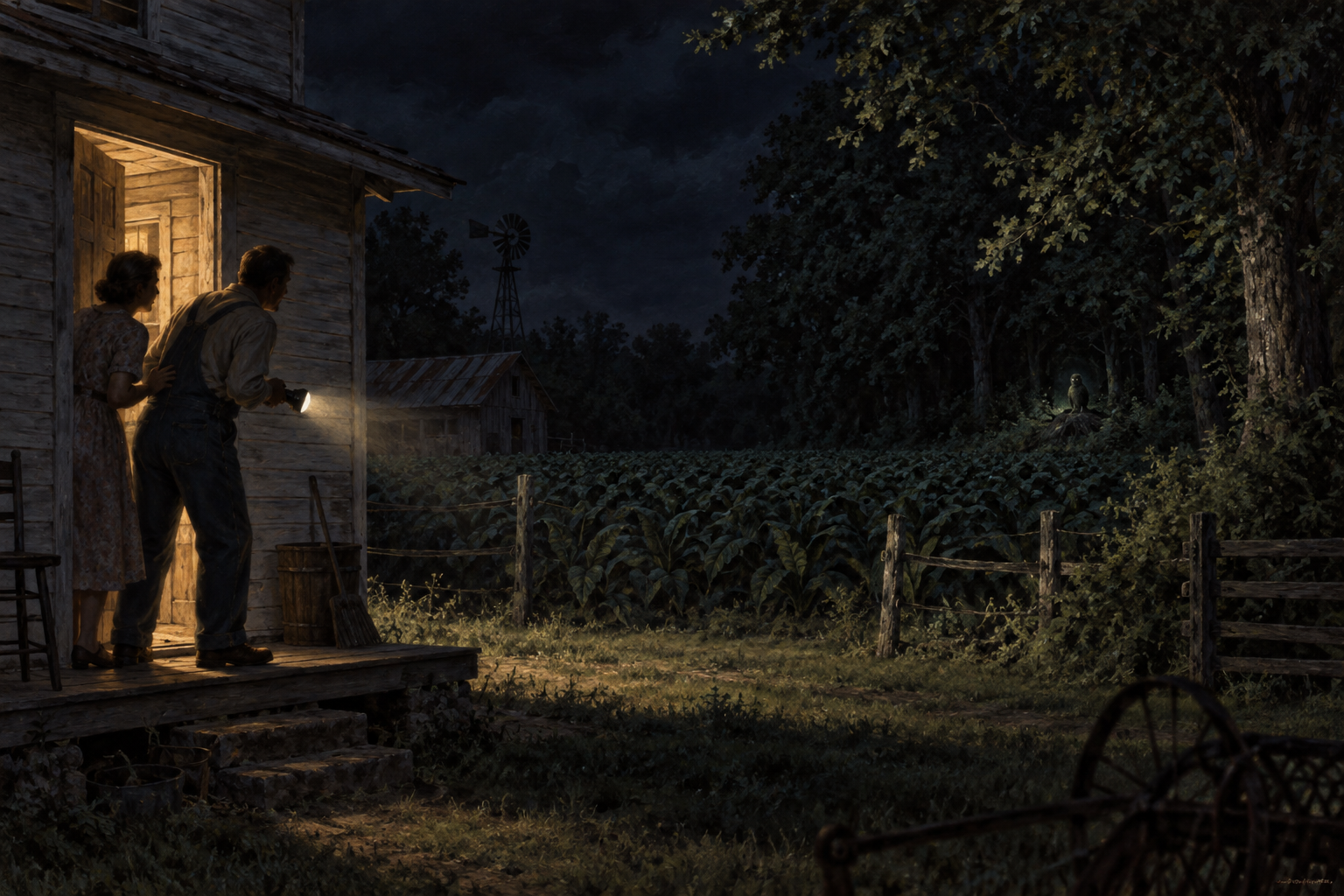
Late on 21 August 1955, Billy Ray Taylor said that a bright object crossed the sky near the rural home shared by the Sutton and Lankford families outside Kelly, Kentucky. Later, people inside reported small figures with large luminous eyes approaching the house. Men fired through windows and a doorway; the figures withdrew or seemed to float away, then returned.
The frightened group drove to Hopkinsville police headquarters. Officers and military police searched the property, finding spent ammunition and damage consistent with gunfire but no intruder, body, tracks or landed craft. Reports resumed after police left and ended before dawn.
The case is unusually rich in named witnesses yet poor in independent physical evidence. Owls seen under bad lighting, heightened alarm after a meteor, and mutual reinforcement can account for parts of the description. A deliberate hoax has also been proposed, but contemporary police encountered a family whose distress they regarded as genuine.
It belongs beside evidence, testimony and legend, the archive’s guide to recording strange experiences, and the problem of interpreting ordinary lights in extraordinary reports.
Claim, Context and Cautions
A light, then figures at the windows
Taylor's first report concerned a bright object moving towards a field. The close-encounter narrative began later, when the household said a small figure approached with raised arms and bright eyes. Subsequent figures appeared at windows, on the roofline and in a nearby tree.
Accounts agree on the broad sequence but vary in the number, appearance and timing of the visitors. The famous label ‘little green men’ was a press simplification; early descriptions more often stressed pale or silvery colour.
What the police could establish
Police arrived after the family sought help in Hopkinsville. They found no creature or landing trace. Bullet holes, spent cartridges and the witnesses' agitation established that weapons had been discharged and that the occupants believed something was outside.
Those observations corroborate a disturbance, not its extraordinary interpretation. No officer reported seeing the beings during the search.
Owls and perceptual escalation
Great horned owls can appear large at close range, have reflective eyes, grasp branches with extended talons and glide silently. Investigators have therefore proposed that one or more owls supplied the visual stimulus. A meteor could explain the earlier light.
This hypothesis fits several features without proving that every reported appearance had the same cause. Repeated firing, darkness and shared expectation could then amplify ambiguous sights.
Hoax, intoxication and weak claims
Contemporary reporting entertained alcohol and fabrication. The household denied drinking, and police did not describe a simple drunken prank. Later retellings sometimes add details absent from early statements or treat family agreement as independent corroboration.
A hoax remains possible but requires a motive and sustained performance that the surviving record does not demonstrate. Sincerity and accurate identification are separate questions.
What remains unresolved
The secure core is narrow: witnesses reported a light, then fired at perceived figures; police investigated and recovered no extraordinary material. The experience became folklore because the descriptions were vivid and the confrontation prolonged.
The evidence supports a frightening night and an unresolved identification. It does not establish extraterrestrial visitors, nor does it permit a confident reconstruction of every stimulus.
Contextual glossary
Terms used in this entry
Definitions are offered as reading aids, not as conclusions about the case.
- Close encounter
- A classification used for reported nearby encounters with an unusual aerial object or its alleged effects. It organises testimony; it does not certify that the reported object had an extraordinary origin.
- Hoax
- A deliberate attempt to make false evidence or a false story appear genuine. A hoax can still become culturally important, but its later influence should not be confused with the original claim.
- Reconstruction
- A later model, image or account made to represent an event from surviving information. It can clarify a hypothesis but should remain visibly separate from contemporary evidence.
- Corroboration
- Independent information that supports part of an account, such as a record, trace or separately obtained observation. Repetition from a shared source is not independent corroboration.
- Meteor
- The streak of light produced when a small extraterrestrial body heats the atmosphere during entry. The object in space is a meteoroid; material that reaches the ground is a meteorite.
Reference trail
Sources
- Isabel Davis and Ted Bloecher, Close Encounters at Kelly and Others of 1955 (opens in a new tab)Book record for the detailed witness investigation assembled close to the event.
- Kentucky New Era, contemporary Kelly report transcription (opens in a new tab)Transcription of local contemporary coverage used for the earliest public sequence and descriptions.
- Joe Nickell, “Siege of the Little Green Men” (opens in a new tab)Critical reconstruction presenting the owl, meteor and perceptual-escalation explanation.
- Kentucky Cop Stories, Hopkinsville police historical account (opens in a new tab)Police-history context used cautiously for the response and local institutional memory.
Case Book
Photographs, Maps and Supporting Images
Supporting images provide documentary, geographic or visual context. Read each caption for its date, source and evidential limits.

Continue researching
Follow the evidence, context and comparisons
Curated connections
Selected editorially for this entry.
A field guide to three words that often get tangled in mystery research.
Curated connection · ArticleA Field Guide for Recording Strange Experiences ResponsiblyA calm checklist for writing down unusual events before memory, excitement and online feedback reshape them.
Curated connection · ArticleHow Ordinary Lights Become Extraordinary UFO ReportsAircraft, satellites, planets, drones and atmospheric effects can become strange when context is missing.
More through shared context
Additional routes based only on existing topics, themes and metadata.
The crew’s visual report was real and professionally documented. Radar returns were intermittent and disputed, while darkness, cloud and uncertain distance made size estimates especially fragile.
Same primary topic · Shared theme: Witness & memory · Case fileSocorro: Lonnie Zamora and the Object in the ArroyoThe Socorro incident rests on a prompt police report and documented ground traces, yet neither the marks nor later theories securely identify what Lonnie Zamora saw.