Scientific Anomalies & Natural Phenomena
The Vela Incident: A Double Flash Over the South Atlantic
Vela 6911 detected an unexplained double flash on 22 September 1979. Official and scientific assessments disagreed over whether it marked a secret atmospheric nuclear test.
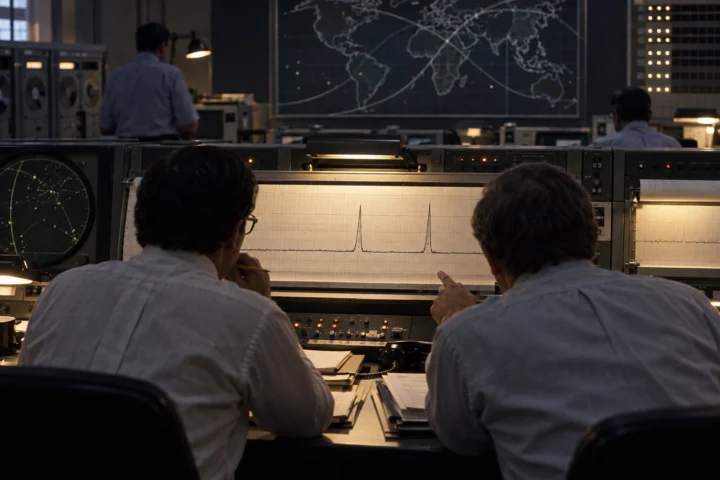
At 00:53 UTC on 22 September 1979, optical sensors aboard the aging U.S. satellite Vela 6911 recorded two pulses over the ocean south of Africa. Such a “double flash” was the signature the spacecraft had been built to detect: the changing light curve of an atmospheric nuclear explosion.
The alert did not become a simple confirmation. A White House scientific panel chaired by Jack Ruina concluded that the signal was probably not nuclear and considered sunlight scattered by debris after a micrometeoroid impact. Other U.S. agencies and laboratory specialists judged a small test more likely.
Hydroacoustic signals and later reports of iodine-131 in Australian sheep were argued as corroboration, but attribution remains contested. Israel and South Africa have often been named in speculation; neither a responsible source nor the surviving public record proves which state, if any, conducted a test.
The evidential tension resembles the archive’s treatment of wartime sensor ambiguity, levels of evidence, and the need for cautious interpretation in technical witness reports.
Claim, Context and Cautions
What the satellite recorded
Vela satellites used paired optical instruments called bhangmeters to recognise the fast first pulse and slower second pulse expected from a nuclear fireball in the atmosphere. Alert 747 showed that broad form. It was the only such unexplained event in the system's history to become a major policy dispute.
The observation was instrumental rather than visual testimony, but instruments can suffer damage, unusual geometry and false signatures.
An old spacecraft and a difficult location
Vela 6911 had exceeded its intended service life. The apparent source lay in a remote ocean sector with limited independent coverage and complicated weather. Search aircraft did not return a decisive debris or fallout result.
Those conditions reduced the corroboration normally expected after a nuclear detection, while also making a small clandestine test easier to conceal.
The Ruina panel’s conclusion
The presidential panel found discrepancies between the two sensors and assessed the event as probably not a nuclear explosion. It explored a “zoo event”—an anomalous signal possibly created when a micrometeoroid struck the satellite and sunlight reflected from debris.
That was a probability judgement, not identification of recovered debris. Later critics argued that the proposed mechanism did not reproduce the trace well.
Government disagreement behind the finding
Declassified memoranda show that the CIA, Defense Intelligence Agency, Department of Energy laboratories and other specialists did not uniformly accept the panel's view. Some assessments assigned a high probability to a nuclear event. Political consequences surrounding proliferation and relations with suspected states formed the context, but context alone cannot prove suppression.
The record establishes disagreement among informed analysts, not a single hidden official answer.
Possible corroborating signals
Researchers have revisited hydroacoustic data consistent with an energetic ocean-area event and iodine-131 measurements reported in Australian sheep thyroids. Timing and transport models can make these observations compatible with a test. Their association with Alert 747 is inferential: neither sample was a labelled fragment from an identified device.
Later peer-reviewed work has strengthened the nuclear interpretation without making attribution certain.
What can responsibly be concluded
The Vela flash closely resembled the phenomenon the satellite was designed to find. The principal alternative arose from sensor inconsistencies and absent decisive fallout, not from a demonstrated mundane source.
A small atmospheric nuclear test is a serious and arguably strong explanation. The public evidence does not support naming a perpetrator as established fact, so the event remains disputed rather than solved.
Contextual glossary
Terms used in this entry
Definitions are offered as reading aids, not as conclusions about the case.
- Light curve
- A graph showing how an object’s brightness changes over time. Astronomers use its shape, depth and repetition to investigate eclipses, stellar activity and material passing in front of a star.
- Corroboration
- Independent information that supports part of an account, such as a record, trace or separately obtained observation. Repetition from a shared source is not independent corroboration.
Reference trail
Sources
- National Security Archive, “The Vela Flash: Forty Years Ago” (opens in a new tab)Declassified memoranda documenting the detection, scientific review and disagreement among U.S. agencies.
- National Security Archive, “The Vela Incident: Nuclear Test or Meteoroid?” (opens in a new tab)Document set contrasting the presidential panel with intelligence and laboratory assessments.
- C. M. Wright and L.-E. De Geer, “The 22 September 1979 Vela Incident: The Detected Double-Flash” (opens in a new tab)Peer-reviewed forensic reassessment of the bhangmeter traces and competing physical scenarios.
- U.S. government publication, Moving Beyond Pretense: Nuclear Power and Nonproliferation (opens in a new tab)Government-hosted historical discussion of the disputed event and policy setting.
Case Book
Photographs, Maps and Supporting Images
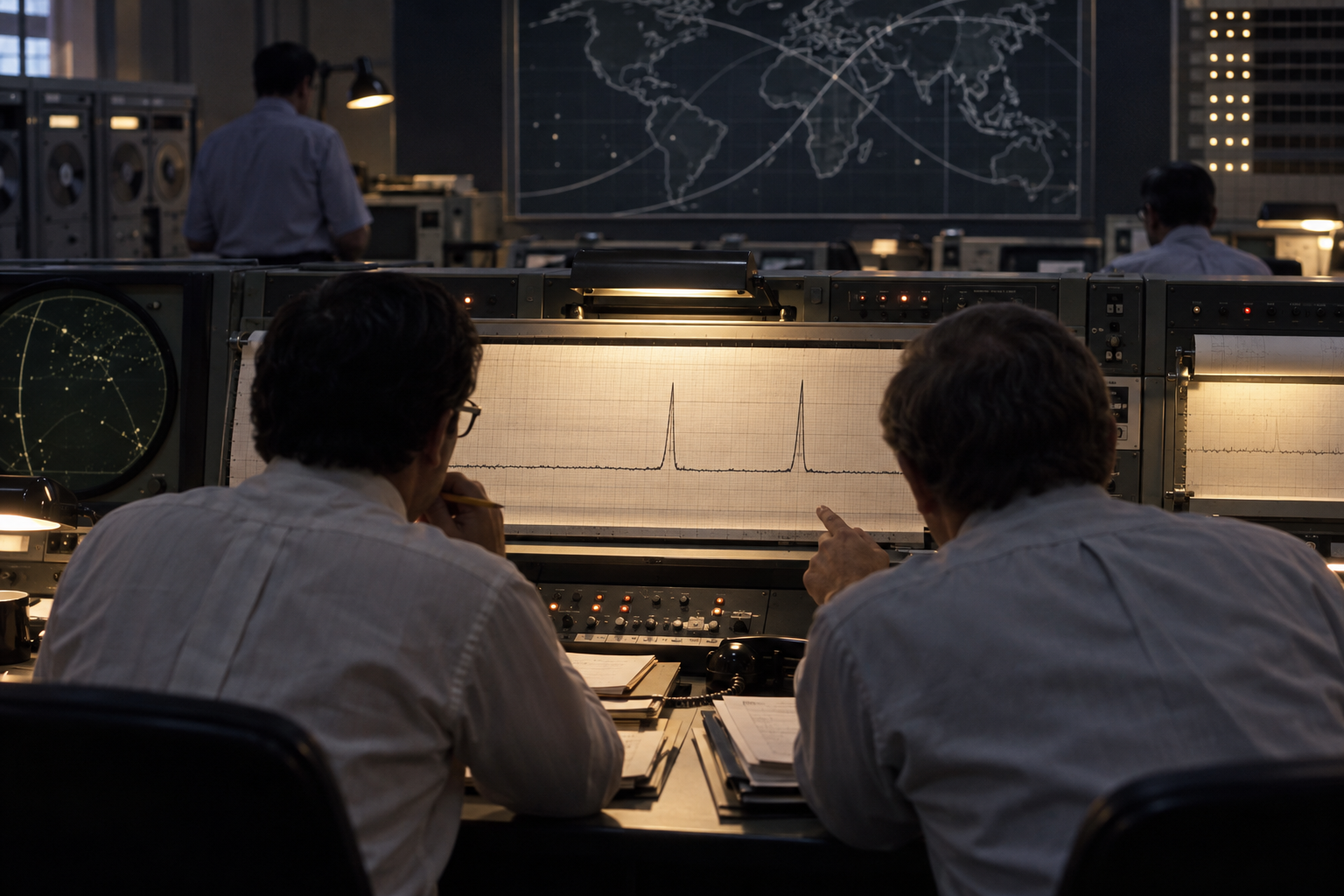
Supporting images provide documentary, geographic or visual context. Read each caption for its date, source and evidential limits.

Continue researching
Follow the evidence, context and comparisons
Curated connections
Selected editorially for this entry.
In February 1942, Los Angeles saw searchlights, anti-aircraft fire and rumours of enemy aircraft in a case where fear, weather and uncertainty lit up the sky.
Curated connection · ArticleThe Difference Between Evidence, Testimony and LegendA field guide to three words that often get tangled in mystery research.
Curated connection · ArticlePilot Reports and the Problem of Expert PerceptionTrained observers matter, but expertise does not remove ambiguity from distance, speed, glare and surprise.
More through shared context
Additional routes based only on existing topics, themes and metadata.
The Bloop was a real hydrophone recording, but not evidence of a giant animal. NOAA’s later Antarctic observations identified the same sound family in large icequakes.
Same primary topic · Shared theme: Strange signals · Case fileThe Taos Hum: A Sound the Instruments Could Not ShareThe Taos Hum became a public problem in the early 1990s when residents described a distant-engine sound. Researchers documented sincere reports but found no common external source.