Archaeology & Disputed Artefacts
The Phaistos Disc: Forty-Five Signs Without a Key
The Phaistos Disc is a genuine-looking Minoan artefact with 45 sign types and no adequate parallel text. Its script, language and purpose remain undeciphered.
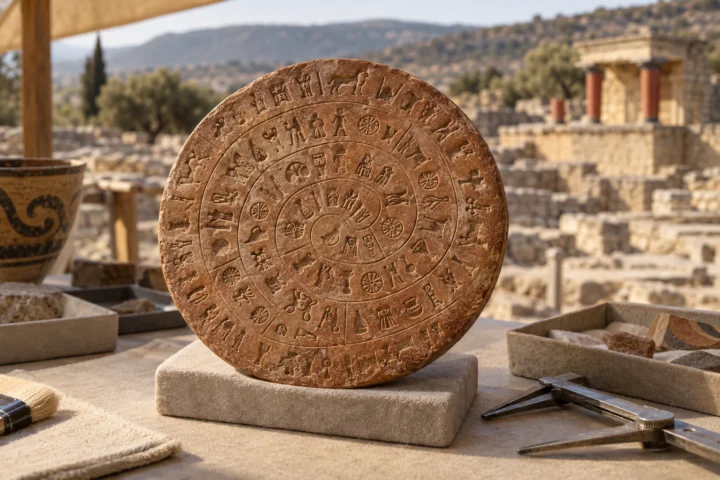
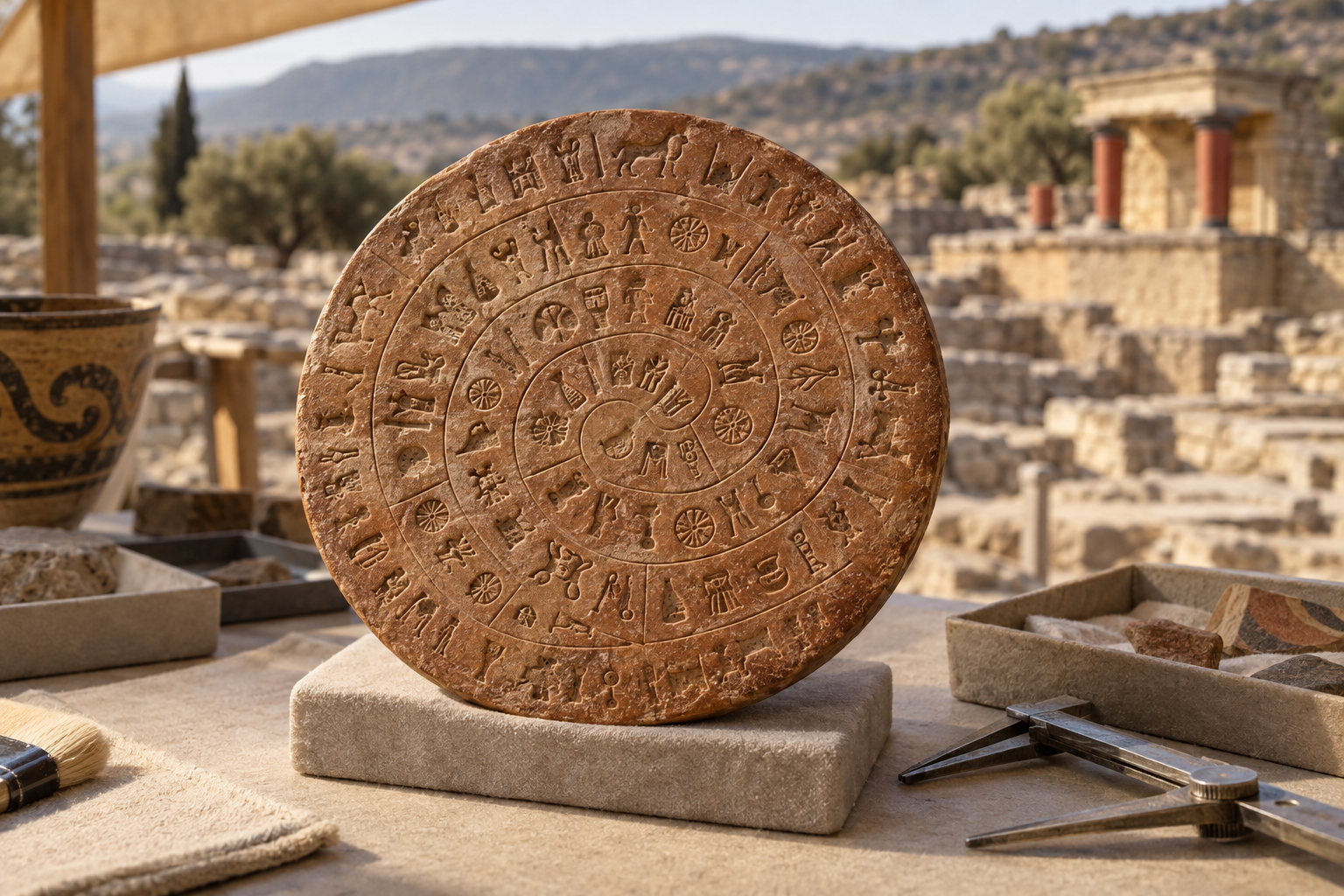
In July 1908, Italian archaeologist Luigi Pernier reported finding a fired-clay disc in a room at the Minoan palace of Phaistos on Crete. Both faces carry signs impressed into a spiral before firing. Forty-five distinct sign types repeat across 241 impressions, separated into groups.
The method resembles movable stamps, but the text has no substantial parallel. Without another inscription in the same system, a bilingual version or a known language, proposed translations cannot be checked. The disc has been called a hymn, calendar, game, list, prayer and mathematical object—often with more confidence than evidence.
Its uniqueness also prompted forgery allegations. Recent study places its clay technology, impressed marks and archaeological setting more comfortably within Phaistos material culture, although non-destructive scientific dating has not supplied a final independent age.
The problem echoes the disciplined restraint needed for the Voynich Manuscript, the provenance questions around out-of-place artefacts, and the archaeological context of the Antikythera mechanism.
Claim, Context and Cautions
An object from a difficult context
Pernier found the disc during excavation of the palace complex, in a deposit whose disturbance and exact dating have been debated. It entered the Heraklion Archaeological Museum and became one of the most recognisable Minoan objects.
The discovery record supports an excavated provenance, while its early documentation is less precise than a modern stratigraphic report.
Stamped signs in a spiral
The maker pressed individual sign punches into soft clay and added dividing strokes before firing. The repeated motifs include people, tools, plants and animals. Visual resemblance does not tell us a sign's sound or meaning.
The small sign inventory suggests a syllabic system more readily than hundreds of independent picture-words, but the disc alone cannot prove the language encoded.
Why one short text is not enough
Decipherment requires patterns that can be tested across many texts, ideally with known names, languages or bilingual equivalents. On one disc, a solver can assign values until a desired phrase appears without predicting anything new. Statistical structure may show that the sequence is organised; it cannot select one translation from many.
A proposed reading becomes evidence only when independent material confirms it.
Claims of translation
Readings have identified deities, military calls, calendars and legal documents. They disagree on direction, language, sign values and even where the text begins. None has achieved scholarly consensus. Headlines that say the disc has been “solved” usually report a proposal rather than a replicated decipherment.
The proper status is undeciphered, not meaningless.
Forgery arguments and archaeological replies
Critics noted the disc's uniqueness and suggested Pernier or another modern maker produced it. That serious claim deserves testing, but motive-based stories are not physical proof. Comparative work on Phaistos pottery, pot-marks and impressed decoration has identified local practices that make the object less isolated.
Recent scholarship therefore favours authenticity while acknowledging that direct thermoluminescence testing has not resolved every doubt.
What the disc can tell us now
Even without a translation, manufacture, sign grouping and find context inform the history of writing and craft in Bronze Age Crete. The disc may preserve language, notation or a specialised formal text. Its precise function remains open.
Uncertainty is not an invitation to choose the most attractive reading. It is a description of a dataset too small to carry the weight placed upon it.
Contextual glossary
Terms used in this entry
Definitions are offered as reading aids, not as conclusions about the case.
- Archaeological context
- An object’s recorded relationship to its layer, feature, surrounding finds and excavation location. Once that context is lost, claims about the object’s date and use become much harder to test.
- Excavation
- The controlled removal and recording of archaeological deposits. Because digging destroys the original arrangement, plans, photographs, samples and layer records are as important as the objects recovered.
- Material culture
- The objects, buildings and physical environments through which people organise and express life. Researchers interpret these remains alongside their manufacture, use, deposition and social setting.
- Forgery
- An object, document or image made or altered so that it will be accepted as something it is not. Demonstrating forgery requires evidence about manufacture, materials, provenance or transmission, not merely an unusual claim.
- Epigraphy
- The study of inscriptions, including their script, language, material, date and context. Reading a sign is only one step; authenticity and the history of the inscribed object also matter.
Reference trail
Sources
- Giorgia Baldacci, “The Phaistos Disc: Placing an Enigmatic Artefact in its Cultural Context” (Oxford, 2024) (opens in a new tab)Recent archaeological study arguing that the disc fits Phaistos material culture while noting limits of direct scientific analysis.
- Mnamon, Scuola Normale Superiore, “Phaistos Disc” (opens in a new tab)Academic ancient-writing resource describing the object, sign system and absence of a conclusive decipherment.
- Yves Duhoux, “Le déchiffrement du Disque de Phaistos…” (Persée) (opens in a new tab)Scholarly examination of whether statistical methods can securely decipher the short unique text.
- “L’énigme du disque de Phaistos” (Persée, 1998) (opens in a new tab)Review of the many incompatible interpretations and the state of the question.
Case Book
Photographs, Maps and Supporting Images
Supporting images provide documentary, geographic or visual context. Read each caption for its date, source and evidential limits.

Continue researching
Follow the evidence, context and comparisons
Curated connections
Selected editorially for this entry.
The Voynich Manuscript is a real medieval codex filled with undeciphered writing, strange plants and diagrams that keep attracting scholars, codebreakers and dreamers.
Curated connection · ArticleOut-of-Place Artefacts and the Value of CautionWhy disputed objects need context, chain of custody and patient interpretation before becoming extraordinary evidence.
Curated connection · Case fileThe Antikythera Mechanism: Ancient Gears Without Ancient AliensThe Antikythera Mechanism is genuinely astonishing, but its lesson is ancient technical skill, not a shortcut to fringe claims.
More through shared context
Additional routes based only on existing topics, themes and metadata.
Scientifically examined crystal skulls do not support claims of ancient or paranormal origin. Tool marks, quartz provenance and sales records place prominent examples in the modern era.
Same primary topic · Shared theme: Disputed artefacts · Case fileNan Madol: Engineering a Ceremonial City on the ReefNan Madol remains archaeologically challenging, but its builders and broad chronology are not unknowable. Local oral histories, settlement evidence and scientific dating converge on Pohnpeian construction and Saudeleur power.