Scientific Anomalies & Natural Phenomena
The Wow! Signal: Seventy-Two Seconds at Big Ear
The Wow! signal was a one-time narrow-band radio event near the hydrogen line, recorded on 15 August 1977. Its shape was noteworthy; its source remains unconfirmed.
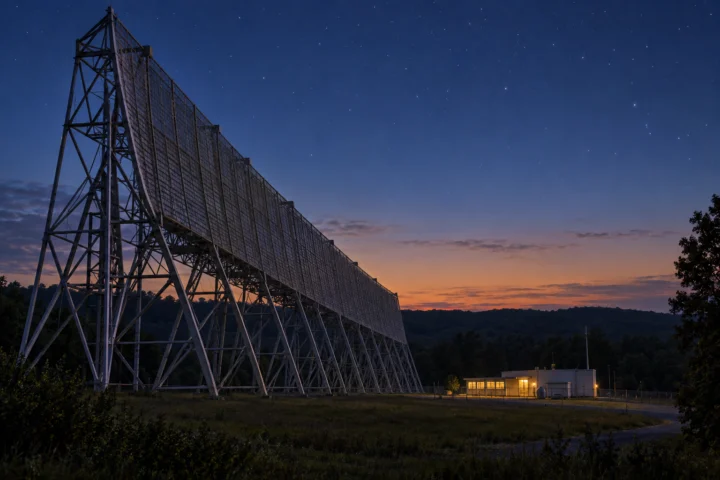
On 15 August 1977, the Ohio State University Radio Observatory’s Big Ear telescope recorded a strong narrow-band signal during a search for possible extraterrestrial transmissions. Volunteer astronomer Jerry Ehman noticed the sequence “6EQUJ5” on a computer printout and wrote “Wow!” beside it.
The characters encoded intensity, not a message. Over 72 seconds, the signal rose and fell in a way consistent with a fixed sky source passing through Big Ear’s beam as Earth rotated. It lay close to the neutral-hydrogen frequency, a part of the spectrum SETI researchers considered a plausible meeting place.
Big Ear had two feed horns. A fixed celestial source should have appeared again in the second feed minutes later, but it did not. Repeated searches at the candidate coordinates also failed to recover it. Terrestrial interference, reflection, a transient natural source and an artificial transmitter remain hypotheses rather than identifications.
The file connects naturally to ordinary and extraordinary signals, the monitoring problem in Hessdalen, and the need for repeatable evidence explained in the field guide.
Claim, Context and Cautions
What “6EQUJ5” means
Big Ear printed signal strength in successive ten-second samples using digits and then letters for higher values. The six-character sequence records a rise to a peak and decline; it is not decoded language. Ehman's handwritten reaction supplied the memorable name.
The original record establishes that the receiver registered something unusual in one narrow frequency channel.
A beam-shaped event
As the sky drifted through the fixed telescope, a steady point source would brighten and fade over roughly the observed duration. The Wow! intensity profile broadly followed that expectation, distinguishing it from a single instantaneous spike.
Beam fit suggests celestial geometry but is not exclusive proof of extraterrestrial distance. Reflections and interference can sometimes mimic sky-bound behaviour.
Frequency near neutral hydrogen
The signal occurred near 1420 megahertz, the natural emission line of neutral hydrogen. SETI programmes favour this quiet, physically universal region because another technological civilisation might recognise its significance.
Frequency makes the event interesting; nature also contains hydrogen, and regulations do not make the band perfectly free from terrestrial contamination.
The missing second horn
Big Ear observed each position with two feed horns in sequence. A continuous source should have registered twice, separated by several minutes. Wow! appeared in only one. It may have ceased, changed frequency or been visible through a transient path before the second opportunity.
This single-feed result is the case's sharpest limit: duration beyond the recorded window is unknown.
Follow-up searches and proposed causes
Ohio observers and later projects revisited the sky region without a confirmed recurrence. Comets, satellites, terrestrial transmitters, interstellar scintillation and transient hydrogen emission have been proposed. Recent astrophysical models remain hypotheses requiring matching observations.
No proposal has recovered the exact source, and no encoded information or repetition supports an intentional beacon.
Why SETI requires recurrence
A candidate becomes credible through rapid re-observation at independent instruments, consistent Doppler behaviour and exclusion of local interference. Wow! predates modern automated follow-up and supplied only one trace. Its features justify continued interest but cannot meet that confirmation standard.
The scientifically accurate conclusion is neither “aliens” nor “nothing”: a notable radio transient remains unidentified.
Contextual glossary
Terms used in this entry
Definitions are offered as reading aids, not as conclusions about the case.
- Radio telescope
- An instrument that receives radio waves from the sky, usually with an antenna and sensitive receiver. Recorded signals must be separated from terrestrial interference and instrument effects.
- Contamination
- The introduction of outside material or information into evidence. It may affect DNA, objects, recordings or witness accounts and must be considered before treating a match as independent.
- Scintillation
- Rapid changes in the apparent brightness or position of a distant light caused by turbulence in the atmosphere. Stars near the horizon can seem to flash colours or move.
Reference trail
Sources
- SETI Institute, “The Wow! Signal” (opens in a new tab)Institutional overview of the detection, beam profile, frequency and unresolved status.
- Ohio State University Radio Observatory archive, “About the Wow! Signal” (opens in a new tab)Observatory-hosted source hub including Jerry Ehman’s reports, printout explanation and follow-up history.
- Jerry R. Ehman, Wow! Signal 30th Anniversary Report (opens in a new tab)First-person technical retrospective from the astronomer who identified the printout sequence.
- Breakthrough Listen, “Search for the WOW! Signal” (opens in a new tab)Modern SETI follow-up programme and concise statement of the signal’s frequency and non-redetection.
Case Book
Photographs, Maps and Supporting Images
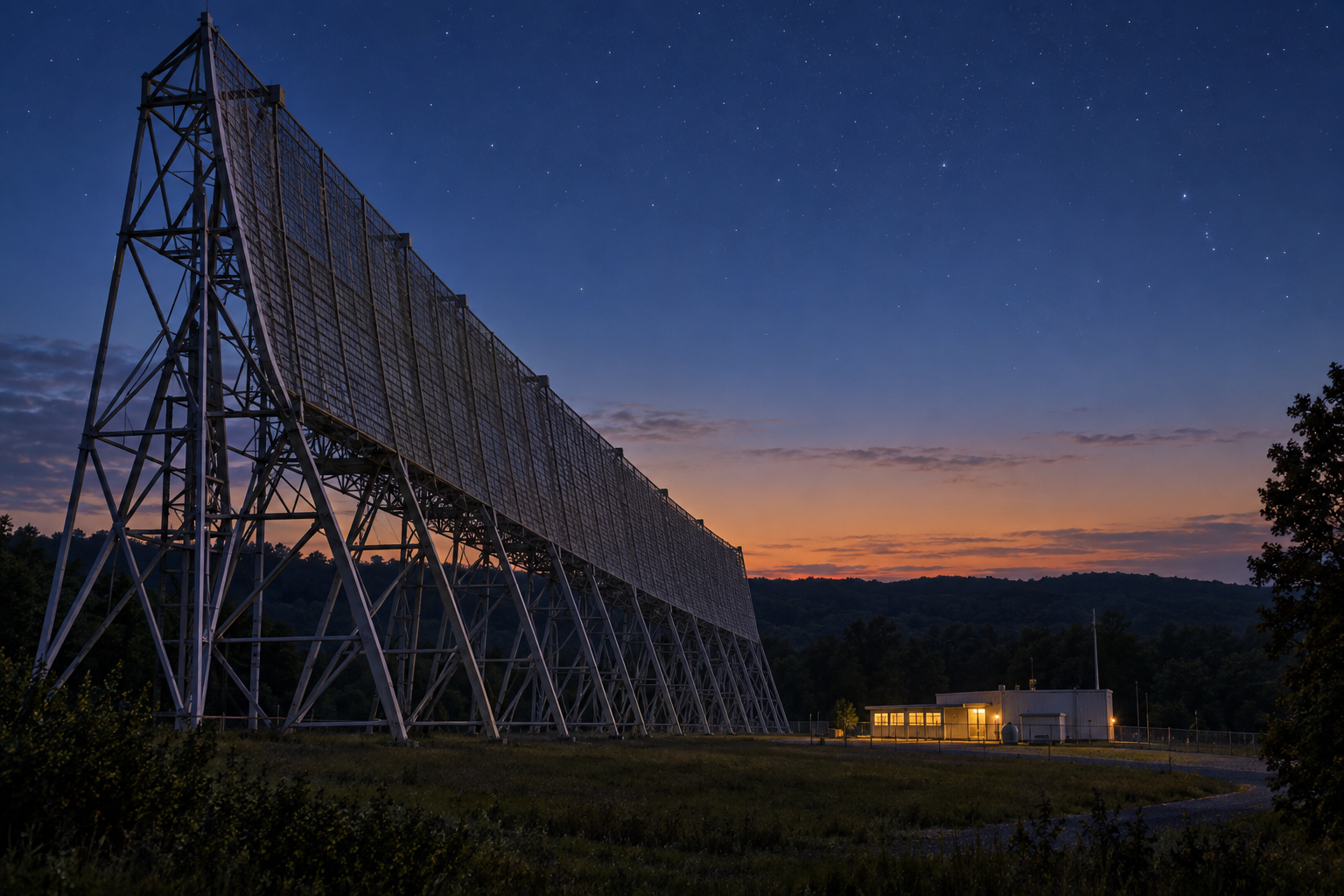
Supporting images provide documentary, geographic or visual context. Read each caption for its date, source and evidential limits.

Continue researching
Follow the evidence, context and comparisons
Curated connections
Selected editorially for this entry.
Aircraft, satellites, planets, drones and atmospheric effects can become strange when context is missing.
Curated connection · Case fileThe Hessdalen Lights: A Valley Under ObservationHessdalen’s recurring lights prompted field campaigns and automatic monitoring after a wave in the early 1980s. The label covers mixed observations, not one proven phenomenon.
Curated connection · ArticleA Field Guide for Recording Strange Experiences ResponsiblyA calm checklist for writing down unusual events before memory, excitement and online feedback reshape them.
More through shared context
Additional routes based only on existing topics, themes and metadata.
The Taos Hum became a public problem in the early 1990s when residents described a distant-engine sound. Researchers documented sincere reports but found no common external source.
Same primary topic · Shared theme: Strange signals · Case fileThe Bloop: An Ocean Sound Traced to Breaking IceThe Bloop was a real hydrophone recording, but not evidence of a giant animal. NOAA’s later Antarctic observations identified the same sound family in large icequakes.