Folklore & Legends
The Wild Hunt: How Europe’s Night Riders Became One Legend
The Wild Hunt is best understood as a scholarly and popular umbrella for varied regional traditions, not one unchanged pagan myth transmitted intact across Europe.
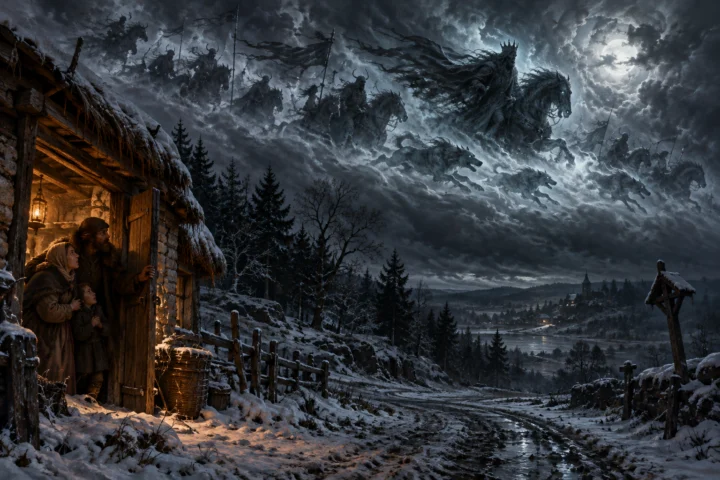
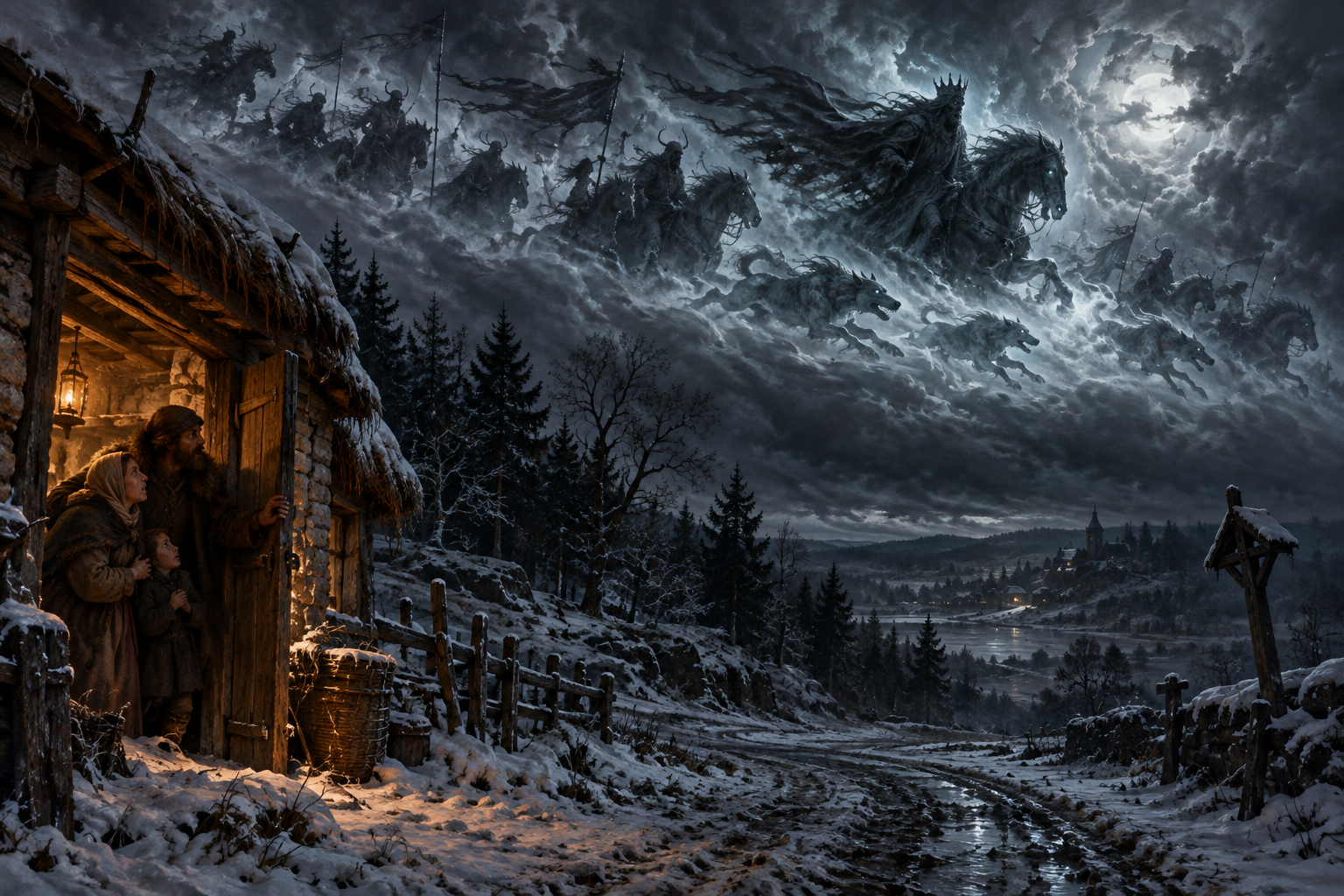
Across parts of Europe, people told of noisy companies crossing the night: dead warriors, female spirits, hunters, hounds, witches or condemned souls. Encounters could foretell war or death, punish anyone who joined the chase, or reward a person who treated the procession correctly. Leaders included Wotan or Odin, Holda, Herodias, King Herla and local hunters.
“The Wild Hunt” makes these accounts sound like versions of one ancient story. The phrase and its grand comparative model were popularised by Jacob Grimm in the nineteenth century. Grimm assembled medieval texts and contemporary German traditions into a survival of pre-Christian religion, an influential interpretation that later writers extended across Britain and northern Europe.
Modern scholarship is more cautious. Night rides by female spirits, armies of the dead and cursed huntsmen may have different histories that were grouped through comparison. Regional traditions changed under Christian preaching, antiquarian collection, nationalism, fiction and modern pagan practice.
This does not make the regional stories modern inventions. It changes the historical question from “Where did the one Hunt begin?” to “When and why were particular processions connected?” That shift preserves difference between testimony, manuscript motif and later scholarly reconstruction.
The Hunt overlaps the archive’s study of fairy lore as geography, the ominous road animals in phantom black dog legends, and the evidential distinction in evidence, testimony and legend.
Claim, Context and Cautions
Many processions, many leaders
Some narratives describe a hunt with game and hounds; others are processions or armies heard in storm winds. The leader’s identity follows place and period. Odin fits some Scandinavian and German material, while British associations with Herne, Arthur or other figures can be late and literary.
Shared imagery does not prove a single origin. Nocturnal noise, seasonal storms, warfare, hunting privilege and beliefs about the dead offered recurring materials across cultures.
What Jacob Grimm assembled
Grimm’s Deutsche Mythologie collected names, sayings and texts on an unprecedented scale. He interpreted fragments as survivals of a coherent Germanic pagan system, with Wotan leading an ecstatic host. His work preserved valuable references while imposing a unifying historical argument.
The category then shaped later collecting: once researchers expected a Wild Hunt, diverse stories were more likely to be filed beneath that heading.
Christian, pagan and literary layers
Medieval church writers described dangerous night companies through Christian categories of demons, penance and delusion. Those texts may preserve local practice, clerical polemic or both. Later Romanticism restored heroic gods and national pasts, and twentieth-century fantasy made the spectral cavalry visually consistent.
Calling every element pagan skips centuries of change. Calling it purely Christian ignores older names and ritual patterns. The sources support layering rather than a single conversion point.
A tradition still being made
Contemporary festivals, novels, games and religious groups continue to adapt the Hunt. These are authentic acts of modern culture even when they are not evidence for medieval belief. Folklore does not become false because it changes; change is one of its mechanisms.
The responsible conclusion is plural. Europe preserved many stories of perilous night travellers. Grimm’s synthesis gave them a memorable common name, and later culture made that synthesis feel ancient. Studying both the local tales and the history of the category avoids mistaking a scholarly model for a single eyewitness phenomenon.
Contextual glossary
Terms used in this entry
Definitions are offered as reading aids, not as conclusions about the case.
- Black dog
- A spectral or uncanny dog associated in British and Irish traditions with roads, churchyards, boundaries, storms or death omens. Similar motifs do not make every local story the same tradition.
- Reconstruction
- A later model, image or account made to represent an event from surviving information. It can clarify a hypothesis but should remain visibly separate from contemporary evidence.
- Ritual
- A repeated, structured action carrying social, religious or symbolic meaning. Similar-looking actions can have very different meanings, so local and historical context is essential.
Reference trail
Sources
- University of Bristol, The Wild Hunt in the Modern British Imagination (opens in a new tab)Peer-reviewed research tracing Grimm’s category and its interaction with British folklore and modern fiction.
- University of Bristol accepted manuscript (opens in a new tab)Full scholarly text distinguishing several earlier traditions later assembled as the Wild Hunt.
- Wikimedia Commons and Internet Archive, Grimm’s Teutonic Mythology (opens in a new tab)Public-domain scan of the nineteenth-century primary synthesis that popularised the unified Wild Hunt model.
Case Book
Photographs, Maps and Supporting Images
Supporting images provide documentary, geographic or visual context. Read each caption for its date, source and evidential limits.

Continue researching
Follow the evidence, context and comparisons
Curated connections
Selected editorially for this entry.
Hills, rings, paths and boundaries often matter more than wings or glitter in older fairy traditions.
Curated connection · ArticleWhy Phantom Black Dogs Haunt So Many Local LegendsBlack dog stories reveal how roads, boundaries, danger and memory gather into a repeated supernatural form.
Curated connection · ArticleThe Difference Between Evidence, Testimony and LegendA field guide to three words that often get tangled in mystery research.