UFOs & Aerial Phenomena
Westall 1966: A Schoolyard Sighting and a Changing Record
Westall securely records a large school disturbance and sincere aerial observations. The number, path and landing claims vary across sources, while no photograph or official recovery establishes an extraordinary craft.
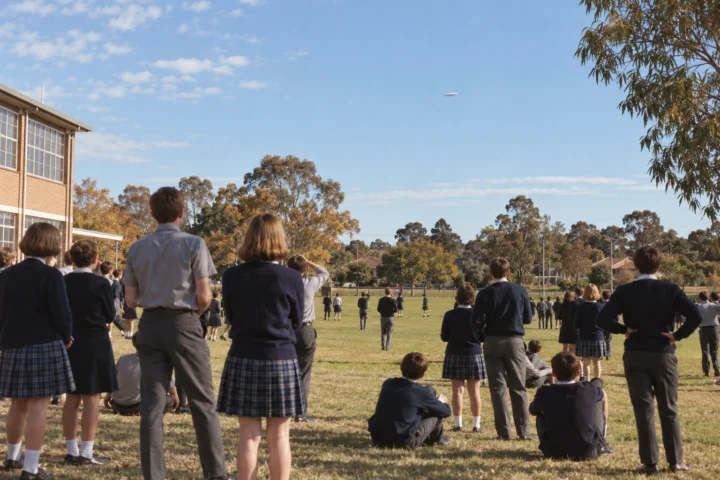
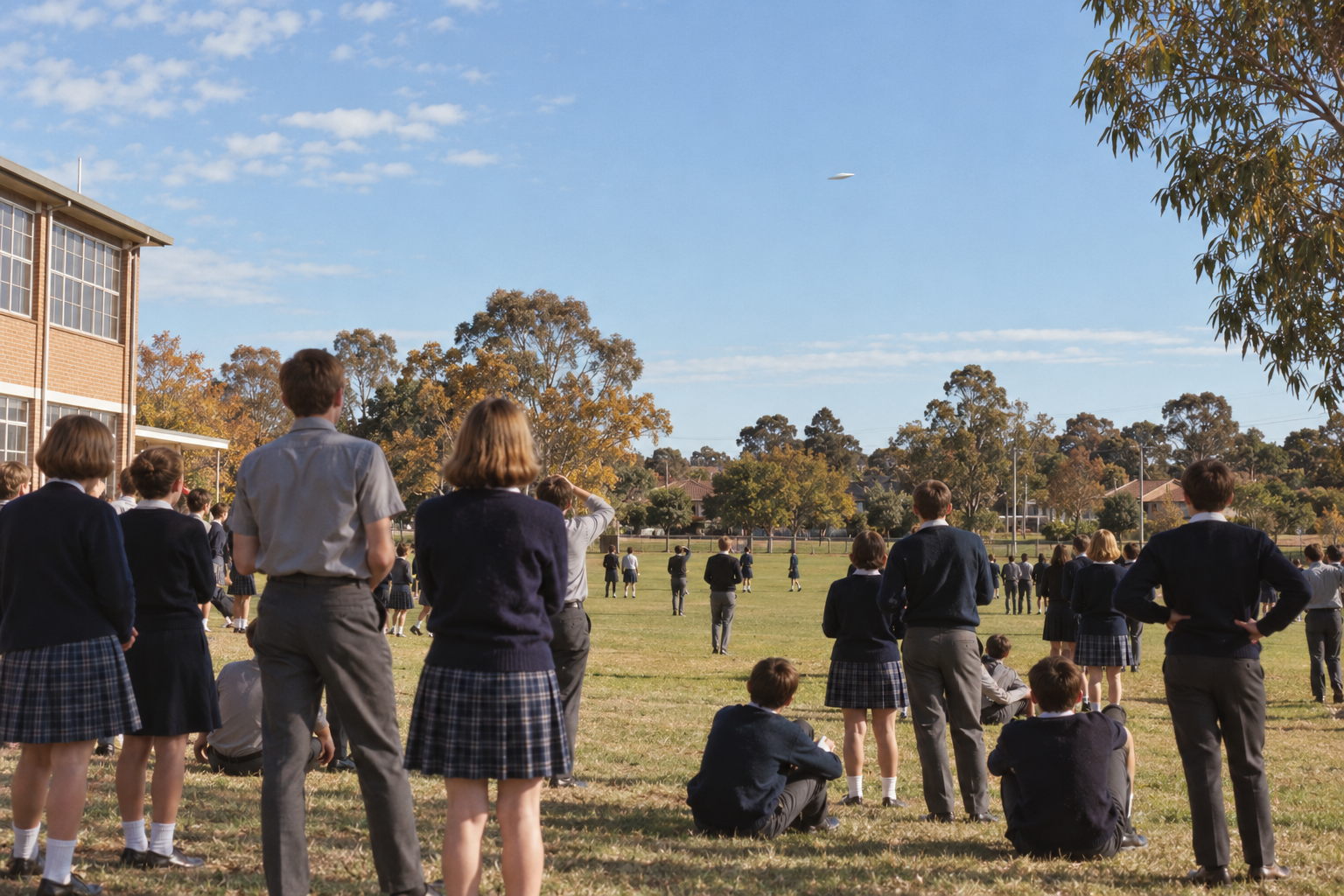
Late in the morning of 6 April 1966, a commotion spread through Westall High School in suburban Melbourne. Students and some adults reported a pale or silvery object moving in daylight toward open ground known as the Grange. Pupils ran outside; accounts describe the object departing rapidly, sometimes after smaller aircraft appeared.
The event itself is not known from one complete official file. Contemporary newspaper reporting and civilian investigators recorded parts of it, while many detailed testimonies were collected decades later. Those records agree on a disruptive aerial sighting but vary over the object’s shape, number, altitude, duration and whether it landed.
Claims that military personnel sealed the area or confiscated film are prominent in later retellings, but surviving documentation does not establish a recovered object. A reputed television film has not surfaced. Absence of a file is worth noting; it is not evidence of what a missing file contained.
A long-duration research balloon from the HIBAL programme has been proposed. Balloons and their parachuted instruments could look unfamiliar, and secretive Cold War activity supplies context. Yet no released launch and tracking record has conclusively placed a particular payload through every reported movement at Westall.
The case belongs beside the child-witness record at Ariel School, the closer adult report at Socorro, and the perceptual cautions in ordinary lights and extraordinary reports.
Claim, Context and Cautions
What the early record supports
Press and investigation notes made close to April 1966 support the core claim that students and at least some adults reported an unidentified aerial object and that school authorities found the attention disruptive. Early accounts are more valuable for chronology than recollections first recorded after repeated documentaries and reunions.
They still do not form a controlled survey. Investigators faced restricted access, witnesses talked together, and early summaries compressed individual differences.
Many witnesses, not one witness
A crowd is not automatically hundreds of independent observations. Pupils stood at different points, arrived at different times and influenced one another's attention. Some saw only a distant object; others later described descent, a ground trace or close approach. Each proposition needs its own witness chain.
Agreement on broad shape gains weight when it can be traced to early, independent statements. Agreement emerging in later shared retellings is harder to interpret.
Balloon, aircraft and extraordinary craft
A high-altitude research balloon or descending payload can explain a pale object, slow drift and official sensitivity, while ordinary aircraft may account for reported followers. It has more difficulty with accounts of sharp acceleration unless those are perspective effects, compressed memory, or observations of another stimulus.
An exotic craft can be made to fit the narrative, but it predicts decisive imagery or physical evidence that has not appeared. Neither label should be treated as an observed fact.
The defensible remainder
Westall is more than a modern internet legend: contemporary sources anchor an unusual school-day incident. It is less than the unified mass encounter often advertised. The archive contains divergent testimony, incomplete official records and later memories shaped by public attention.
The correct status is unresolved at the level of the original aerial stimulus. Claims of landing, intimidation and recovery have lower and differing support. Preserving that hierarchy protects the witnesses from blanket dismissal without converting sincere recollection into proof of a non-human vehicle.
Contextual glossary
Terms used in this entry
Definitions are offered as reading aids, not as conclusions about the case.
- Oral history
- A recorded interview about remembered experience, usually created with attention to the speaker, context and purpose. It is a source to interpret, not a transcript of the past without mediation.
Reference trail
Sources
- Project 1947, Westall case source file (opens in a new tab)Transcriptions and citations for contemporary newspaper coverage and early civilian investigation.
- ABC News, The Westall UFO Mystery (opens in a new tab)Public-broadcaster review combining witness interviews, archival gaps and the HIBAL hypothesis.
- UFO Research Australia, James E. McDonald audio index (opens in a new tab)Archive index documenting early recorded material and the Westall case in the Australian collection.
Case Book
Photographs, Maps and Supporting Images
Supporting images provide documentary, geographic or visual context. Read each caption for its date, source and evidential limits.

Continue researching
Follow the evidence, context and comparisons
Curated connections
Selected editorially for this entry.
Children at Ariel School in Ruwa reported a strange object and figures on 16 September 1994. Drawings and interviews preserve their accounts, while chronology and interview method limit firm conclusions.
Curated connection · Case fileSocorro: Lonnie Zamora and the Object in the ArroyoThe Socorro incident rests on a prompt police report and documented ground traces, yet neither the marks nor later theories securely identify what Lonnie Zamora saw.
Curated connection · ArticleHow Ordinary Lights Become Extraordinary UFO ReportsAircraft, satellites, planets, drones and atmospheric effects can become strange when context is missing.
More through shared context
Additional routes based only on existing topics, themes and metadata.
The Belgian wave combined sincere observations, institutional openness and an ambiguous radar episode. It did not produce a verified craft, and its reports likely include multiple stimuli.
Same primary topic · Shared theme: Mass sightings, Witness & memory · Case fileThe Phoenix Lights: Two Events, One NightOn 13 March 1997, reports of a moving light formation crossed Arizona before a separate row of lights appeared near Phoenix. One event has a strong military-flare explanation; the other remains disputed.