Occult & Psychical Research
The Miracle of the Sun: Witnesses at Fátima in 1917
The Fátima crowd event is historically documented, while its cause and religious meaning remain disputed. Testimony, expectation, optics and weather must be kept distinct.
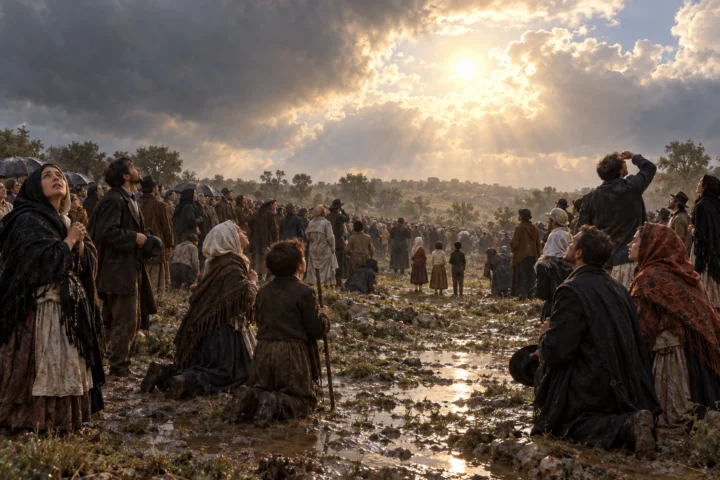
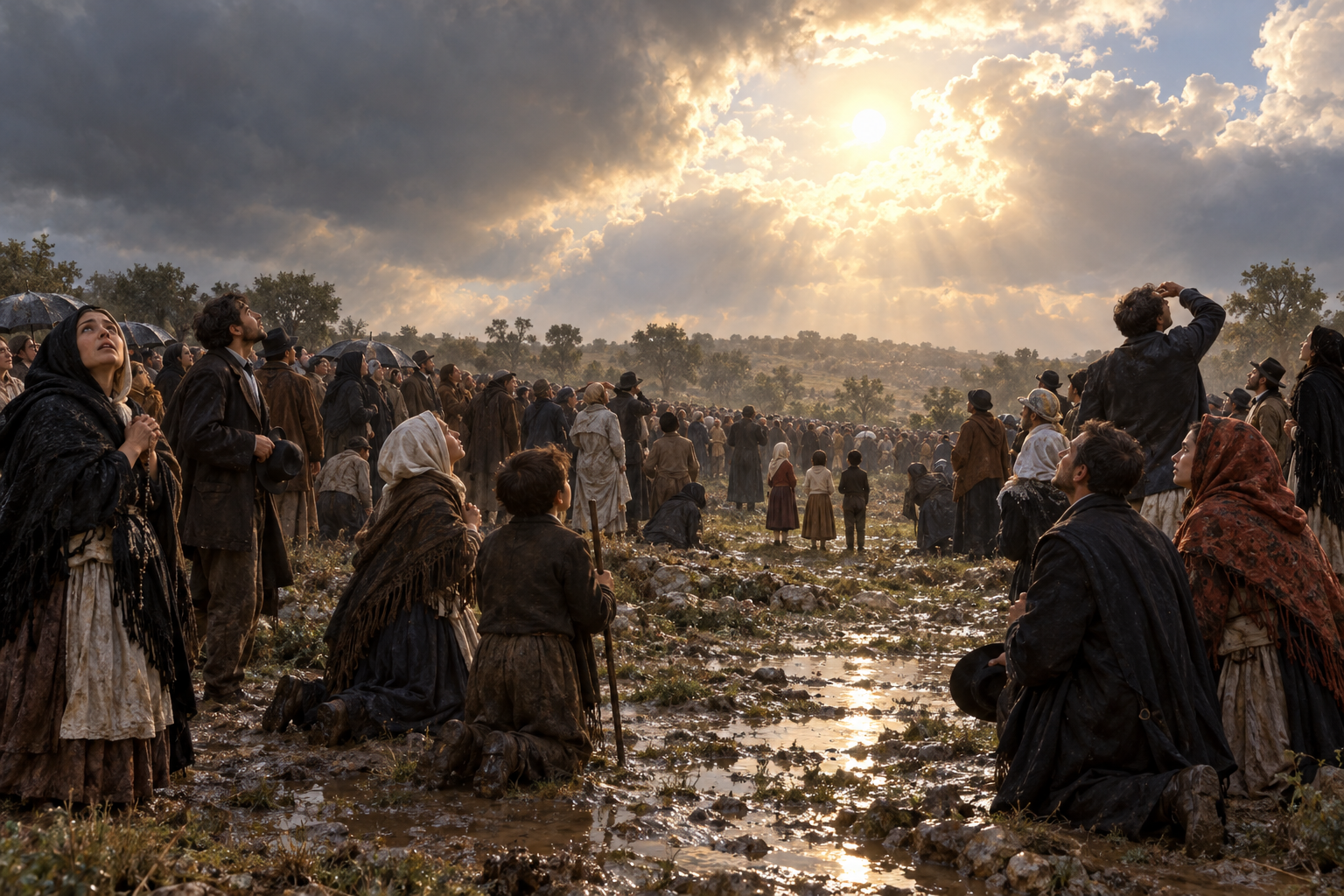
On 13 October 1917, a large crowd gathered in rain at Cova da Iria near Fátima. Three children had said that an apparition would provide a sign. As clouds thinned, many observers reported a pale sun, colours, spinning motion or an apparent descent towards the earth. Others described less, saw nothing unusual, or recorded the crowd’s reactions.
The event was reported in contemporary Portuguese newspapers, including by journalists who did not share the pilgrims’ expectations. That gives the gathering a firm historical record. It does not make every quoted description identical or turn a crowd estimate into a count of people who saw the same phenomenon.
No observatory recorded the sun moving from its astronomical position. Staring towards a bright disc through changing cloud can create afterimages, colour shifts and apparent motion; expectation and social attention can shape how those effects are named. Weather may explain the sudden visibility and drying without explaining every personal interpretation.
The case can be approached through the perception issues in extraordinary light reports, the treatment of sincere witnesses in evidence, testimony and legend, and the changing narrative of the Moberly–Jourdain experience.
Claim, Context and Cautions
A promised event and an expectant crowd
The children’s earlier claims provided a date and place, so pilgrims, journalists and opponents arrived expecting a public test. Rain, mud, political conflict over Catholicism and intense anticipation formed part of the observation conditions.
Expectation does not prove that reports were false. It means they were not blank-slate observations and should not be treated as mutually independent laboratory readings.
Accounts that do not form one measurement
Witnesses used different language: a silver disc, rotation, coloured light, a zigzag or a plunge. Reports were recorded at different times, and later depositions were shaped by an established devotional narrative. Photographs document the crowd and weather, not a displaced sun.
A large number of observers can establish that a social and perceptual event occurred while leaving its exact visual content variable.
Optics, weather and scale
Thin cloud can reduce glare enough to make the solar disc visible. Retinal afterimages and involuntary eye movement can produce colour and motion after staring at a bright source. Moving cloud also changes contrast and apparent position.
These mechanisms are plausible and repeatable, but the surviving record cannot reconstruct what reached each observer’s eyes at each moment.
History, faith and evidential limits
The Catholic Church later judged the apparitions worthy of belief, a religious determination distinct from an astronomical finding. Historians also examine how the event developed within Portugal’s struggle between secular republican government and Catholic mobilisation.
The archive can document claims, context and natural possibilities without adjudicating private faith. What it cannot responsibly say is that the sun physically crossed the sky above one field.
Counting witnesses without manufacturing consensus
Crowd estimates range widely, and attendance is not equivalent to witnessing a particular solar motion. Contemporary reports often describe collective reactions while quoting only selected individuals. Later devotional collections naturally sought affirmative testimony, whereas hostile newspapers had their own political incentives. A reliable history compares those source purposes instead of averaging them into a plebiscite.
Reports from places away from Cova da Iria are especially important to date and trace. Some were recorded much later, after the event had an established name. No corresponding worldwide astronomical disturbance was observed, which rules against the sun itself changing position while leaving local optical and social experience open.
The event can therefore be historically substantial without a single agreed sensory record. Thousands gathering, the weather shifting and many people reporting unusual impressions are compatible with variation, non-observation and later religious meaning. Disputed is more accurate than either “nothing happened” or “astronomy confirmed a miracle”.
Contextual glossary
Terms used in this entry
Definitions are offered as reading aids, not as conclusions about the case.
- Apparition
- A reported figure or presence seen without an obvious physical person present. The word describes the experience without deciding whether its cause was environmental, psychological or unknown.
Reference trail
Sources
- Portuguese Catholic University, Fátima in the press, 1917–2017 (opens in a new tab)Institutional repository record for an exhibition catalogue tracing the newspaper memory of the 1917 events.
- Sanctuary of Fátima, Critical Documentation 1917–1930 (opens in a new tab)Guide to a scholarly critical edition of primary documents and the later canonical inquiry; reflects the institution’s religious perspective.
- Jeffrey Bennett, When the Sun Danced (opens in a new tab)Book-length scholarly history placing the reports within early twentieth-century Portuguese religion and politics.
Case Book
Photographs, Maps and Supporting Images
Supporting images provide documentary, geographic or visual context. Read each caption for its date, source and evidential limits.

Continue researching
Follow the evidence, context and comparisons
Curated connections
Selected editorially for this entry.
Aircraft, satellites, planets, drones and atmospheric effects can become strange when context is missing.
Curated connection · ArticleThe Difference Between Evidence, Testimony and LegendA field guide to three words that often get tangled in mystery research.
Curated connection · Case fileThe Moberly–Jourdain Experience: Lost at VersaillesCharlotte Moberly and Eleanor Jourdain described an uncanny walk at Versailles in 1901. Their early notes and later research document a developing interpretation, not independent proof of a time slip.
More through shared context
Additional routes based only on existing topics, themes and metadata.
In February 1942, Los Angeles saw searchlights, anti-aircraft fire and rumours of enemy aircraft in a case where fear, weather and uncertainty lit up the sky.
Shared theme: Mass sightings, Witness & memory · Case fileThe Ariel School Sighting: Children at the Edge of the PlaygroundChildren at Ariel School in Ruwa reported a strange object and figures on 16 September 1994. Drawings and interviews preserve their accounts, while chronology and interview method limit firm conclusions.