Disappearances & Unresolved Identities
D. B. Cooper: Ransom, Airstairs and a Vanishing Suspect
The D. B. Cooper case has a secure crime, crew testimony and recoverable evidence, but hundreds of named suspects have not produced a documented identification.
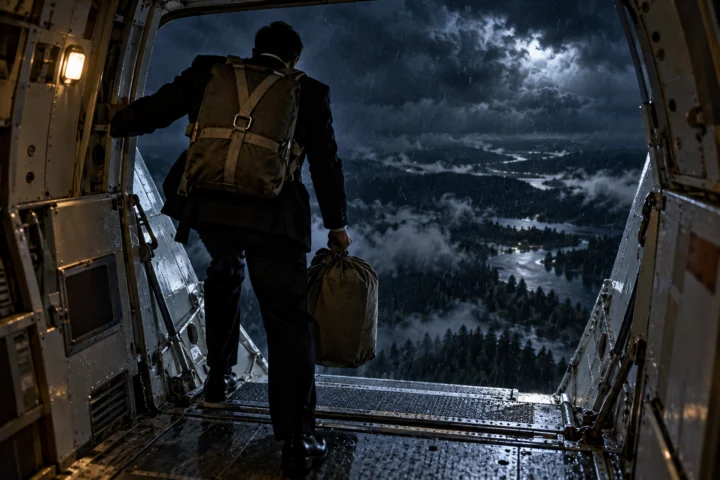
On 24 November 1971, a man using the name Dan Cooper boarded Northwest Orient Flight 305 from Portland to Seattle. He told a flight attendant he had a bomb, demanded four parachutes and $200,000 in twenty-dollar notes, and released the passengers after the ransom was delivered.
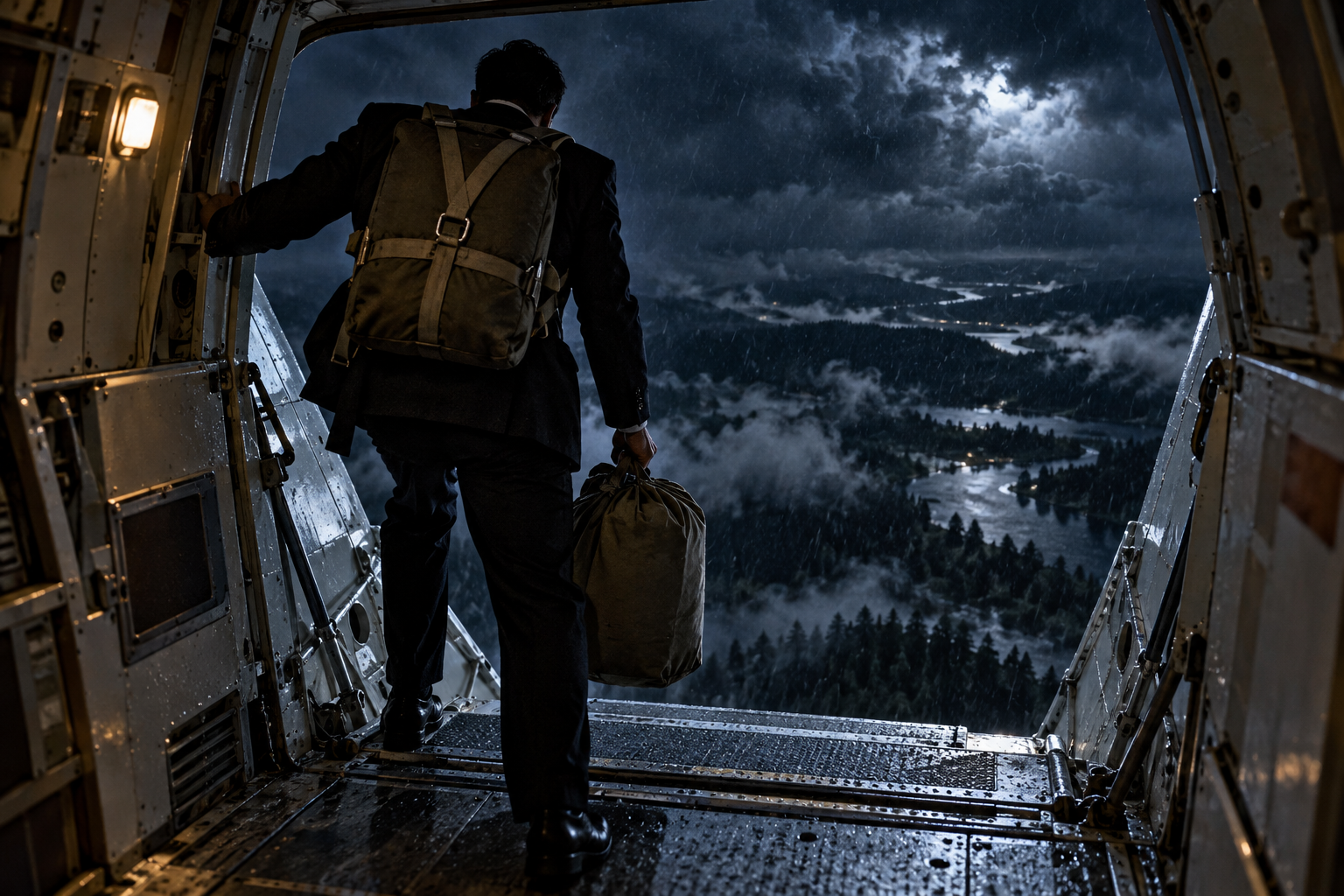
The Boeing 727 took off again under his instructions. Somewhere between Seattle and Reno, the rear airstairs were lowered and Cooper disappeared into a cold, rainy night with a parachute and the money. The crew landed safely. Search teams found no confirmed landing site, body or parachute.
The FBI investigated the case as NORJAK for 45 years and examined hundreds of suspects. In 1980, $5,800 of the ransom was found decaying on a Columbia River bank. The serial numbers were genuine, but the money did not identify who deposited it or how it reached that location.
The case rewards the evidential discipline used for the Isdal Woman, the source gaps of the Yuba County Five, and the archive’s distinction between evidence and legend.
Claim, Context and Cautions
The documented hijacking
Crew members interacted with Cooper for hours and preserved a consistent operational sequence. Investigators recovered a clip-on tie and other material from the aircraft, recorded the ransom serial numbers and reconstructed the flight.
The press-created initials “D. B.” were not the name on the ticket. That small error shows how quickly even a well-documented case can acquire a permanent false detail.
A jump designed around the aircraft
The 727’s rear stairs could be lowered in flight, and Cooper specified altitude, speed and flap conditions. His plan showed some relevant knowledge. Yet he jumped at night in poor weather with unsuitable clothing and a parachute that could not be steered.
Competence in planning does not prove that he survived the landing.
What the recovered money proves
A child found three packets of ransom notes at Tena Bar in 1980. Their serial numbers confirmed that some of the money left the hijacker’s control and reached the river environment. Disputes continue over erosion, dredging and deposit timing.
The find narrows theories but does not select a suspect. No verified spent ransom bill ever entered circulation.
A suspect list without an identification
The FBI considered more than 800 suspects in the first five years and continued testing leads for decades. Resemblance, military service, parachuting experience or a dramatic family story can generate a candidate; identification requires a chain connecting that person to the ticket, aircraft evidence and ransom.
No public candidate has met that standard. In 2016 the FBI redirected active resources while leaving the identity and outcome unresolved.
Why the flight path remains an area, not a point
The crew felt a pressure change associated with the rear stairs, but they did not see the jump. Wind, aircraft speed, the precise moment of departure and Cooper’s canopy behaviour all affect a landing calculation. Search areas changed as investigators refined the timeline, and dense forest, rivers and private land complicated recovery.
This uncertainty matters whenever a suspect is tied to one convenient location. A found parachute, buried money story or deathbed confession must first be authenticated and then placed inside the documented flight geometry. Publicity has repeatedly run ahead of that work.
Survival remains open for the same reason. The conditions were dangerous and the gear imperfect, yet failure to find a body is not proof of death. Failure to trace spending is not proof that he lived under a new identity. Both endings fit parts of the silence; neither completes the evidence.
Contextual glossary
Terms used in this entry
Definitions are offered as reading aids, not as conclusions about the case.
- Uncertainty
- The stated limit on what a measurement, reconstruction or body of evidence can establish. Describing uncertainty is not indecision; it prevents a result from appearing more precise than the evidence allows.
Reference trail
Sources
- FBI, D. B. Cooper Hijacking (opens in a new tab)Official case history for the flight, ransom, jump, investigation and 1980 currency discovery.
- FBI Vault, D. B. Cooper files (opens in a new tab)Released investigative files used to distinguish documented leads from later suspect claims.
- U.S. National Archives, D. B. Cooper case file (opens in a new tab)Archival presentation of the U.S. Attorney’s case file and downloadable federal report.
Case Book
Photographs, Maps and Supporting Images
Supporting images provide documentary, geographic or visual context. Read each caption for its date, source and evidential limits.

Continue researching
Follow the evidence, context and comparisons
Curated connections
Selected editorially for this entry.
The Isdal Woman case combines a documented unexplained death with coded travel records, uncertain identity and later forensic reconstruction. Espionage remains a possibility, not an established fact.
Curated connection · Case fileThe Yuba County Five: A Road Into the SnowA disappearance case where winter road, confusion and delayed discovery created a mystery larger than any one clue.
Curated connection · ArticleThe Difference Between Evidence, Testimony and LegendA field guide to three words that often get tangled in mystery research.
More through shared context
Additional routes based only on existing topics, themes and metadata.
Frederick Valentich’s recorded radio exchange is evidence of what he reported, not of what caused the disappearance. Disorientation, misidentification and accident remain plausible without recovered wreckage.
Same primary topic · Shared theme: Aviation · Case fileAmelia Earhart’s Last Flight: Radio, Fuel and an Empty SearchThe surviving radio and search record most directly supports fuel exhaustion and a sea crash near Howland. Castaway and capture theories remain possible narratives but lack confirmed physical evidence linking Earhart to another location.