Investigation & Evidence
Reading Medieval Chronicles as Evidence
Chronicles are neither transparent fact-books nor worthless legends. Comparing manuscripts, sources, chronology, genre and independent records reveals what a text can support and where uncertainty remains.
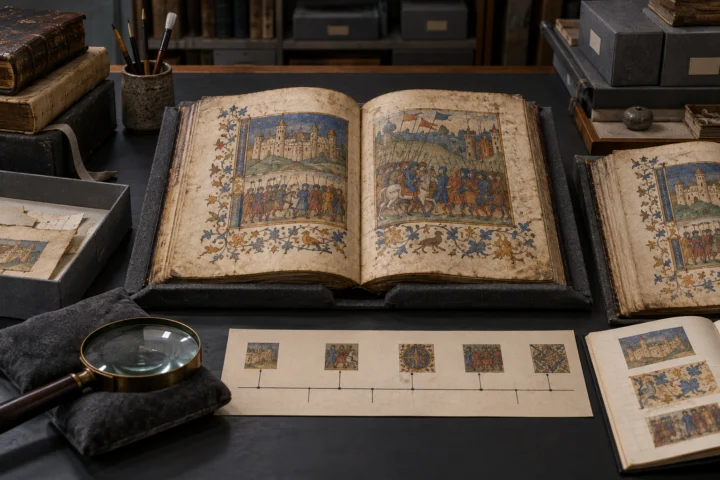
A medieval chronicle can place a battle, famine, comet or marvel into a memorable sequence. It cannot be read as a stenographic record. Authors selected events for religious, dynastic and moral purposes, often writing years later and copying predecessors whose words are no longer separately preserved.
The first question is therefore not whether a chronicler was “reliable” in the abstract. It is what manuscript survives, when its underlying text was composed, which passage belongs to which layer, and how the writer could have known the reported detail. A near-contemporary annal and a lavish thirteenth-century retelling of an eleventh-century event have different evidential reach.
Copying preserved texts but also changed them. Scribes omitted lines, modernised names, harmonised contradictions and added local material. Historians compare independent manuscript witnesses and build a family of readings rather than silently choosing the most dramatic version.
Miracles and monsters still carry evidence: they reveal expectations, rhetoric and the social uses of history. They do not automatically establish the event described. That distinction matters in cases such as the Green Children of Woolpit, traditions of the Wild Hunt, and the wider boundary between testimony and legend.
Claim, Context and Cautions
Start with the physical witness
A work may survive in one late copy or dozens of manuscripts made in different places. Palaeography, bindings, pigments and ownership notes help date and locate each witness. Digital images widen access but do not replace catalogue history or inspection of erased, cropped and reordered leaves.
The date of a manuscript is not necessarily the date of its text. A copy made in 1400 may preserve a lost work written in 1150, while a marginal addition may be later still.
Find the sources inside the source
Chroniclers routinely borrowed annals, saints' lives, letters, oral reports and other chronicles. Repeated wording can expose dependence. Ten later writers copying one account do not create ten independent witnesses. Where an author changes a borrowed passage, that change may reveal a new source, local knowledge or an editorial agenda.
Names and dates should be checked against charters, administrative documents, inscriptions, coins and archaeology. Agreement is meaningful only after dependence has been considered.
Genre, patronage and useful bias
A monastic annal, royal genealogy and crusade history addressed different audiences. Patronage could encourage praise or blame, yet bias does not make every statement false. It tells the reader which selections and causal explanations need special scrutiny.
Even hostile descriptions may securely establish that a dispute existed. Formulaic portents may locate an event within a moral scheme rather than provide an astronomical observation precise enough for identification.
Build a conclusion in layers
A careful reading separates propositions. The text may establish that a story circulated by a certain date, make an underlying event plausible, but leave dialogue and supernatural causation unsupported. Confidence should attach to each proposition instead of to the chronicle as a whole.
Variant readings, translation choices and editorial emendations belong in the audit trail. The durable result is often modest: a bounded claim with a known textual ancestry. That method respects medieval authors as historical actors while preventing a vivid narrative from becoming evidence for more than its transmission can bear. Recording uncertainty is not evasive; it is how later readers can revisit the judgment when another manuscript or independent date appears.
Contextual glossary
Terms used in this entry
Definitions are offered as reading aids, not as conclusions about the case.
- Uncertainty
- The stated limit on what a measurement, reconstruction or body of evidence can establish. Describing uncertainty is not indecision; it prevents a result from appearing more precise than the evidence allows.
- Chronicle
- A historical narrative organised broadly by time, often compiled from earlier records, testimony and tradition. A chronicle can preserve valuable material while also reflecting its author’s period and purpose.
- Palaeography
- The study of historical handwriting and scripts. Letter forms, abbreviations and writing practices can help date and read a document, usually within a range rather than an exact year.
- Variant
- A particular version of a story, belief or custom recorded from one teller, place or occasion. Differences between variants show how tradition is adapted and transmitted.
- Comet
- A small Solar System body rich in ice and dust that can develop a bright coma and tails when heated near the Sun. Its apparent motion and changing form have historically encouraged unusual interpretations.
Reference trail
Sources
- Dictionary of Medieval Latin from British Sources, Histories and chronicles (opens in a new tab)Oxford resource explaining chronicle authorship, compilation and value for political and cultural attitudes.
- British Library, Medieval England and France, 700–1200 (opens in a new tab)Institutional account of the project to digitise 800 manuscripts and their cataloguing context.
- Institute for Advanced Study, Historical Texts as Literary Artifacts (opens in a new tab)Historical-method discussion of authorship, miracle stories and the limits of textual evidence.
Case Book
Photographs, Maps and Supporting Images
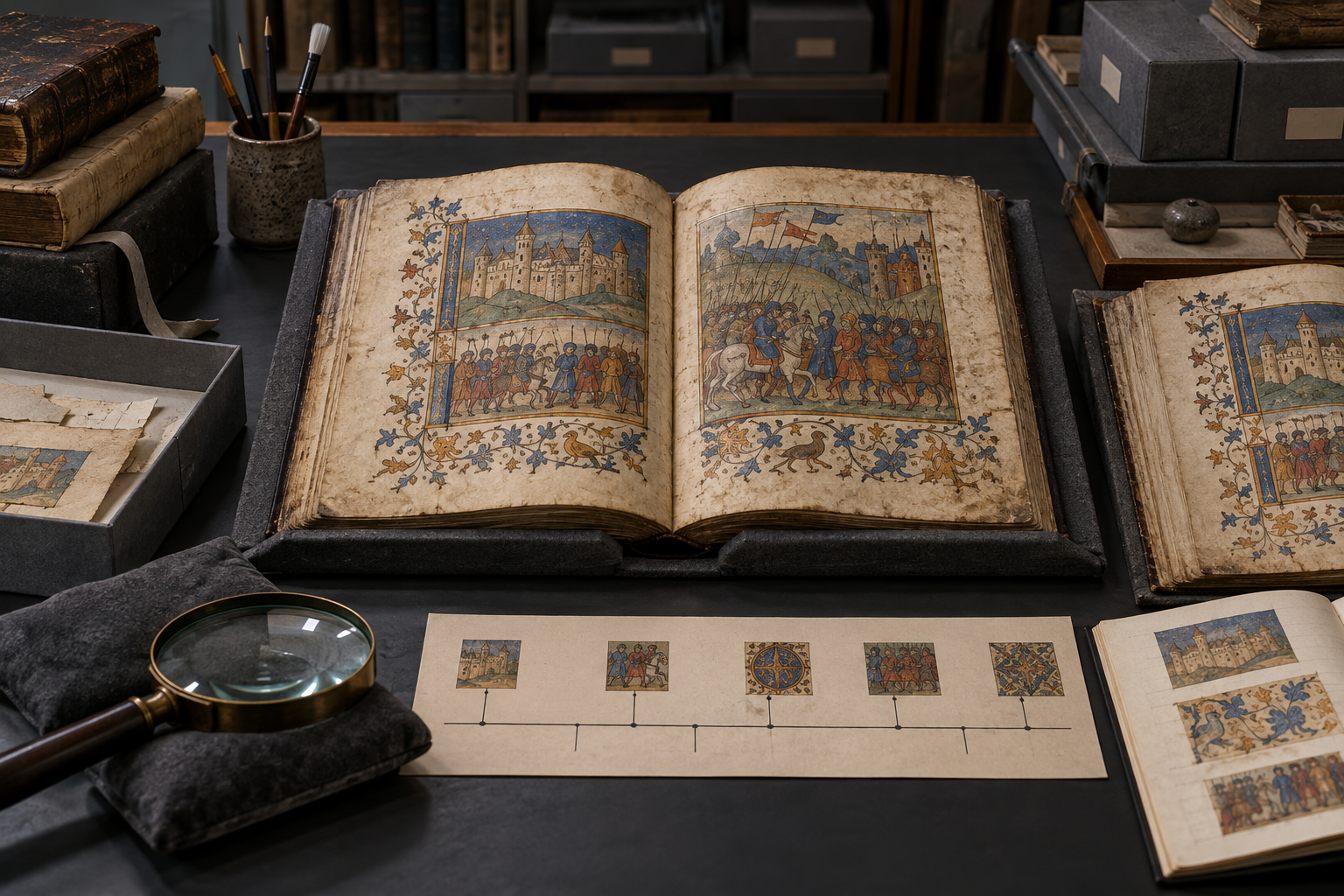
Supporting images provide documentary, geographic or visual context. Read each caption for its date, source and evidential limits.

Continue researching
Follow the evidence, context and comparisons
Curated connections
Selected editorially for this entry.
In the late 12th century, two chroniclers recorded a story about green-skinned children found near Woolpit. The shared core is old; its meaning and literal history remain uncertain.
Curated connection · Case fileThe Wild Hunt: How Europe’s Night Riders Became One LegendThe Wild Hunt is best understood as a scholarly and popular umbrella for varied regional traditions, not one unchanged pagan myth transmitted intact across Europe.
Curated connection · ArticleThe Difference Between Evidence, Testimony and LegendA field guide to three words that often get tangled in mystery research.