Investigation & Evidence
From Unknown Remains to a Name: What Forensic Genetic Genealogy Can Prove
Investigative genetic genealogy is a powerful lead-generating method, not a machine that names a person automatically. Its results depend on sample quality, database rules, documentary genealogy and independent confirmation.
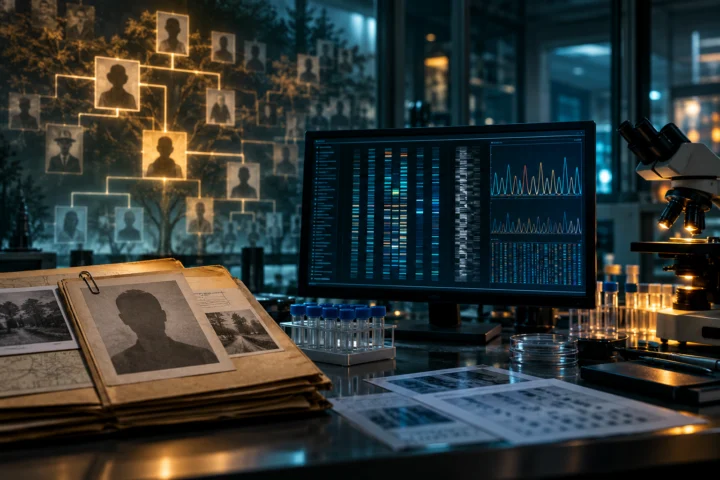
An unidentified body once depended chiefly on fingerprints, dental charts, photographs and a missing-person comparison. Forensic genetic genealogy adds another route. A laboratory develops a dense single-nucleotide polymorphism profile, searches a database that permits law-enforcement use, and looks for people who share inherited DNA segments with the unknown person.
The match is rarely a name. It may indicate distant cousins whose family trees overlap many generations ago. Genealogists then use birth, marriage, death, census and obituary records to identify branches compatible with the person’s estimated age, sex, location and life history. Traditional investigation narrows the candidates.
A candidate identity should be confirmed with a direct reference sample, close-relative comparison, fingerprints, dental evidence or another independent method. The genealogical search generates an investigative lead; it does not by itself prove that the remains belong to one person or that a suspect committed a crime.
The method can work with remains too degraded for older database searches, but preservation, contamination and chain of custody remain decisive. A misleading family tree, adoption, misattributed parentage or identical twins can complicate an apparently neat result.
This framework clarifies the identification questions in the Isdal Woman case, the lineage claim tested in Kaspar Hauser’s story, and the archive’s distinction between evidence and testimony.
Claim, Context and Cautions
Two kinds of forensic profile
Criminal-justice databases commonly use short tandem repeat markers selected for identification. Genealogy services use far larger SNP arrays designed to estimate biological relationships across extended families. A failed STR database search can therefore coexist with useful distant matches in an authorised genealogy database.
The profiles are not interchangeable shortcuts. Laboratories must obtain sufficient human DNA, control contamination and document how a forensic sample became a genealogy-compatible file.
A family tree is a hypothesis
Shared DNA predicts a range of possible relationships rather than one exact place in a pedigree. Investigators build trees around multiple matches and search for descendants whose biography fits the unidentified person. Documentary records can contain spelling errors, informal adoptions and incorrect parentage.
Good practice records every relationship and tests rival branches. A convenient name that fits location is not confirmation, especially when reference families are incomplete.
Privacy and proportionality
Genealogy searching exposes information about relatives who did not provide the forensic sample. Database consent settings, warrants, jurisdictional rules and retention policies therefore matter. United States Department of Justice policy reserves the method for specified serious cases and requires ordinary leads and CODIS searching first.
Rules differ between countries and services. Ethical use requires transparent authority, minimal data exposure and care when contacting relatives who may learn unexpected family information.
What a solved identity means
Restoring a name can return remains to a family and reopen a stalled death investigation. It does not automatically establish cause of death, reconstruct a person's final movements or identify an offender. Those are separate evidential questions.
The strongest conclusions combine genetics with anthropology, records and a confirmatory comparison. Forensic genetic genealogy changes the search space dramatically, but its proper product is a tested identification rather than a compelling family-tree story. The method is most persuasive when the public record shows both the genealogy lead and the conventional test that closed the identification.
Contextual glossary
Terms used in this entry
Definitions are offered as reading aids, not as conclusions about the case.
- Forensic genetic genealogy
- The use of a forensic DNA profile with genealogical records and genetic matches to develop identity or kinship leads. Documentary research and direct confirmation are still required before a proposed identification is treated as established.
- Chain of custody
- The documented sequence showing who collected, stored, copied, tested and transferred an object or recording. Gaps make alteration, contamination or mistaken identity harder to rule out.
- Contamination
- The introduction of outside material or information into evidence. It may affect DNA, objects, recordings or witness accounts and must be considered before treating a match as independent.
Reference trail
Sources
- NIJ Forensic Technology Center of Excellence, Introduction to Forensic Genetic Genealogy (opens in a new tab)Technical introduction to SNP profiles, genealogy databases, lead development and confirmatory testing.
- National Human Genome Research Institute, Investigative Genomics (opens in a new tab)Government overview distinguishing CODIS from investigative genetic genealogy and describing privacy questions.
- US Department of Justice, Interim FGGS Policy (opens in a new tab)Primary policy defining case thresholds, database searching, investigative collaboration and confirmation safeguards.
Case Book
Photographs, Maps and Supporting Images
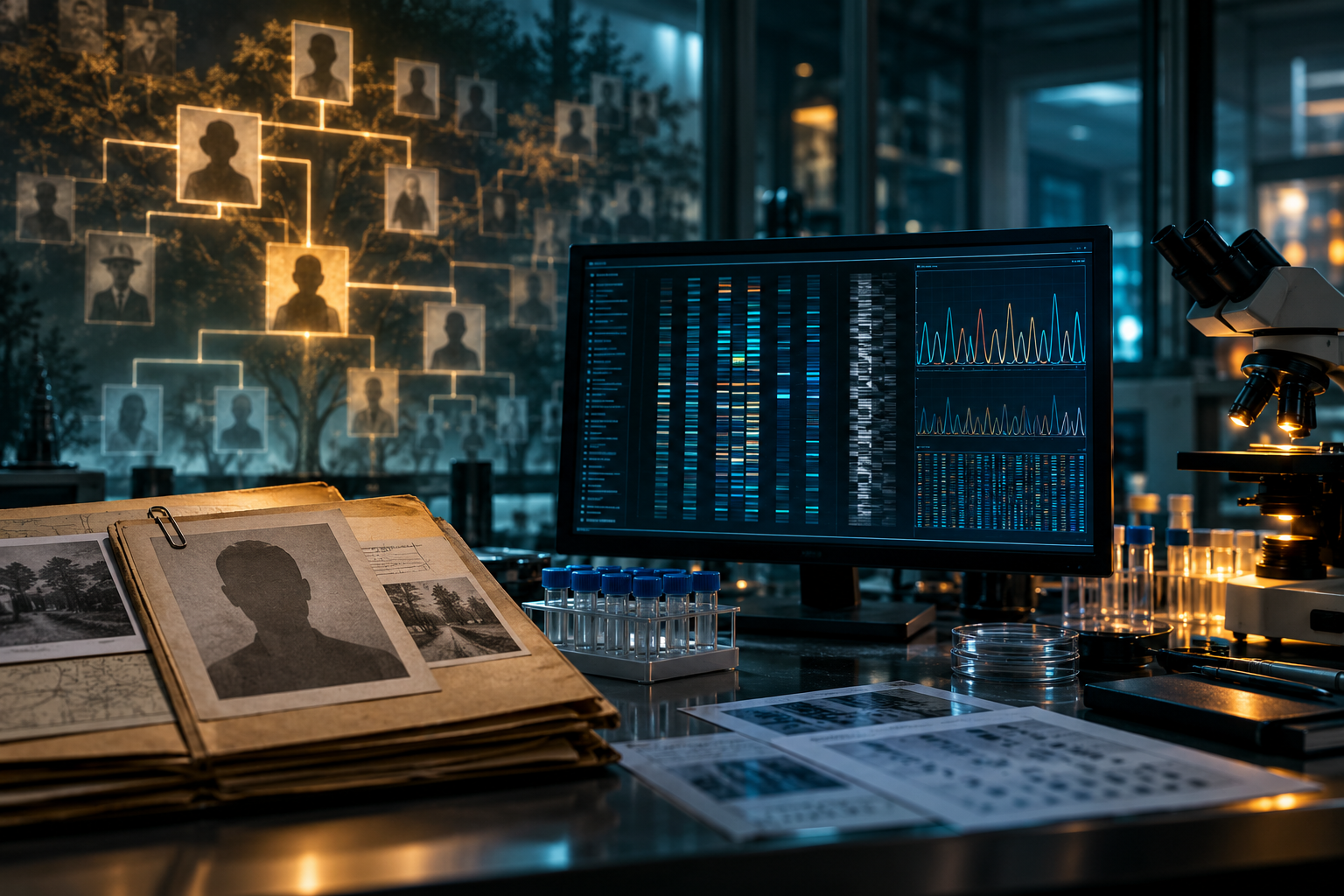
Supporting images provide documentary, geographic or visual context. Read each caption for its date, source and evidential limits.

Continue researching
Follow the evidence, context and comparisons
Curated connections
Selected editorially for this entry.
The Isdal Woman case combines a documented unexplained death with coded travel records, uncertain identity and later forensic reconstruction. Espionage remains a possibility, not an established fact.
Curated connection · Case fileKaspar Hauser: The Foundling, the Prince Claim and the DNA ResultKaspar Hauser was a real unidentified youth whose changing story attracted patrons and suspicion. Modern mitochondrial DNA excludes the House of Baden maternal line; it does not reveal his parents or fully resolve his fatal wound.
Curated connection · ArticleThe Difference Between Evidence, Testimony and LegendA field guide to three words that often get tangled in mystery research.