Cryptids & Animal Reports
The Ivory-billed Woodpecker: Evidence at the Edge of Extinction
The ivory-billed woodpecker controversy tests how conservation science handles suggestive video, acoustic recordings, expert sightings and the irreversible claim of extinction.
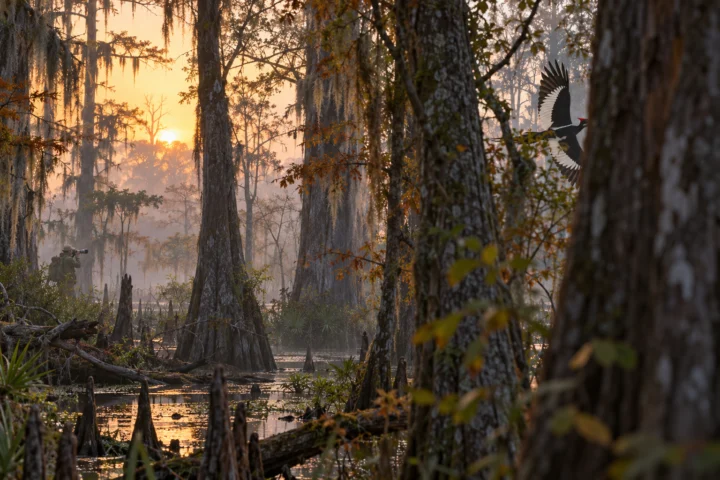
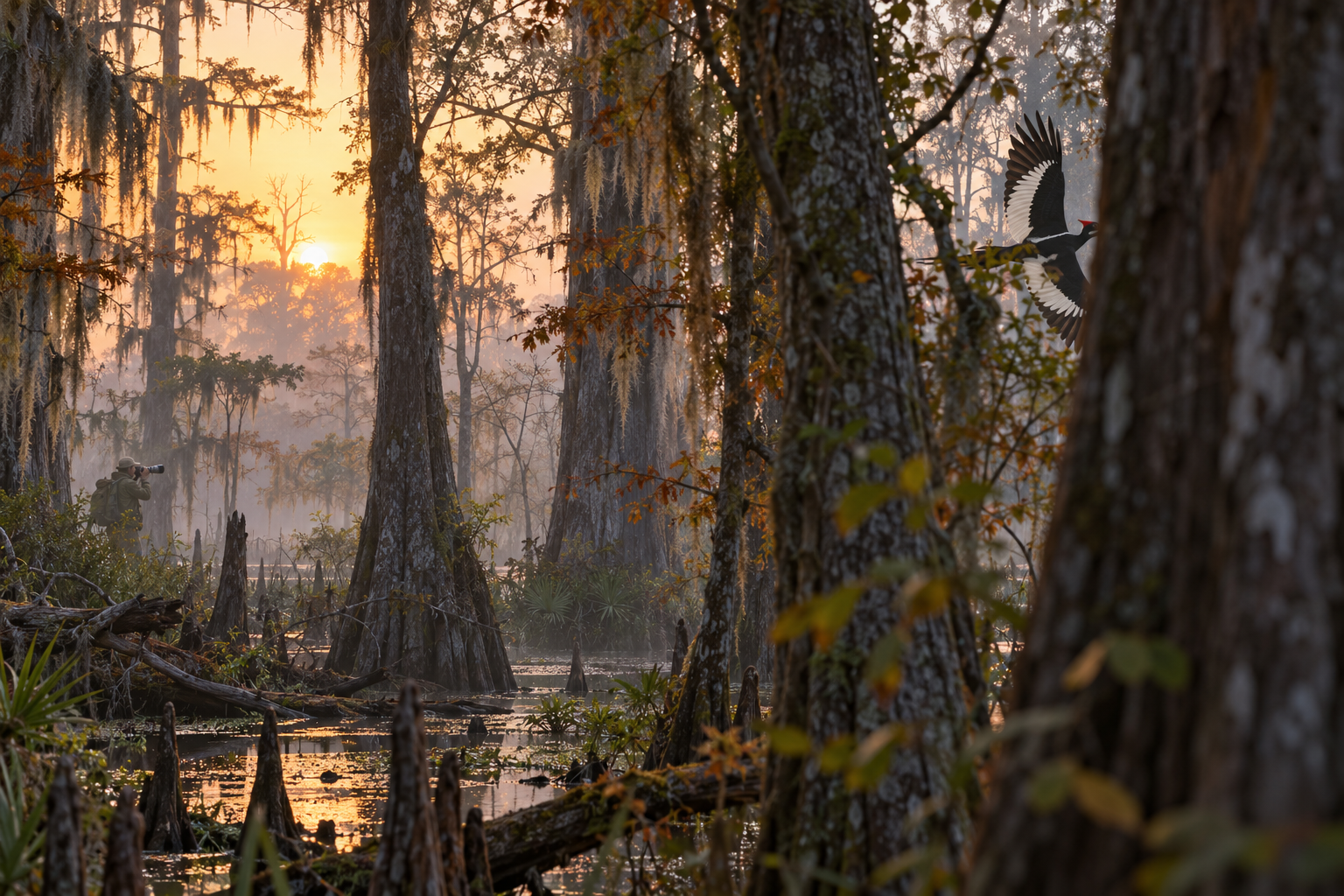
The ivory-billed woodpecker was once a spectacular inhabitant of mature southern forests. Logging and collection devastated its habitat and numbers. The last broadly accepted United States observations came from Louisiana’s Singer Tract in the 1940s, including film and sound recordings. Later sightings kept hope alive without producing comparable evidence.
In 2005, a team led by Cornell researchers announced that the species persisted in Arkansas. Their case combined seven sightings, possible calls and double knocks, and a four-second 2004 video filmed by David Luneau. The United States Fish and Wildlife Service treated the report seriously and supported habitat protection and searches.
Critics argued that the video could show a pileated woodpecker and that sounds and brief views were not diagnostic. Years of intensive searching failed to produce a clear photograph, nest, feather with confirmed DNA or specimen. Advocates have continued to present recordings and imagery, but expert interpretation remains divided.
Search intensity cuts both ways. It improves the chance of detection, making continued failure informative, but vast swamp forests are difficult to survey completely. The correct inference is declining probability under stated search conditions, not a mathematically absolute absence.
The case differs from the specimen-backed coelacanth rediscovery, reinforces the archive’s distinction between evidence and testimony, and contrasts with the identified tissue of the Saint Augustine Monster.
Claim, Context and Cautions
The evidence announced in 2005
Field observers reported a large black-and-white woodpecker, and analysts argued that the Luneau bird’s wing pattern, size and flight were consistent with an ivory-bill. Autonomous recorders captured sounds compared with historical calls and characteristic double raps.
Each line was suggestive; none was a close diagnostic record. Combining evidence can strengthen a case only when the pieces are at least partly independent and their alternative identifications are properly weighted.
The pileated alternative
Pileated woodpeckers are widespread, large and black with substantial white in the wings. Motion blur, interlaced video and viewing angle can change the apparent distribution of white. Critics produced plausible frame-by-frame alternatives and stressed that sincere expert observers can make mistakes during seconds-long forest views.
Acoustic double knocks also occur from other sources, while distant calls can be confused. Location in suitable habitat raises probability but does not make an ambiguous signal diagnostic.
Extinction is also a difficult claim
Failure to find a rare bird is not equivalent to proof that none survives. Detection depends on population size, range, behaviour and search effort. For that reason the Fish and Wildlife Service continued evaluating information rather than including the ivory-bill in its 2023 final delisting of twenty-one extinct species. A later five-year review nevertheless described it as presumed extinct.
Legal protection and scientific certainty are different decisions; caution can preserve habitat while identification remains disputed.
What would resolve the controversy
A clear geolocated sequence showing diagnostic plumage and behaviour, repeated observation of the same individual, genetic material with secure custody, or a nest monitored by independent teams would transform the case. Another distant silhouette adds much less.
The most honest status is uncertain rather than rediscovered or conclusively extinct. Historical existence is established beyond doubt; modern persistence is not. Conservation may still be justified because bottomland habitat benefits many species and because premature certainty in either direction has consequences. Public enthusiasm should support better observation, not lower the identification standard applied to an exceptionally important record.
Contextual glossary
Terms used in this entry
Definitions are offered as reading aids, not as conclusions about the case.
- Extinction
- The loss of the last living member of a species. Failure to detect a rare animal is not instant proof of extinction, but repeated, well-designed surveys can make continued survival increasingly unlikely.
- Motion blur
- Smearing recorded when the camera or subject moves during an exposure. It can enlarge lights, erase outlines and turn an ordinary object into an unfamiliar shape.
Reference trail
Sources
- U.S. Fish and Wildlife Service, 2005 rediscovery announcement (opens in a new tab)Official contemporary statement detailing the video, seven sightings and acoustic evidence behind the announcement.
- PubMed, Rediscovery of the ivory-billed woodpecker (opens in a new tab)Bibliographic record for the 2005 peer-reviewed Science paper presenting the Arkansas evidence.
- U.S. Fish and Wildlife Service, 2023 extinction delisting decision (opens in a new tab)Official statement explaining that the Service withheld the ivory-bill from the final rule while continuing review.
Case Book
Photographs, Maps and Supporting Images
Supporting images provide documentary, geographic or visual context. Read each caption for its date, source and evidential limits.

Continue researching
Follow the evidence, context and comparisons
Curated connections
Selected editorially for this entry.
The 1938 coelacanth was a genuine zoological surprise. Its rediscovery demonstrates gaps in sampling while modern genetics corrects the misleading idea of a species frozen in time.
Curated connection · ArticleThe Difference Between Evidence, Testimony and LegendA field guide to three words that often get tangled in mystery research.
Curated connection · Case fileThe Saint Augustine Monster: From Giant Octopus to Whale TissueThe Saint Augustine Monster was a real stranded carcass whose decayed form misled early observers. Preserved samples support degraded whale tissue, not a giant octopus.