Hauntings & Apparitions
Old Jeffrey at Epworth Rectory: A Haunting Preserved in Family Letters
Epworth’s “Old Jeffrey” is unusually well documented through Wesley family correspondence, but the accounts remain household testimony copied and published later, with no independent test of the noises.
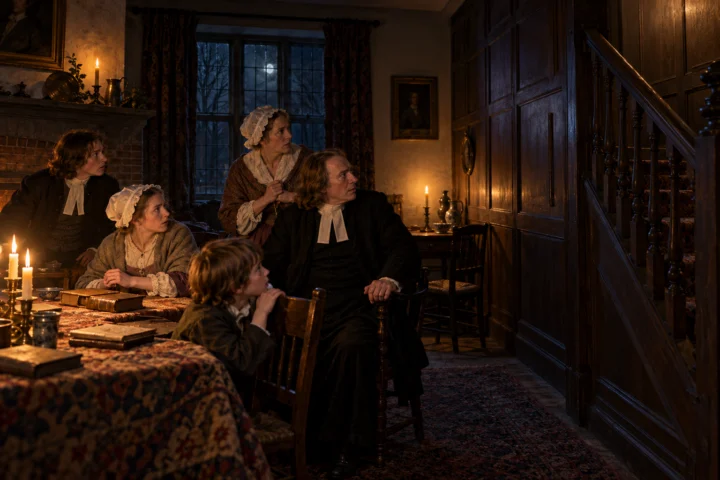
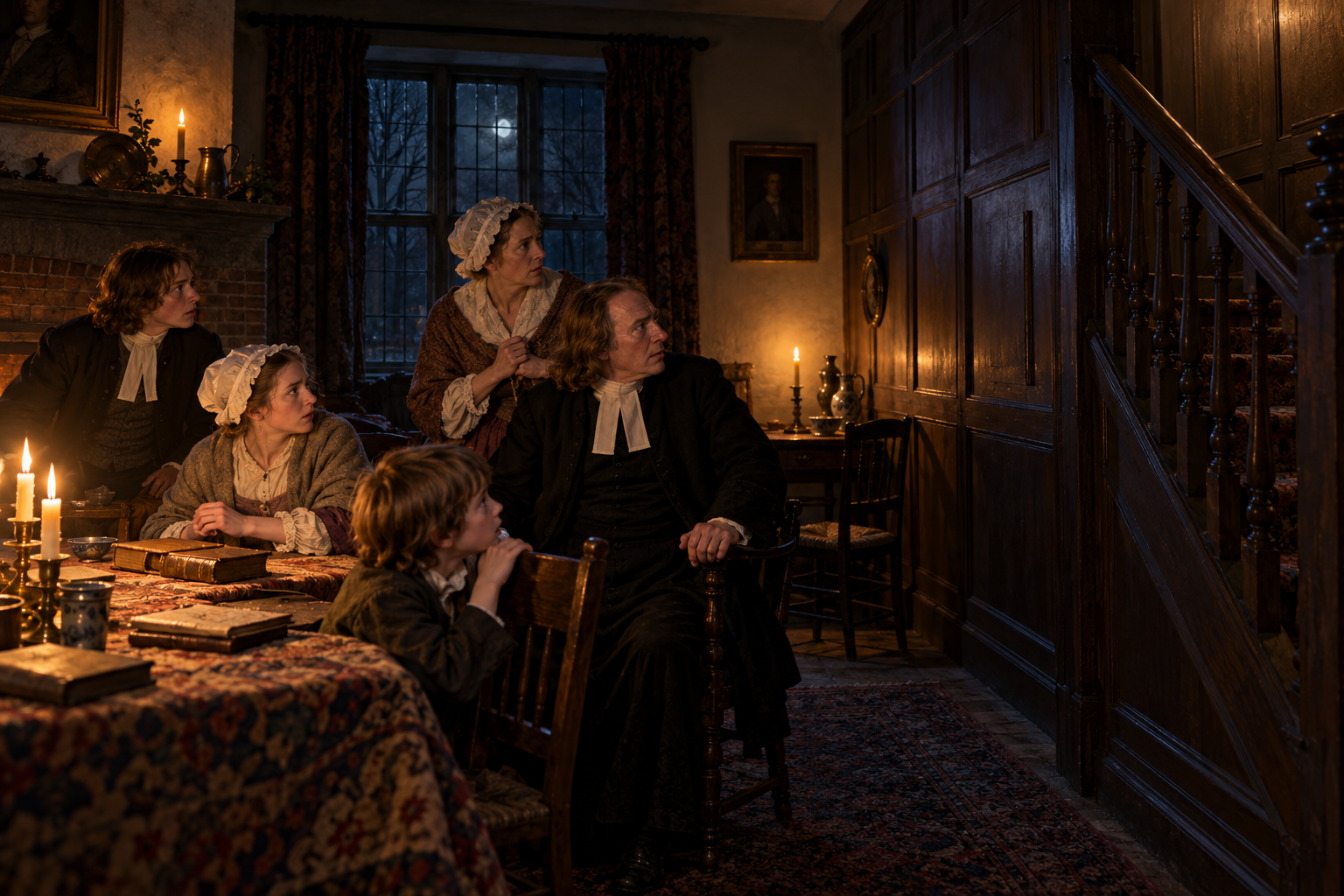
During December 1716 and January 1717, members of the Wesley family at Epworth Rectory reported knocks, groans, footsteps and rattling doors. The noises were nicknamed “Old Jeffrey.” Samuel Wesley, the rector, kept an account; family members wrote to Samuel Wesley Jr., while John Wesley later collected recollections from relatives and neighbours.
The correspondence is why Epworth survives as more than a village ghost story. Witnesses described sounds in different rooms, sometimes responding to prayers or political references. They disagreed over details and interpretations, but several household members said they heard something unusual.
Documentation does not equal laboratory control. The rectory was a large working household with children, servants, animals, wooden fabric and winter weather. No independent observer continuously watched likely sound sources. Letters circulated within a family already discussing a ghost, allowing expectation and shared vocabulary to shape later accounts.
The noises also changed as they were remembered. Later editions gave readers a compact haunting with a name and personality, while the underlying documents preserve interruptions, uncertainty and competing suspicions. That editorial history belongs to the evidence and prevents a simple transcript-like reading.
Epworth can be compared with the archive’s anatomy of a haunting report, the public tests of the Cock Lane Ghost, and the later American tradition of the Bell Witch.
Claim, Context and Cautions
A family archive
Accounts were written close to the events, an important advantage over folklore first recorded generations later. Samuel Wesley listed dates and effects, and correspondence let absent family members ask questions. John Wesley’s later interviews added named testimony.
The archive still has a transmission history. Originals, copies, shorthand transcriptions and eighteenth-century publication are not interchangeable. Historians must ask when each wording entered the record and whether later editors regularised it.
What witnesses said
Reports included tapping, footsteps on stairs, a rocking cradle, a sounding latch and noises that seemed to follow people between rooms. Some family members initially suspected rats or tricks. Samuel reportedly challenged the source and interpreted particular timing as meaningful.
The witnesses did not observe a single visible agent performing all these acts. Similar descriptions show a shared household experience, but they do not exclude several ordinary events gathered under one name.
Household and political context
The Wesleys lived amid financial pressure, parish conflict and intense religious and political commitments. Modern scholarship notes that interpretations of the supernatural in this period could map onto Tory and Whig or High- and Low-Church divisions. Claims that the noises reacted to political prayers belong to that context.
Context does not prove fabrication. It explains why ambiguous noises could carry meaning and why this family preserved them so carefully.
An unresolved source of noise
Proposed explanations include prank-playing children or servants, rodents, structural movement and a mixture of events amplified through family attention. No confession or physical finding securely resolves the episode. A paranormal cause faces the larger problem that no controlled condition showed a force acting independently of occupants and building.
Epworth is valuable because testimony survives, not because the testimony compels a ghost. Its careful classification is uncertain: a documented claim of disturbances whose mechanism cannot now be recovered from correspondence alone. The family’s status later made the papers unusually collectible and publishable; countless ordinary households left no comparable archive. Survival of documentation therefore measures historical attention as well as the original event.
Contextual glossary
Terms used in this entry
Definitions are offered as reading aids, not as conclusions about the case.
- Haunting
- A pattern of unusual experiences attributed to a place, including apparitions, sounds, movement or sensed presences. A location log is more informative than treating every incident as one cause.
- Uncertainty
- The stated limit on what a measurement, reconstruction or body of evidence can establish. Describing uncertainty is not indecision; it prevents a result from appearing more precise than the evidence allows.
Reference trail
Sources
- Duke Divinity School, The Journal and Letters of Charles Wesley (opens in a new tab)Scholarly edition describing the family notebooks, copied letters and interview material through which the Epworth accounts survive.
- Wesley Center Online, Wesley’s Letters: Volume One (opens in a new tab)Digitised Wesley correspondence and editorial context for the family record and Epworth household.
- Oxford Academic, The Wesleys’ Tory Ghost (opens in a new tab)Historical analysis of the 1716 disturbances within the family’s religious, political and community conflicts.
Case Book
Photographs, Maps and Supporting Images
Supporting images provide documentary, geographic or visual context. Read each caption for its date, source and evidential limits.

Continue researching
Follow the evidence, context and comparisons
Curated connections
Selected editorially for this entry.
A practical guide to separating atmosphere, testimony, memory, environment and possible causes in a reported haunting.
Curated connection · Case fileThe Cock Lane Ghost: Knocks, Crowds and an Enlightenment HoaxThe Cock Lane Ghost became a public test of spirit claims, murder accusations and experimental controls. Contemporary investigators ultimately exposed deliberate production of the knocks.
Curated connection · Case fileThe Bell Witch: A Haunting Built From Legend and MemoryThe Bell Witch story is one of America's most durable haunting legends, but its power comes from later storytelling as much as any recoverable event.