Scientific Anomalies & Natural Phenomena
The Kentucky Meat Shower: Flesh From a Clear Sky
The Kentucky Meat Shower was a documented fall of animal tissue, not weather creating meat. Conflicting identifications and absent surviving evidence leave the source probable rather than certain.
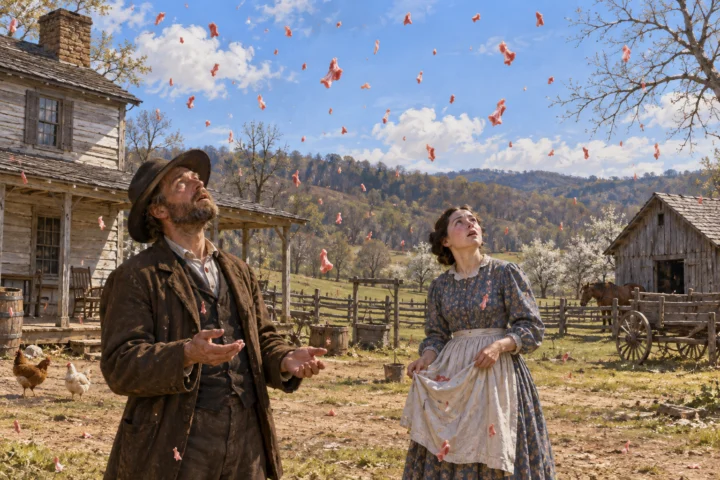
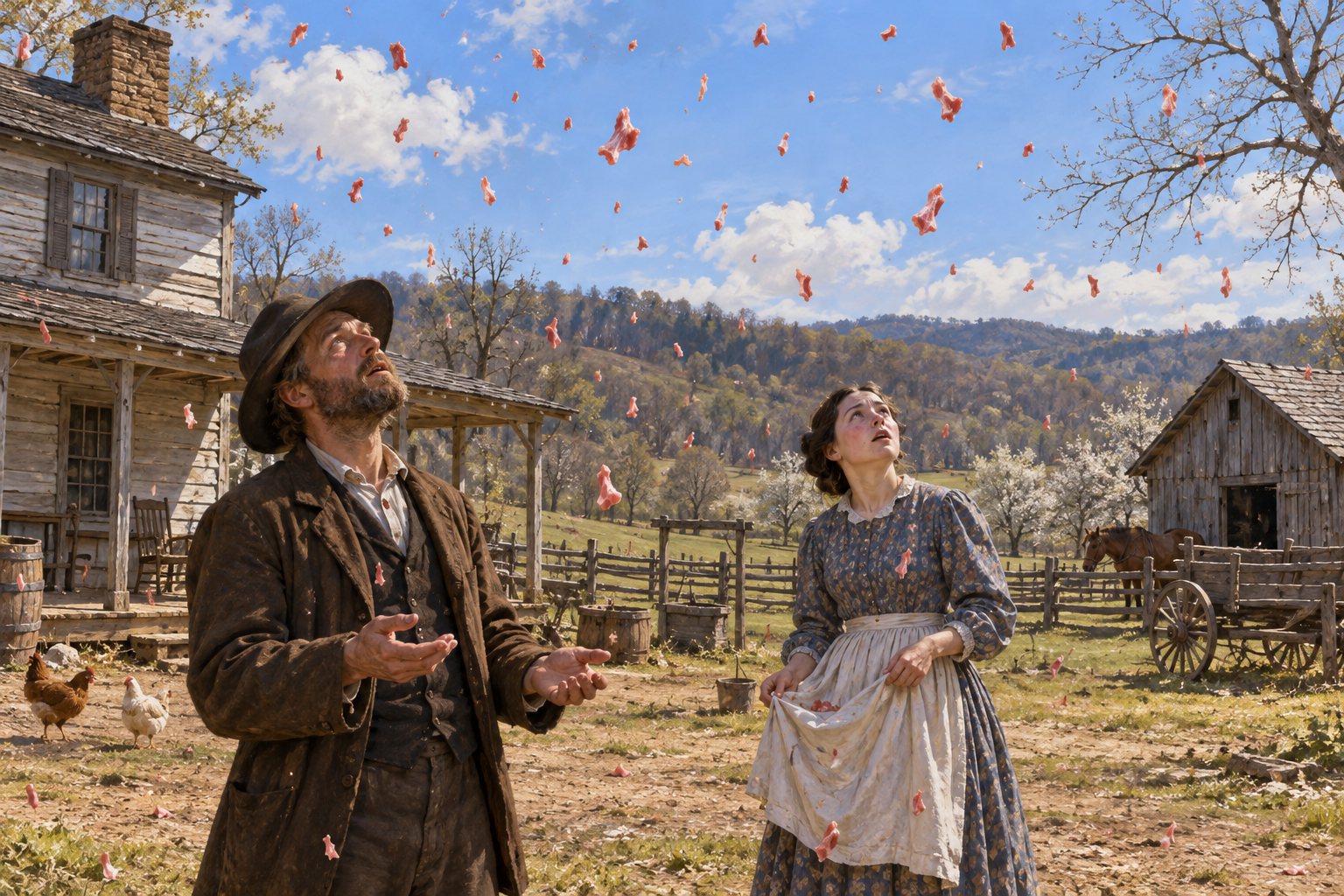
On 3 March 1876, pieces of animal tissue fell for several minutes around the home of Allen Crouch near Olympia Springs in Bath County, Kentucky. The sky was reportedly clear. Samples were collected, tasted by at least one observer and sent to physicians and naturalists.
Contemporary descriptions varied in size and identification. Microscopic examinations were reported as showing lung tissue, cartilage or muscle, while other writers proposed material associated with amphibians or microorganisms. “Meat” was a reasonable visual description, not a single laboratory result agreed by every examiner.
The most durable explanation is that a flock of vultures disgorged partially digested food while flying overhead. Vultures can vomit when alarmed or to lighten themselves, and a group could distribute material across a field without a visible storm. No observation of the birds at the exact moment survives, so the mechanism remains an inference.
The shower belongs beside the physical aftermath of Tunguska, the caution urged by out-of-place artefacts, and the process by which newspapers turn anomalies into enduring tales.
Claim, Context and Cautions
A fall witnessed at the farm
The event was unusual enough to attract local visitors and press attention. Reports describe flakes or chunks scattered over a defined area rather than one carcass dropped intact. The clear weather ruled out an ordinary rainstorm as the carrier.
It did not rule out animals overhead. The witnesses looked at the material after it began to fall; they did not document a complete view of the sky and every possible source.
Conflicting tissue identifications
Nineteenth-century examiners used microscopy to compare fibres and structures, but sample handling and terminology were not standardised across every account. Identifications included lung, cartilage and muscular tissue from different animals.
That disagreement weakens claims that one exotic substance was established. It is compatible with mixed or partly digested animal material.
The vulture hypothesis
Turkey and black vultures feed communally and may regurgitate when disturbed. Material released by several birds could spread across a farm and seem to arrive from an empty sky because the birds were high, moving or noticed only after the fall.
The hypothesis fits known behaviour and the biological character of the samples. It lacks the direct observation that would make it a demonstrated explanation.
What the surviving record cannot recover
No securely curated set of samples is available for modern DNA, histology or chemical testing. Newspaper accounts copied one another, and some later summaries treat colourful remarks as laboratory findings.
The lost chain of custody means modern certainty cannot be manufactured from repeated wording.
An anomaly without impossible physics
Something material fell and was collected; that core is stronger than many “falls from the sky” legends. Nothing in the evidence requires flesh to form in the atmosphere or pass through a supernatural process.
The case remains uncertain at the level of exact animal source and flight sequence. Vulture regurgitation is the best-supported ordinary account, not a witnessed solution.
Contextual glossary
Terms used in this entry
Definitions are offered as reading aids, not as conclusions about the case.
- Chain of custody
- The documented sequence showing who collected, stored, copied, tested and transferred an object or recording. Gaps make alteration, contamination or mistaken identity harder to rule out.
- Anomaly
- An observation or result that does not fit the current account. An anomaly identifies a question; it is not, by itself, evidence for any particular extraordinary explanation.
Reference trail
Sources
- Scientific American, 11 March 1876 issue (opens in a new tab)Digitised contemporary scientific periodical carrying early discussion of the Kentucky fall.
- Explore Kentucky History, Kentucky Meat Shower (opens in a new tab)Kentucky historical resource for the location, witnesses, press response and later interpretation.
- Smithsonian Magazine, “When Meat Rained From the Sky” (opens in a new tab)Museum journalism reviewing contemporary examinations and the vulture-regurgitation hypothesis.
- JSTOR record on the Kentucky shower (opens in a new tab)Historical scholarly record used to cross-check the scientific discussion of the material.
Case Book
Photographs, Maps and Supporting Images
Supporting images provide documentary, geographic or visual context. Read each caption for its date, source and evidential limits.

Continue researching
Follow the evidence, context and comparisons
Curated connections
Selected editorially for this entry.
A 1908 blast over Siberia flattened forest without leaving a classic impact crater, making Tunguska a cornerstone case in anomaly, science and myth.
Curated connection · ArticleOut-of-Place Artefacts and the Value of CautionWhy disputed objects need context, chain of custody and patient interpretation before becoming extraordinary evidence.
Curated connection · ArticleThe Role of Newspapers in Spreading Strange TalesOld newspapers preserved remarkable local reports, but they also shaped them for appetite, humour and alarm.