Hauntings & Apparitions
The Great Amherst Mystery: Esther Cox and a Printed Haunting
The Amherst case rests chiefly on Walter Hubbell’s participant narrative of noises, fires, messages and moving objects around Esther Cox. Some incidents had witnesses; controls were poor.
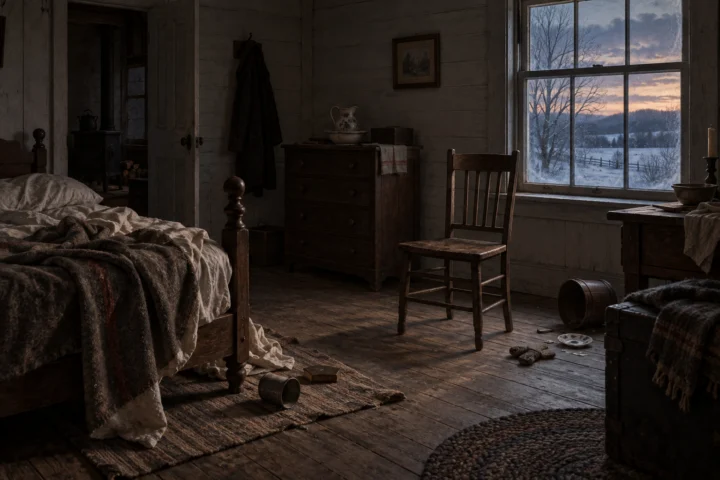
In 1878, a household in Amherst, Nova Scotia, began reporting knocks, moving bedding, unexplained fires and messages apparently forming on walls. The disturbances centred on nineteen-year-old Esther Cox after a traumatic assault attempt. Actor and lecturer Walter Hubbell entered the household, observed events and turned them into a book and touring story.
Hubbell’s narrative is near-primary: he names people, places himself in rooms and records episodes soon after the alleged events. It is also an interested account by a performer who later profited from the mystery. The home was crowded, observation informal and opportunities for concealment abundant.
Some incidents may have involved deliberate action by Cox or others; illness, dissociation, family tension and later embellishment have also been proposed. No single confession or controlled test explains the entire printed sequence. Conversely, quantity of anecdotes does not overcome their common source and weak controls.
The record invites comparison with the Enfield Poltergeist, the contested household events at Battersea, and the archive’s anatomy of a haunting.
Claim, Context and Cautions
A vulnerable person at the centre
The reports began after an attempted sexual assault that Cox survived. Historical accounts then describe illness, fear and household disruption before overt ‘poltergeist’ effects. Modern diagnosis at a distance would be irresponsible, but the context matters.
Later supernatural summaries often detach the phenomena from the pressures on the young woman around whom they clustered.
What Hubbell said he observed
Hubbell described knocks answering questions, objects moving, words appearing and small fires. His presence makes the account more immediate than a legend collected generations later. Yet he was neither a neutral laboratory observer nor able to maintain continuous control of the rooms and participants.
His book is evidence that claims were made and promoted; each episode still needs separate scrutiny.
Witness quantity and shared conditions
Neighbours and visitors reportedly attended demonstrations. Multiple people seeing an object move can corroborate that movement, but not necessarily its unseen cause. They often shared the same angle, expectations and uncontrolled room.
Names and crowds should not be counted as independent replications when information and conditions were common.
Fraud and human agency
Trickery can explain messages, thrown objects and fires where attention centred on a participant. Accounts that Cox was detected causing at least some disturbances are part of the later debate, although versions differ and do not amount to a clean confession covering the whole affair.
Mixed cases are possible: genuine distress, pranks, accidental events and embellished reporting need not share one cause.
A book that became the case
Successive editions of <em>The Great Amherst Mystery</em> preserved the story while fixing Hubbell's viewpoint as its spine. Modern retellings frequently recycle those scenes without marking their provenance.
The responsible verdict is disputed. The narrative is historically traceable, but its conditions cannot distinguish paranormal agency from human action and interpretation.
Contextual glossary
Terms used in this entry
Definitions are offered as reading aids, not as conclusions about the case.
- Haunting
- A pattern of unusual experiences attributed to a place, including apparitions, sounds, movement or sensed presences. A location log is more informative than treating every incident as one cause.
- Poltergeist
- A cluster of reported noises, object movement or disruption traditionally attributed to an unseen agency. Cases require attention to household dynamics, access, building conditions and witness timing.
- Provenance
- The documented history of an object’s origin, ownership, location and handling. A dramatic claim with weak provenance cannot reliably establish where or when an object came from.
Reference trail
Sources
- Walter Hubbell, The Great Amherst Mystery, Open Library record (opens in a new tab)Bibliographic and digitised access to the principal near-primary published narrative.
- IAPSOP scan, The Great Amherst Mystery (opens in a new tab)Searchable historical edition used to verify episode wording and authorial claims.
- Wikimedia Commons / National Library of Medicine scan (opens in a new tab)Independent institutional scan used to cross-check the published text and edition history.
- Field Report Archive, Great Amherst case record (opens in a new tab)Secondary chronology used cautiously to separate reported events from later interpretations.
Case Book
Photographs, Maps and Supporting Images
Supporting images provide documentary, geographic or visual context. Read each caption for its date, source and evidential limits.

Continue researching
Follow the evidence, context and comparisons
Curated connections
Selected editorially for this entry.
The Enfield case remains famous because it was recorded, argued over and repeatedly reinterpreted, which makes it a perfect archive for uncertainty.
Curated connection · Case fileThe Battersea Poltergeist: Taps, Notes and a Long InvestigationFrom 1956, the Hitchings family reported household disturbances attributed to “Donald”. Investigator Harold Chibbett kept a large record, while ordinary access and weak controls left human agency unresolved.
Curated connection · ArticleThe Anatomy of a Haunting ReportA practical guide to separating atmosphere, testimony, memory, environment and possible causes in a reported haunting.
More through shared context
Additional routes based only on existing topics, themes and metadata.
In 1835, newspaper readers met moon forests, lunar animals and winged people in a celebrated lesson about media, science and appetite.
Shared theme: Media & rumour · Case fileThe Hammersmith Ghost: When a Rumour Ended in a Fatal MistakeThe Hammersmith Ghost is historically established as a rumour with lethal consequences, not as a verified haunting. Trial evidence documents mistaken identification, public fear and a lasting legal problem.