Cryptids & Animal Reports
The Flatwoods Monster: Light, Vapour and an Owl-Shaped Figure
Witnesses near Flatwoods reported a bright object, irritating mist and a tall, glowing-eyed form on 12 September 1952. A meteor and startled owl explain much, but not by direct proof.
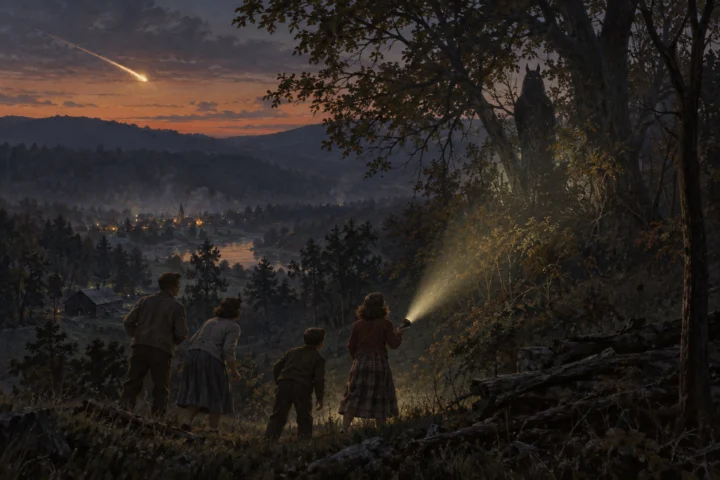
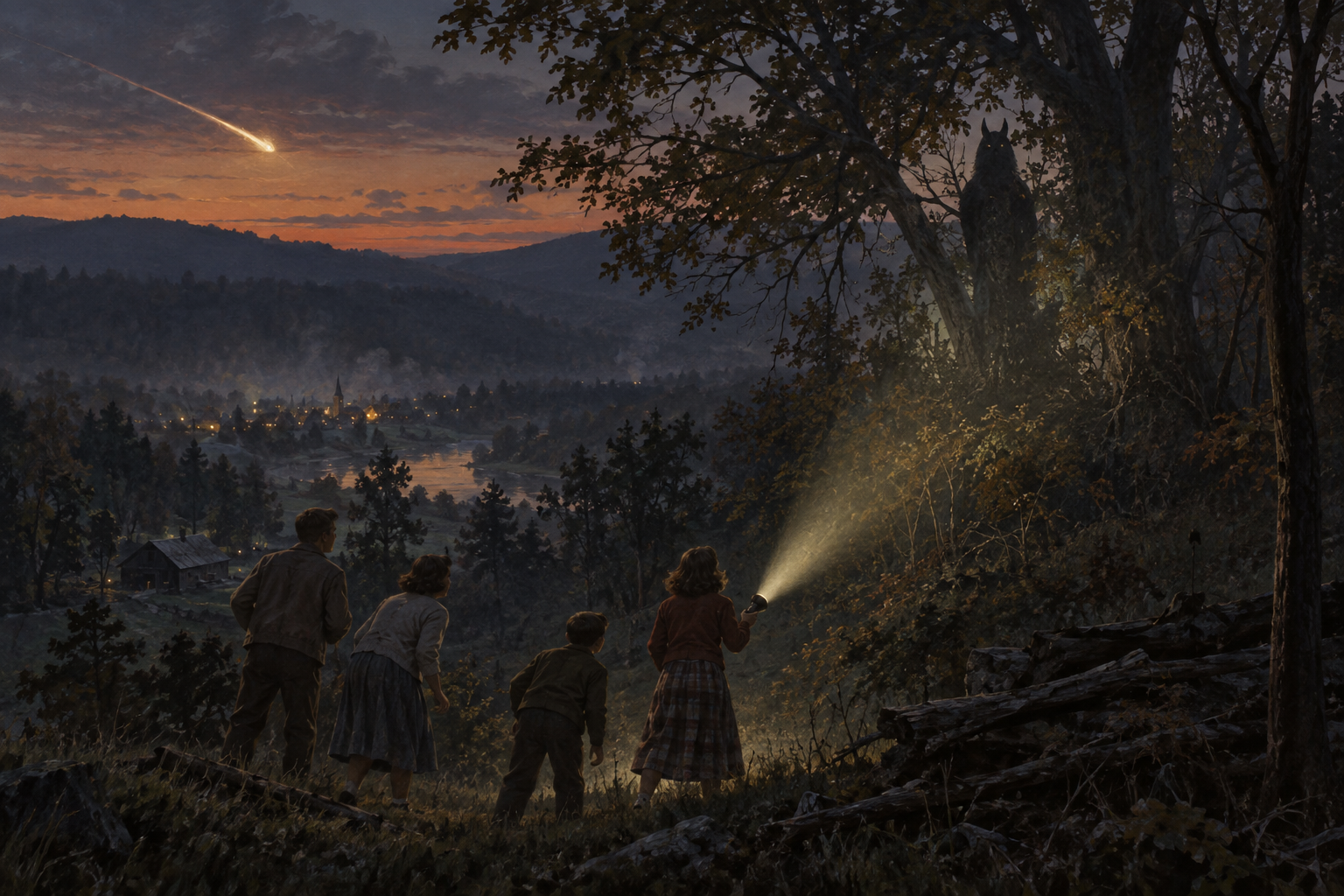
On the evening of 12 September 1952, children in Flatwoods, West Virginia, saw a bright object cross the sky and appear to descend beyond a hill. They returned with adults, including Kathleen May and National Guardsman Eugene Lemon. Near a pulsing red light, the party encountered an odour, mist and a tall shape with a round or hooded outline and bright eyes.
The group fled. Some participants later reported nausea or throat irritation. Newspapers rapidly turned the episode into a landed-saucer story and fixed the now-familiar image of a skirted, clawed monster. The U.S. Air Force file connected the sky light with a meteor and found no recovered craft.
A startled barn owl in foliage offers a economical model for the face, eyes and claw-like shapes; vegetation and haze could enlarge its outline. That reconstruction is plausible rather than demonstrative. The exact light on the hill and the source of the reported irritation were not sampled under controlled conditions.
The case connects with West Virginia’s Mothman tradition, the mechanics of misread sky lights, and the way newspapers spread strange tales.
Claim, Context and Cautions
The object across the evening sky
The initial observation was distant: a bright object travelled overhead and seemed to come down. Similar fireball reports occurred in the region that evening. A meteor can look close and can appear to descend behind a local horizon even when it remains far away.
The decision to search the hill linked that astronomical sight with whatever the party later met on the ground.
A brief encounter under poor conditions
The witnesses approached after dark with a torch. Lemon's dog reacted, and the group noticed a red light before the beam revealed the figure. The viewing interval was short and emotionally charged.
Descriptions were not perfectly uniform. Height, colour, arms and the ‘spade’ or hooded outline hardened as artists and newspapers repeated a composite image.
The owl reconstruction
A barn owl has large forward-facing eyes, a heart-shaped facial disc and talons that can resemble small hands. Perched among branches, lit abruptly and viewed from below, it could contribute both the face and imposing outline.
The proposal gains strength from ordinary animal behaviour and the lack of tracks or artefacts. It cannot reproduce a past view experimentally because the precise perch, distance and lighting were not preserved.
Mist, smell and illness
Witnesses described an unpleasant smell or mist, and several later felt unwell. Local vegetation, smoke, fear-driven hyperventilation or an unrelated irritant have been suggested. Claims of chemical contamination were never supported by samples or medical findings specific enough to identify an agent.
Symptoms are part of the testimony, but they do not establish propulsion exhaust or poison.
From report to state icon
The Flatwoods figure acquired a stable visual identity that exceeds the variable early record. Tourism and popular culture preserve that identity without making it a literal portrait.
The most supported account combines a visible fireball with a later terrestrial misidentification. The case remains disputed because that synthesis is inferential, not because evidence requires an unknown creature.
Contextual glossary
Terms used in this entry
Definitions are offered as reading aids, not as conclusions about the case.
- Reconstruction
- A later model, image or account made to represent an event from surviving information. It can clarify a hypothesis but should remain visibly separate from contemporary evidence.
- Meteor
- The streak of light produced when a small extraterrestrial body heats the atmosphere during entry. The object in space is a meteoroid; material that reaches the ground is a meteorite.
- Misidentification
- A real object, animal, sound or event interpreted as something else because identifying information was limited. Distance, darkness and unfamiliar angles commonly remove useful scale and context.
- Contamination
- The introduction of outside material or information into evidence. It may affect DNA, objects, recordings or witness accounts and must be considered before treating a match as independent.
Reference trail
Sources
- West Virginia Encyclopedia, “Flatwoods Monster” (opens in a new tab)State reference summarising witnesses, location, contemporary response and later cultural history.
- U.S. National Archives, Project Blue Book records (opens in a new tab)Official catalogue record for the U.S. Air Force investigation collection in which the Flatwoods report was recorded.
- History, “The Flatwoods Monster” (opens in a new tab)Secondary historical overview used for chronology and the report’s national reception.
- Skeptical Inquirer investigation PDF (opens in a new tab)Critical field reconstruction of the meteor and owl explanation.
Case Book
Photographs, Maps and Supporting Images
Supporting images provide documentary, geographic or visual context. Read each caption for its date, source and evidential limits.

Continue researching
Follow the evidence, context and comparisons
Curated connections
Selected editorially for this entry.
Mothman is interesting not because the creature is easy to prove, but because the legend gathered itself around a town, a bridge and a tragic collapse.
Curated connection · ArticleHow Ordinary Lights Become Extraordinary UFO ReportsAircraft, satellites, planets, drones and atmospheric effects can become strange when context is missing.
Curated connection · ArticleThe Role of Newspapers in Spreading Strange TalesOld newspapers preserved remarkable local reports, but they also shaped them for appetite, humour and alarm.