Hoaxes, Misidentifications & Media
The Black Knight Satellite: How Separate Stories Became One Object
The Black Knight is a composite legend assembled from unrelated radio experiments, Cold War tracking stories and STS-88 photographs of lost thermal insulation.
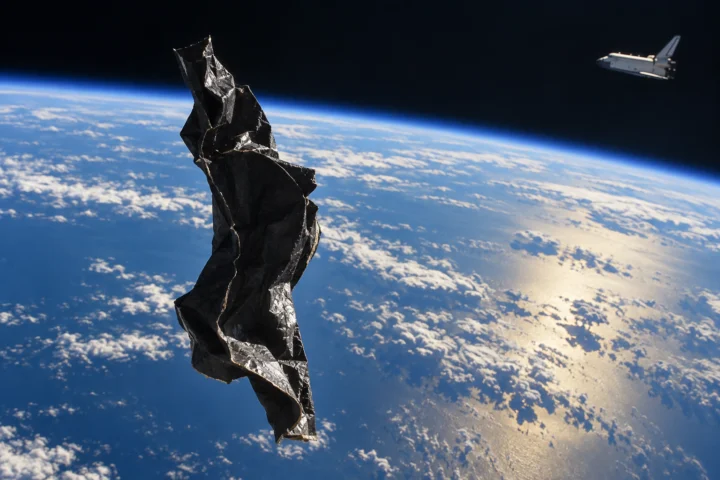
The Black Knight satellite is often described as a 13,000-year-old alien object in polar orbit, monitored since Nikola Tesla detected signals from space. That biography was not reported as one event. It was assembled later by joining episodes separated by decades, different instruments and different objects.
Tesla described unusual electrical signals in 1899, before artificial satellites existed, and later radio researchers investigated long-delayed echoes. Cold War newspapers reported unidentified objects tracked near the first human satellites. None supplied a continuous observation, orbit or physical link to the modern Black Knight name.
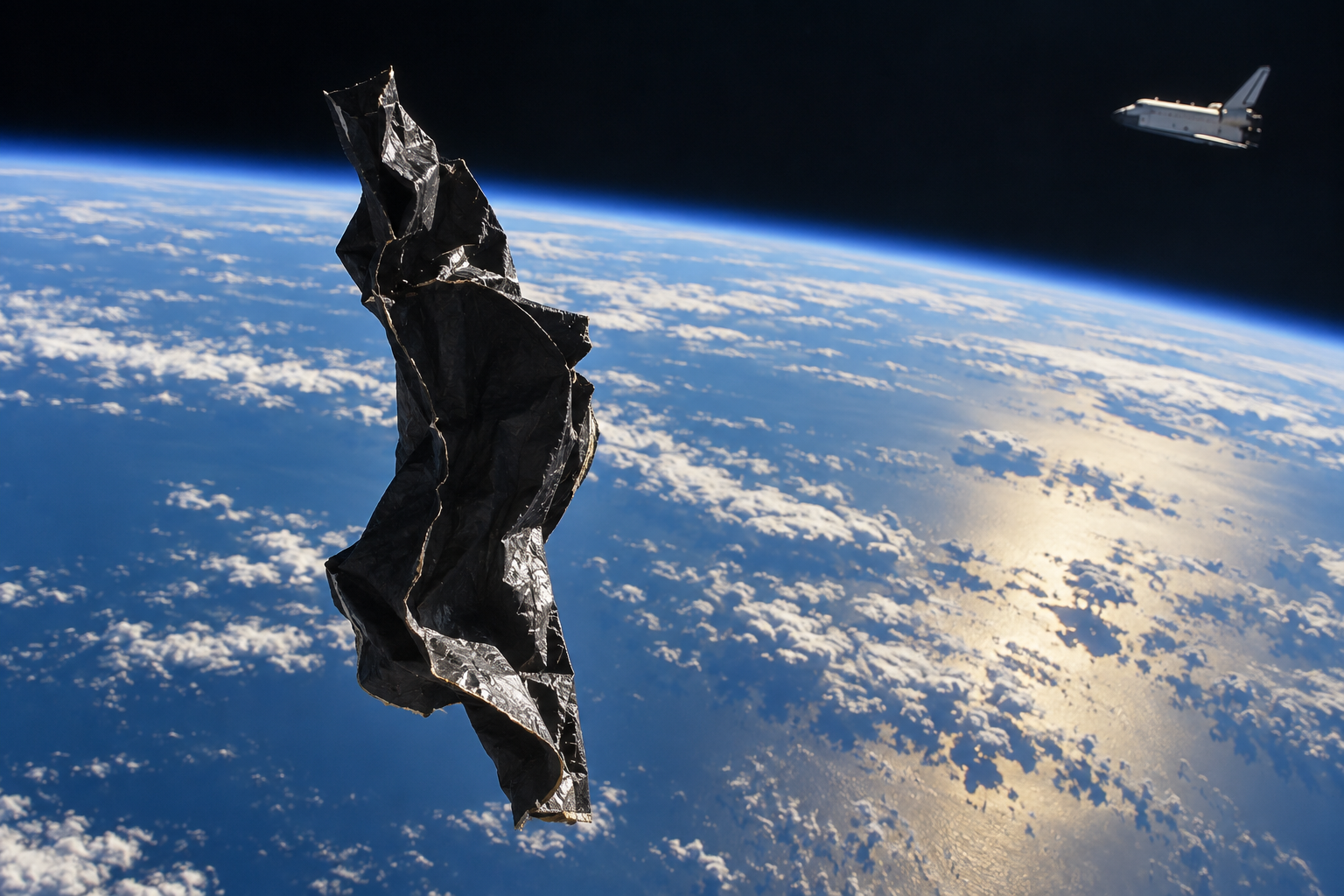
The famous black-object photographs come from NASA’s STS-88 mission in December 1998. Spacewalk communications and mission context identify an escaped thermal cover. In changing sunlight, the tumbling blanket produced dramatic silhouettes before its orbit decayed.
The legend illustrates evidence assembled into story, the visual ambiguity of the Face on Mars, and how ordinary objects acquire extraordinary identities.
Claim, Context and Cautions
A biography built backward
Modern summaries begin with an ancient satellite and search history for earlier hints. This reverses normal identification. To show one object persisted, evidence would need compatible positions, orbits and observations across time. The legend instead changes from radio signal to tracked target to photographed shape.
Similarity at the level of “something unexplained in space” is not continuity.
Tesla and signals from space
At Colorado Springs, Tesla recorded periodic electrical disturbances and speculated about intelligent signals, including from Mars. Early radio equipment was vulnerable to natural and human noise, and his records do not define an orbiting transmitter.
Attaching the Black Knight name to Tesla is retrospective. He neither photographed nor tracked such a satellite.
Long-delayed echoes
In the 1920s and 1930s, experimenters reported radio echoes returning seconds after transmission. Proposed causes ranged from propagation effects to distant reflectors and remain historically interesting. The delay patterns did not locate a single solid object, and later claims that they encoded a star map depend on selective analysis.
A radio phenomenon is not automatically a satellite.
Cold War unknowns in orbit
Early tracking networks sometimes detected targets that were uncertain, miscatalogued or associated with launch debris. Newspaper descriptions of “dark satellites” entered the legend. Space surveillance improved rapidly, and objects in orbit require continuing positional data to establish identity.
No published catalogue connects those temporary reports to an ancient polar object lasting into 1998.
The STS-88 photographs
During construction of the International Space Station, astronauts Jerry Ross and James Newman conducted spacewalks. A thermal cover escaped. Mission photography recorded an irregular dark object tumbling above Earth; its folds and highlights changed between frames.
Those are the images circulated as Black Knight evidence. Their documented mission context provides a direct, ordinary identification.
Why the legend survives the identification
The blanket photographs give a visual centre to older stories that previously lacked one. Cropped frames remove the shuttle context, while timelines present unrelated episodes as repeated encounters. Each retelling then cites the combined timeline as if it were independent evidence.
The Black Knight is explained as a narrative composite. Unusual radio echoes and early tracking uncertainties may have their own histories, but they do not become one alien spacecraft by association.
Contextual glossary
Terms used in this entry
Definitions are offered as reading aids, not as conclusions about the case.
- Source criticism
- The examination of who created a source, when, why, from what information and through what later copies or edits. It helps separate early evidence from repetition.
- Independent evidence
- Evidence obtained through a source or method that did not derive from the claim it appears to support. Several retellings of one account are multiple copies, not multiple independent observations.
Reference trail
Sources
- NASA, STS-88 mission gallery (opens in a new tab)Official mission context and photography for the first International Space Station assembly flight.
- NASA, Space Shuttle Era retrospective (opens in a new tab)Official mission history situating STS-88, its crew and extravehicular work.
- James Oberg, “STS-88 and the Black Knight” source analysis (opens in a new tab)Frame-by-frame and mission-audio reconstruction identifying the photographed object as a lost thermal cover.
- NASA Gateway to Astronaut Photography of Earth (opens in a new tab)Official searchable catalogue containing the STS-88 orbital photographs used in later Black Knight claims.
Case Book
Photographs, Maps and Supporting Images
Supporting images provide documentary, geographic or visual context. Read each caption for its date, source and evidential limits.

Continue researching
Follow the evidence, context and comparisons
Curated connections
Selected editorially for this entry.
A field guide to three words that often get tangled in mystery research.
Curated connection · Case fileThe Face on Mars: Pareidolia in a Planetary ArchiveThe Face on Mars became a classic anomaly because one low-resolution Viking image looked uncannily human until better imaging restored it to geology.
Curated connection · ArticleHow Ordinary Lights Become Extraordinary UFO ReportsAircraft, satellites, planets, drones and atmospheric effects can become strange when context is missing.
More through shared context
Additional routes based only on existing topics, themes and metadata.
Claims made after the Lutz family’s 1975 stay became a bestselling book and film franchise. The murders in the house were real; evidence for the subsequent haunting is not reliable.
Same primary topic · Shared theme: Media & rumour · Case fileThe Max Headroom Broadcast Intrusion: Ninety Seconds UnsolvedThe 22 November 1987 intrusions interrupted WGN briefly and WTTW for about ninety seconds. An attacker probably overpowered microwave programme links; the FCC inquiry found no culprit.