Folklore & Legends
The Devil’s Footprints: Tracks Across the Devon Snow
After a snowy night in February 1855, residents around the Exe estuary reported small, regular tracks in unlikely places. The reports preserve a genuine local mystery, not proof of a single supernatural traveller.
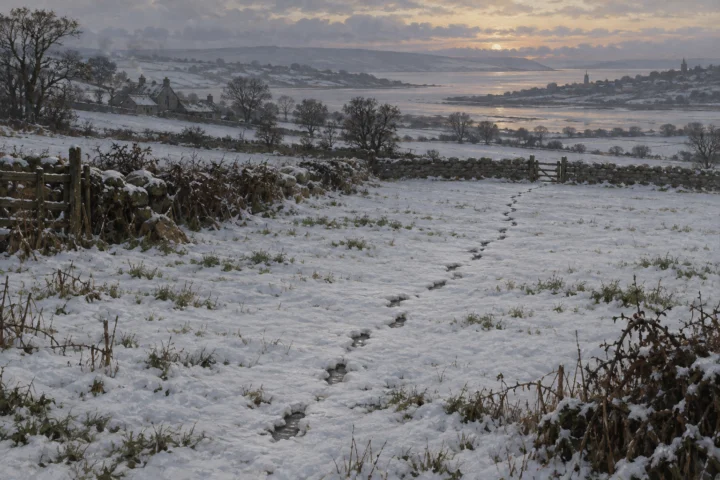
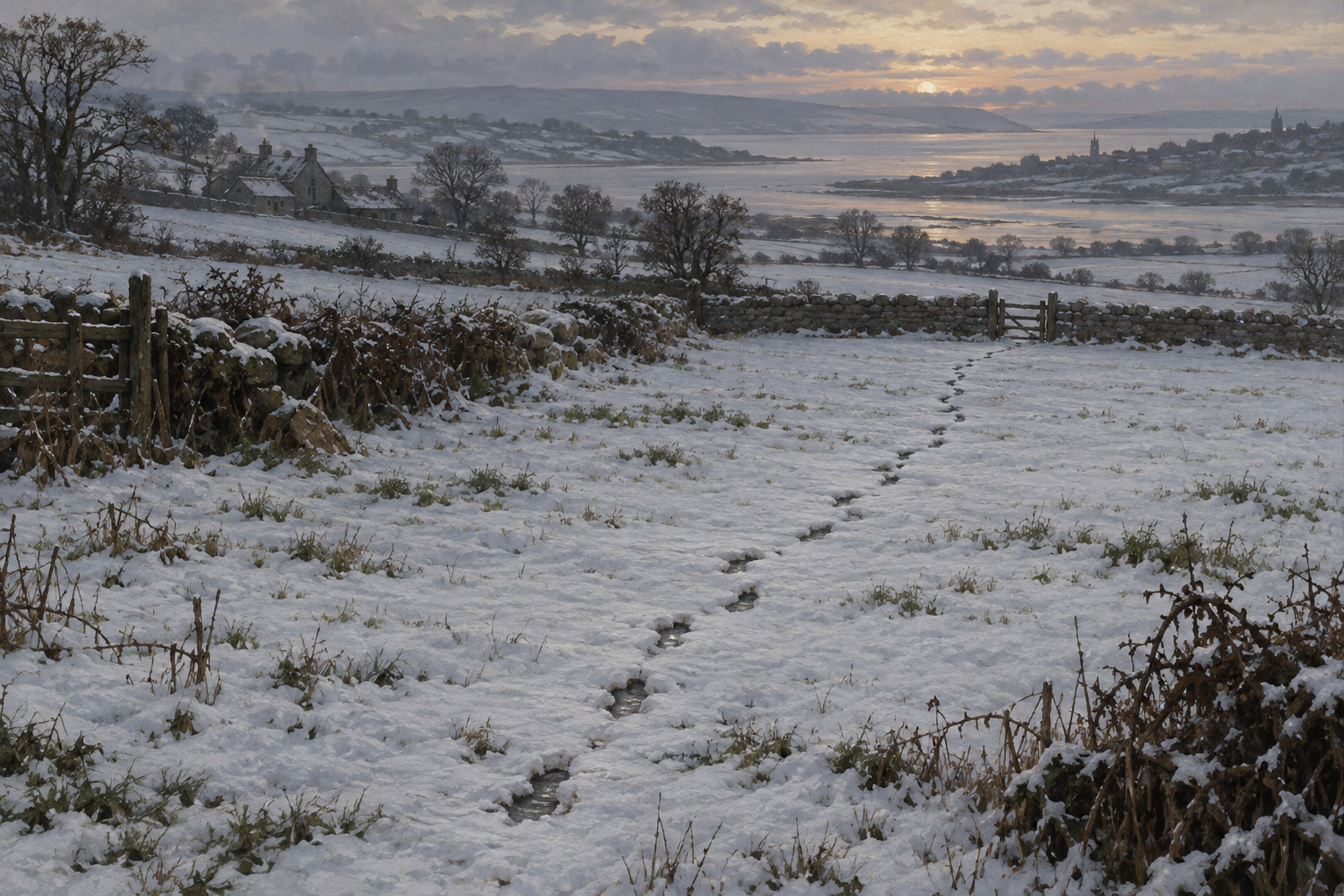
On the morning of 9 February 1855, people around the Exe estuary found lines of small marks in fresh snow. Reports came from Exmouth, Lympstone, Dawlish and neighbouring communities. Some tracks resembled a cloven hoof; others showed claws or a less definite outline. Their regular spacing and single-file appearance made them look stranger than an ordinary animal trail.
The phenomenon became the Devil’s Footprints because the most dramatic reports placed marks on roofs, beyond walls and on opposite sides of the River Exe. Yet no observer followed one unbroken trail around the region. The famous hundred-mile journey was an inference made by joining separate reports, not a measured route left by a single creature.
Snow can merge paired prints, preserve only parts of a gait and change under thaw and refreeze. Mice, birds, badgers, otters and other animals were proposed at the time. Several animals and several kinds of altered track offer a better fit than one impossible traveller, though the surviving record cannot identify every trail.
The case sits between the circulation of strange news, the separation of evidence from legend and the older landscape tradition of phantom black dogs.
Claim, Context and Cautions
The morning after the snow
Snow fell late on 8 February during an exceptionally hard winter, followed in places by rain and renewed frost. By morning, residents were examining repeated marks across gardens, lanes and fields. Local alarm was real: tracking parties followed some trails for miles, while letters and sketches began moving between clergy, naturalists and newspapers.
The weather matters because tracks are records made twice—first by an animal and then by snow as it settles, melts and freezes. A print that began as toes, paws or two overlapping steps can finish as a compact oval or apparent hoof.
One mystery assembled from many trails
The strongest version describes identical marks crossing thirty or forty miles of country and implying a journey of more than one hundred miles. That total came from connecting observations in different places. The longest trail known to have been followed continuously was about five miles, and contemporary tracings varied in size and form.
No surveyor mapped a single line through every parish. The evidence therefore supports widespread puzzling tracks, but not the later picture of one creature completing an exact superhuman itinerary.
What the contemporary record contains
Letters collected by the Reverend H. T. Ellacombe and correspondence published in the Illustrated London News provide the closest material to the event. They include first-hand inspection, tracings and local information, alongside hearsay about rooftops, walls and haystacks. Even direct observers disagreed over whether the marks were cloven or showed claws.
Newspapers then copied and compressed the reports. Repetition across titles can look like independent confirmation when several items ultimately descend from the same letter or correspondent.
Animals proposed in 1855
Suggestions included badgers, otters, rats, mice, birds and an escaped kangaroo. Richard Owen favoured a badger; another correspondent demonstrated how a rodent's gait could leave paired marks that looked hoof-like in snow. None explains every printed detail, particularly if every detail is assumed accurate.
That demand may be the mistake. Different species could have crossed different surfaces during the same night, while weather and storytelling made their trails appear more uniform afterward.
The impossible obstacles
Marks were said to continue over high walls, rooftops and narrow openings, or to stop and resume in open ground. Some animals climb, jump or fly; drifting snow can hide connecting prints; observers may also have joined unrelated sequences. The most extraordinary obstacle reports were not documented by controlled inspection.
These claims are part of the historical story, but their source quality is weaker than the simple fact that many residents saw tracks they could not identify.
A mystery without a single culprit
No preserved specimen, photograph or complete route can now distinguish among the proposed track-makers. The archive is rich enough to reject the tidy hundred-mile legend, but too incomplete to assign every mark to a species.
The Devil's Footprints are best understood as a real episode of unusual snow tracks converted rapidly into one supernatural journey. The uncertainty belongs to the fragmented evidence, not to proof that something literally crossed Devon's roofs on cloven feet.
Contextual glossary
Terms used in this entry
Definitions are offered as reading aids, not as conclusions about the case.
- Uncertainty
- The stated limit on what a measurement, reconstruction or body of evidence can establish. Describing uncertainty is not indecision; it prevents a result from appearing more precise than the evidence allows.
- Hearsay
- An account repeated by someone who did not directly witness the event being described. It may preserve a lead or tradition, but each step between the event and the surviving version increases uncertainty.
Reference trail
Sources
- Mike Dash, The Devil's Hoofmarks: Source Material on the Great Devon Mystery of 1855 (opens in a new tab)Extensive compilation and assessment of contemporary letters, press accounts, tracings and later recollections.
- Illustrated London News reports and correspondence, February–March 1855 (British Online Archives volume) (opens in a new tab)Contemporary illustrated-press context for the published descriptions, drawings and proposed animal explanations.
- Joe Nickell, 'The Devil's Footprints Mystery' (Skeptical Inquirer) (opens in a new tab)Modern critical discussion of the contemporary record, track morphology and multiple-animal explanations.
- Wikimedia Commons, composite of Illustrated London News Devil's Footprints figures (opens in a new tab)Public-domain reproduction identifying the figures published on 24 February and 3 March 1855.
Case Book
Photographs, Maps and Supporting Images
Supporting images provide documentary, geographic or visual context. Read each caption for its date, source and evidential limits.

Continue researching
Follow the evidence, context and comparisons
Curated connections
Selected editorially for this entry.
Old newspapers preserved remarkable local reports, but they also shaped them for appetite, humour and alarm.
Curated connection · ArticleThe Difference Between Evidence, Testimony and LegendA field guide to three words that often get tangled in mystery research.
Curated connection · ArticleWhy Phantom Black Dogs Haunt So Many Local LegendsBlack dog stories reveal how roads, boundaries, danger and memory gather into a repeated supernatural form.