UFOs & Aerial Phenomena
Pilot Reports and the Problem of Expert Perception
Trained observers matter, but expertise does not remove ambiguity from distance, speed, glare and surprise.
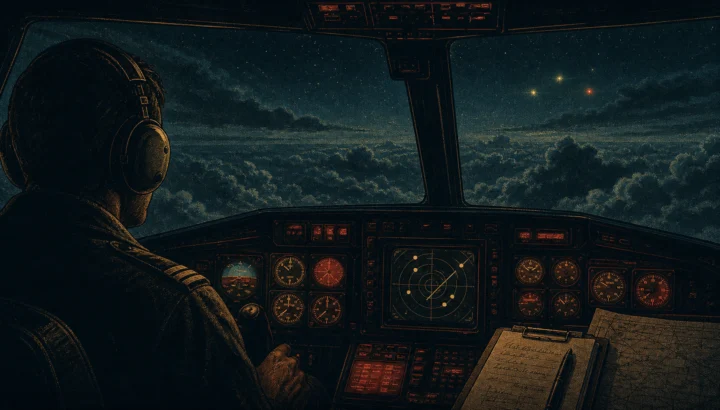
A pilot report should never be waved away because the witness was looking from a cockpit, and it should never be treated as conclusive because the witness was a pilot. Training improves recognition, reporting discipline and knowledge of the working sky. It does not supply distance to an isolated light, remove glare from a canopy or free a crew member from the demands of flying an aircraft.
The useful position lies between automatic belief and automatic dismissal. Ask what the pilot’s expertise could genuinely establish, what the viewing conditions withheld, and which records survived beyond memory.
What pilot expertise adds
Pilots routinely interpret navigation lights, approach patterns, cloud structures, weather radar, cockpit instruments and radio instructions. They know how ordinary traffic behaves in controlled airspace. A report made promptly may be tied to an exact aircraft position, altitude, heading and time. Air-traffic recordings, radar tracks, flight plans, weather observations and accounts from other crew can turn a fleeting sighting into a testable event.
Expertise is strongest when it is specific. A pilot identifying a familiar aircraft type at a useful distance is applying trained recognition. A pilot describing an unfamiliar point of light without range information is confronting many of the same limits as a ground observer. Rank and experience cannot recover measurements that were never available.
Visual traps inside a cockpit
Night flying removes a dependable horizon and reduces the scene to scattered lights. FAA training material treats false horizons and autokinesis as operational hazards, not curiosities. Autokinesis makes a stationary light appear to move after prolonged fixation in darkness. A sloping cloud bank, shoreline or pattern of ground lights can be mistaken for the horizon.
Relative motion creates another trap. If two aircraft hold nearly constant bearings, the other aircraft may seem stationary even while the distance closes. A turn by either aircraft can make the light appear to dart sideways. Without range, an apparent climb or acceleration may be only a change in viewing geometry.
Canopies and windscreens introduce reflections, double images and internal glare. Instrument lighting, a tablet, a cabin light or another crew member’s device can produce a luminous shape that moves with head position. At altitude, thin cloud or ice can diffuse lights. Infrared and other sensors add their own limits: blooming, contrast enhancement, stabilisation and parallax can make recorded motion look unlike physical motion.
Workload and memory
A cockpit is not an observation platform with no other purpose. A pilot may be communicating, navigating, monitoring weather, managing systems and maintaining separation while an unexpected light appears. Attention is selective under workload. The emotional core of an event may be retained clearly while angle, duration or sequence changes during later retelling.
That is why first reports matter. Compare the pilot’s initial radio call or written statement with later interviews. Extra detail is not automatically false, but a feature first mentioned years later should not carry the same evidential weight as a description recorded at the time.
How to read an aviation mystery
- Fix the platform: aircraft position, altitude, heading, speed and attitude at the time.
- Fix the sightline: which window, bearing relative to the nose, angle above or below the horizon, and whether the view crossed a canopy.
- Separate systems: visual observation, radar return and infrared image are different evidence streams. Determine whether they tracked the same thing.
- Preserve timing: compare radio logs, flight data, weather and nearby traffic using a common clock.
- Test geometry: apparent motion, especially in video, should be checked against movement of the observing aircraft and camera.
- Compare accounts: independent crew descriptions are more useful than a group account agreed after discussion.
Cases that show the distinction
The Rendlesham Forest witnesses were trained military personnel, though not airborne observers. Their status makes the documentation important; it does not merge observations from separate nights or settle the identity of every light. The Battle of Los Angeles similarly involved military observers and equipment operating under pressure. Authority increased the consequences of uncertainty without necessarily resolving it.
AARO’s published Eglin resolution offers a more recent example of method. Its analysis considered a pilot account, flight geometry, sun angle, wind and comparison testing before assessing the object as likely lighter-than-air. The useful lesson is not that every pilot report is a balloon. It is that expertise becomes most persuasive when joined to geometry and independent records.
Respect without overreach
Pilot reports deserve careful investigation because they may preserve unusually rich operational context. They also demonstrate why “expert witness” is not a substitute for a chain of evidence. The strongest response respects the observer, reconstructs the conditions and allows the conclusion to remain uncertain when the record cannot support more.
Contextual glossary
Terms used in this entry
Definitions are offered as reading aids, not as conclusions about the case.
- Radar return
- Energy received by radar after a transmitted pulse interacts with a target or the environment. A plotted return requires interpretation and can represent an aircraft, weather, terrain, interference or anomalous propagation.
- Infrared
- Electromagnetic radiation with wavelengths longer than visible red light. Infrared sensors can record heat-related or reflected signals, but the colours in a displayed image are often assigned during processing.
- Uncertainty
- The stated limit on what a measurement, reconstruction or body of evidence can establish. Describing uncertainty is not indecision; it prevents a result from appearing more precise than the evidence allows.
- Parallax
- An apparent shift in an object’s position when viewed from different locations. Without a known distance, observers in separated positions may infer misleading size, speed or alignment.
- Bearing
- A direction measured clockwise from north, usually in degrees. A bearing gives a line of direction rather than a distance; two or more reliable bearings may help locate a source.
Reference trail
Sources
- FAA Airplane Flying Handbook: Night Operations (opens in a new tab)Official discussion of night vision, false horizons, autokinesis and aircraft-light recognition.
- FAA: Aeromedical Safety Brochures (opens in a new tab)Official pilot material on vision, fatigue and spatial-disorientation hazards.
- AARO: Eglin UAP Case Resolution (opens in a new tab)A worked official example using pilot testimony, geometry, wind, sun angle and comparison testing.
Case Book
Photographs, Maps and Supporting Images
Supporting images provide documentary, geographic or visual context. Read each caption for its date, source and evidential limits.

Continue researching
Follow the evidence, context and comparisons
Curated connections
Selected editorially for this entry.
Rendlesham remains one of the most famous UFO cases in Britain because it produced sightings, notes and later arguments in the shadow of a military base.
Curated connection · Case fileThe Battle of Los Angeles: Searchlights, Shells and Wartime NervesIn February 1942, Los Angeles saw searchlights, anti-aircraft fire and rumours of enemy aircraft in a case where fear, weather and uncertainty lit up the sky.
Curated connection · ArticleHow Ordinary Lights Become Extraordinary UFO ReportsAircraft, satellites, planets, drones and atmospheric effects can become strange when context is missing.
More through shared context
Additional routes based only on existing topics, themes and metadata.
The crew’s visual report was real and professionally documented. Radar returns were intermittent and disputed, while darkness, cloud and uncertain distance made size estimates especially fragile.
Same primary topic · Shared theme: Aviation, Witness & memory · Case fileKenneth Arnold: The Sighting That Named the Flying SaucerKenneth Arnold’s 1947 report helped launch the modern flying-saucer era. His observation was sincere and carefully timed, but distance and object identity were never independently secured.