Investigation & Evidence
A Field Guide for Recording Strange Experiences Responsibly
A calm checklist for writing down unusual events before memory, excitement and online feedback reshape them.
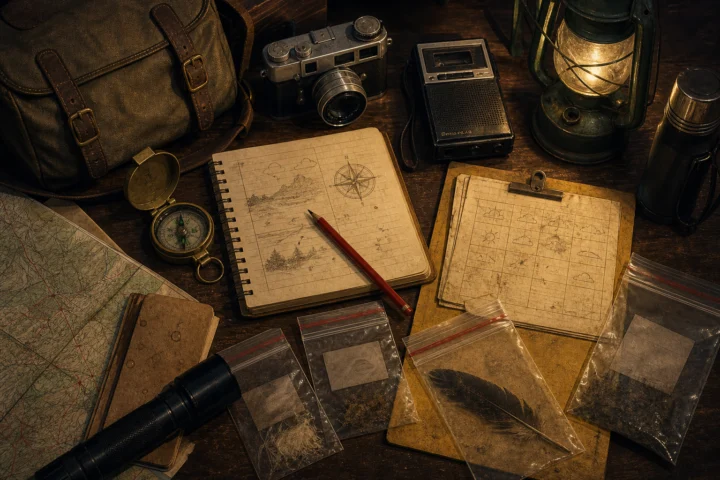
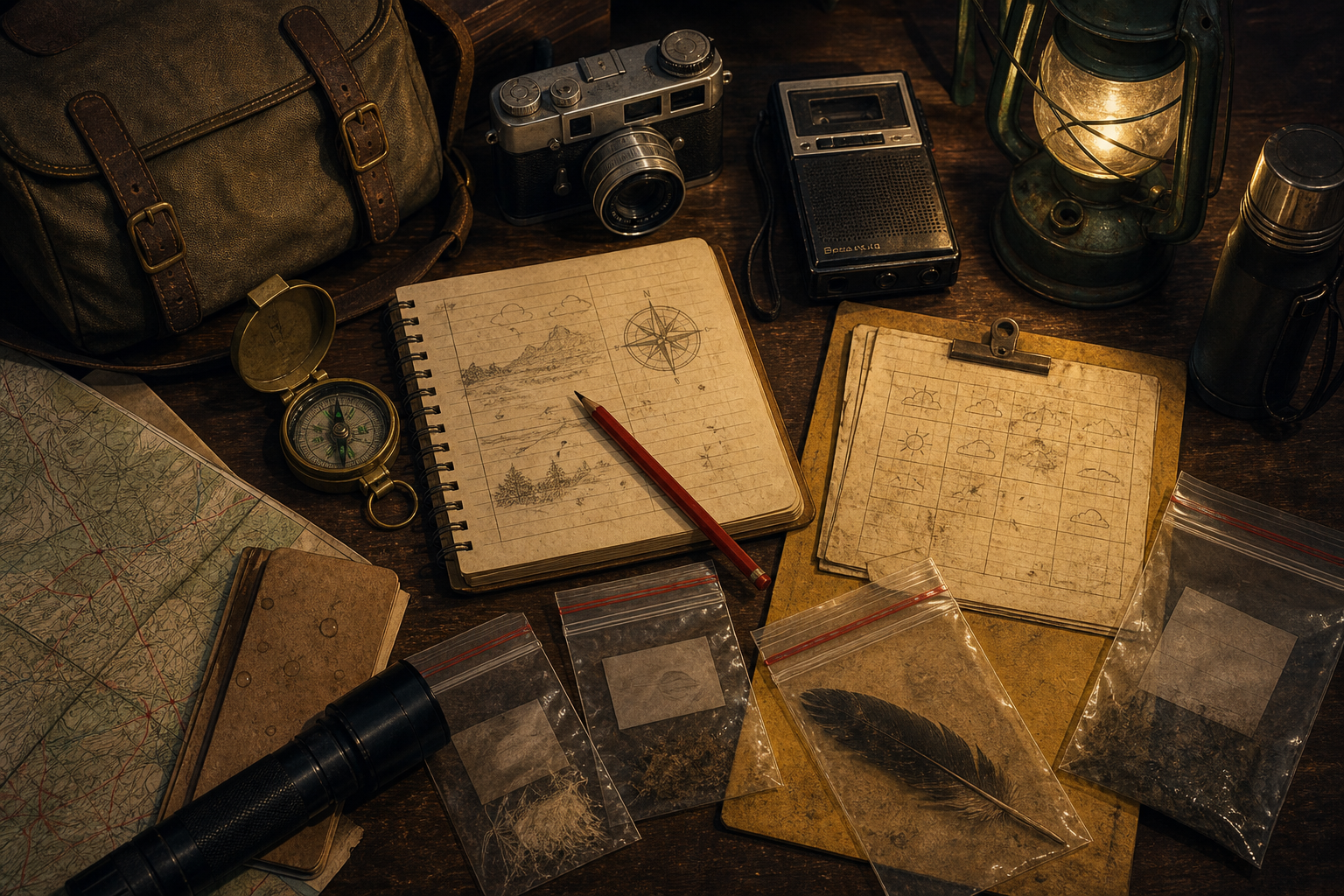
A strange experience is easiest to distort in the first hour after it happens. Excitement, fear, group discussion and online searching can all turn a raw observation into a polished story before the useful details have been recorded. The goal of a field note is not to explain the event immediately. It is to keep the first version intact.
Write before you interpret. A useful note can still leave room for mystery, but it should preserve enough ordinary context that someone else can test the report later. The best strange reports are not the loudest ones; they are the ones that still have dates, directions, weather, witnesses and original files attached.
Start with the plain facts
Record the date, time, location and duration. Add the direction you were facing, where the sound or object seemed to come from, and what was happening immediately before the event. If the report involves a light in the sky, note compass direction, height above the horizon, cloud cover and whether nearby aircraft, satellites or planets were checked. The article on ordinary lights becoming UFO reports is a useful companion for that kind of sighting.
If the report involves a place, describe the layout. A staircase, corridor, window, road bend or treeline can matter more than atmosphere. For household sounds or possible hauntings, sketch the rooms, doors, heating pipes, windows and neighbouring walls. The point is not to debunk the experience before it is understood. It is to stop the setting from vanishing.
What to write down
- Exact time, date and time zone.
- Location, including nearest road, room, landmark or viewing point.
- Weather, visibility, temperature, wind and recent changes.
- Who was present, where each person was standing and what each person noticed first.
- What was seen, heard, felt or smelled, in the order it happened.
- How long the event lasted, using a clock if possible rather than a guess.
- Any photographs, audio, video, screenshots or original files.
- Possible ordinary causes already checked.
- What you believed about the place or topic before the event.
What to photograph
Take a wide shot first. Close crops are dramatic but often useless. Photograph the full scene, then the specific area of interest, then the surrounding context. For a window-face image, that means the whole building, the window, the angle of the camera, reflective surfaces and any interior light sources. The Window Face Photograph case shows why originals, angles and reflections matter more than enlarged screenshots.
Preserve original files. Do not overwrite, filter, sharpen or compress the only copy. If you share a version online, keep the untouched file separately. Metadata, sequence numbers and surrounding photos can be more valuable than the image that looks most mysterious.
What not to assume
Do not assume sincerity proves accuracy. Do not assume an ordinary explanation means a witness was foolish. Do not assume a local legend caused the event, or that the event proves the legend. The best working position is patient uncertainty: something was reported, the report has conditions, and those conditions can be examined.
A simple field-note structure
Use this order when writing up a report: observation, context, witnesses, media, checks already made, possible explanations, unresolved points. Keep emotional impressions, such as fear or certainty, but label them as impressions. A good archive note can say “I felt watched” without turning that feeling into proof that someone was there.
Why this matters
Good notes protect mystery from bad evidence. They also protect witnesses from having their experience flattened into belief, ridicule or content. Devil’s Hideout is interested in reports that can be read carefully. A field note is how that care begins.
Contextual glossary
Terms used in this entry
Definitions are offered as reading aids, not as conclusions about the case.
- Uncertainty
- The stated limit on what a measurement, reconstruction or body of evidence can establish. Describing uncertainty is not indecision; it prevents a result from appearing more precise than the evidence allows.
- Metadata
- Information stored about a record, such as its creation time, device, location, format or editing history. Metadata can support provenance but may be missing, altered or copied incorrectly.
- UFO
- Unidentified flying object, historically used for an aerial observation that remains unidentified at the time of reporting. In popular culture it often implies a spacecraft, which is a separate claim.
Reference trail
Sources
- Oral History Society: Legal and ethical advice (opens in a new tab)Practical guidance on consent, responsible interviewing, preservation and the treatment of personal testimony.
- US National Archives: Digital photographic records (opens in a new tab)Detailed guidance on retaining original image files, captions, technical metadata and rights information.
- US National Archives: Digitizing family papers and photographs (opens in a new tab)Accessible advice on filenames, basic who-what-where-when metadata and maintaining multiple backups.
Case Book
Photographs, Maps and Supporting Images
Supporting images provide documentary, geographic or visual context. Read each caption for its date, source and evidential limits.
Continue researching
Follow the evidence, context and comparisons
Curated connections
Selected editorially for this entry.
A practical guide to separating atmosphere, testimony, memory, environment and possible causes in a reported haunting.
Curated connection · ArticleSleep Paralysis, Ghosts and the Edge of WakingA terrifying human experience sits at the crossroads of neurology, folklore, bedroom architecture and belief.
Curated connection · ArticleThe Difference Between Evidence, Testimony and LegendA field guide to three words that often get tangled in mystery research.
More through shared context
Additional routes based only on existing topics, themes and metadata.
Aircraft, satellites, planets, drones and atmospheric effects can become strange when context is missing.
Shared theme: Witness & memory · Same country or region · ArticlePilot Reports and the Problem of Expert PerceptionTrained observers matter, but expertise does not remove ambiguity from distance, speed, glare and surprise.