UFOs & Aerial Phenomena
How Ordinary Lights Become Extraordinary UFO Reports
Aircraft, satellites, planets, drones and atmospheric effects can become strange when context is missing.
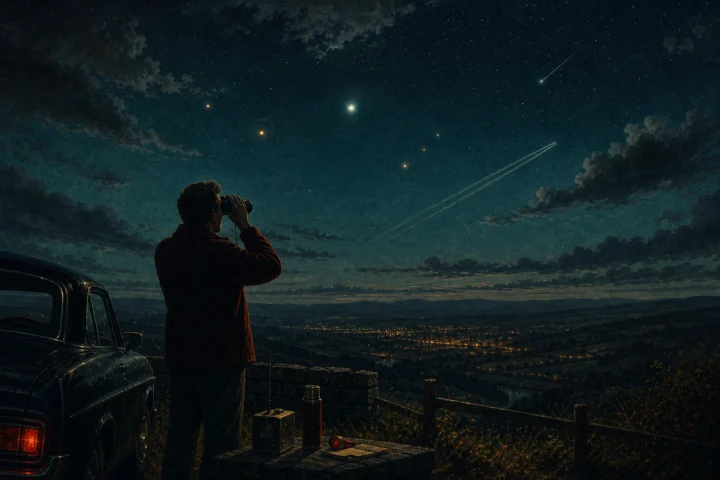
A light over a dark horizon contains almost none of the information we normally use to recognise an object. There may be no visible surface, no fixed scale, no reliable distance and no horizon sharp enough to measure movement against. A witness can describe the light accurately and still misjudge what produced it. That is not a failure of honesty or intelligence; it is the normal cost of trying to read a three-dimensional sky from one viewpoint.
The first useful question is therefore not “What did it look like?” but “What information was available?” Direction, elevation, duration, weather, viewing angle and independent records often matter more than colour or apparent shape. When those details are missing, surprise supplies a story faster than evidence can supply an identification.
Why the night sky removes scale
A small nearby object and a large distant object can occupy the same apparent size. Without knowing distance, apparent speed is equally unstable. A light moving slowly nearby may cross the observer’s field of view faster than an aircraft travelling hundreds of kilometres per hour far away. An aircraft approaching nearly head-on can appear stationary because its bearing changes very little. When it turns, its landing lights may dim abruptly and create the impression that it accelerated or vanished.
Sound is a poor instant check. Wind, terrain and distance delay or redirect it. A witness may see an aircraft before hearing it, or never connect a later engine sound with the earlier light. Through a window, reflections add another plane of movement: an indoor lamp or phone screen can appear against the outdoor sky and move when the witness moves.
Ordinary sources that become extraordinary
Aircraft change appearance as navigation, anti-collision and landing lights rotate into view. A bank can hide one light and expose another. Stacked aircraft on an approach path may look like a formation of stationary points.
Satellites usually move steadily and silently. A group launched together can form a striking line. A satellite can brighten as its surfaces reflect sunlight, then disappear when it enters Earth’s shadow. That change is dramatic to someone expecting a continuously illuminated object.
Planets and stars are most troublesome near the horizon, where atmospheric turbulence can make them flicker, change colour or seem to move. Venus is brighter than any other planet seen from Earth. Thin cloud can repeatedly hide and reveal it, while involuntary eye movement can make a fixed point seem mobile when there are no nearby references.
Drones, balloons and lanterns follow wind or operator-controlled paths that do not resemble conventional aircraft. Balloons can change apparent form as they rotate. Flares descend, drift and fade; viewed without a known firing point or exercise area, their slow motion can seem deliberate.
Weather and optical effects reshape light rather than create a craft. Ice crystals produce haloes and pillars; layers of air with different temperatures bend light from distant sources; low cloud scatters beams from the ground. These effects are unusual enough to deserve attention without requiring an unusual vehicle.
Two archive examples
During the Battle of Los Angeles, searchlights, smoke, anti-aircraft fire and wartime expectation turned an uncertain target into a city-wide emergency. The case does not reduce to one misidentified lamp, but it shows how fear and poor visibility can multiply interpretations faster than evidence.
At Rendlesham Forest, several observations, official paperwork and later testimony produced a much denser record. That density makes the case worth studying, but it does not remove the need to separate events by night, witness and time of recording. A bright source seen through trees, a later inspection of marks and a retrospective claim are not one continuous observation.
A field checklist for a light report
- Record the exact start and end time before checking social media or discussing an explanation.
- Mark the direction faced and estimate elevation above the horizon using a fist or hand-width at arm’s length.
- Describe movement against a fixed landmark, not with words such as “fast” or “hovering” alone.
- Note cloud, haze, wind, precipitation and whether the view was through glass.
- Record sound separately, including any delay after the object disappeared.
- Ask witnesses to write independent accounts before comparing details.
- Check flight paths, satellite passes, bright planets, launches, fireworks and local events for the same time and direction.
- Keep the original photograph or video with metadata and an uncropped view showing the surroundings.
What “unidentified” should mean
Official resolution data provide a useful corrective to the idea that ordinary explanations are merely dismissive guesses. AARO’s published closed-case outcomes include balloons, satellites, uncrewed aircraft, conventional aircraft, birds and sensor artefacts. Some reports remain unresolved because the evidence is insufficient, not because extraordinary performance has been demonstrated.
A good archive allows that distinction to stand. A report may be sincere, detailed and genuinely unidentified. It becomes evidence for a specific extraordinary claim only when the observations exclude ordinary sources and preserve enough context for independent testing. Curiosity starts the file; disciplined uncertainty keeps it useful.
Contextual glossary
Terms used in this entry
Definitions are offered as reading aids, not as conclusions about the case.
- UFO
- Unidentified flying object, historically used for an aerial observation that remains unidentified at the time of reporting. In popular culture it often implies a spacecraft, which is a separate claim.
- Uncertainty
- The stated limit on what a measurement, reconstruction or body of evidence can establish. Describing uncertainty is not indecision; it prevents a result from appearing more precise than the evidence allows.
- Metadata
- Information stored about a record, such as its creation time, device, location, format or editing history. Metadata can support provenance but may be missing, altered or copied incorrectly.
- Bearing
- A direction measured clockwise from north, usually in degrees. A bearing gives a line of direction rather than a distance; two or more reliable bearings may help locate a source.
Reference trail
Sources
- AARO: UAP Reporting Trends (opens in a new tab)Official closed-case resolution categories and reporting data.
- NASA Science: Skywatching FAQ (opens in a new tab)Practical context on planet brightness and observing the night sky.
- Met Office: Optical effects - nature’s light show (opens in a new tab)Explanation of atmospheric reflection, refraction, scattering and diffraction.
- FAA Airplane Flying Handbook: Night Operations (opens in a new tab)Official guidance on night vision, aircraft lights and visual illusions.
Case Book
Photographs, Maps and Supporting Images
Supporting images provide documentary, geographic or visual context. Read each caption for its date, source and evidential limits.

Continue researching
Follow the evidence, context and comparisons
Curated connections
Selected editorially for this entry.
Rendlesham remains one of the most famous UFO cases in Britain because it produced sightings, notes and later arguments in the shadow of a military base.
Curated connection · Case fileThe Battle of Los Angeles: Searchlights, Shells and Wartime NervesIn February 1942, Los Angeles saw searchlights, anti-aircraft fire and rumours of enemy aircraft in a case where fear, weather and uncertainty lit up the sky.
Curated connection · ArticlePilot Reports and the Problem of Expert PerceptionTrained observers matter, but expertise does not remove ambiguity from distance, speed, glare and surprise.
More through shared context
Additional routes based only on existing topics, themes and metadata.
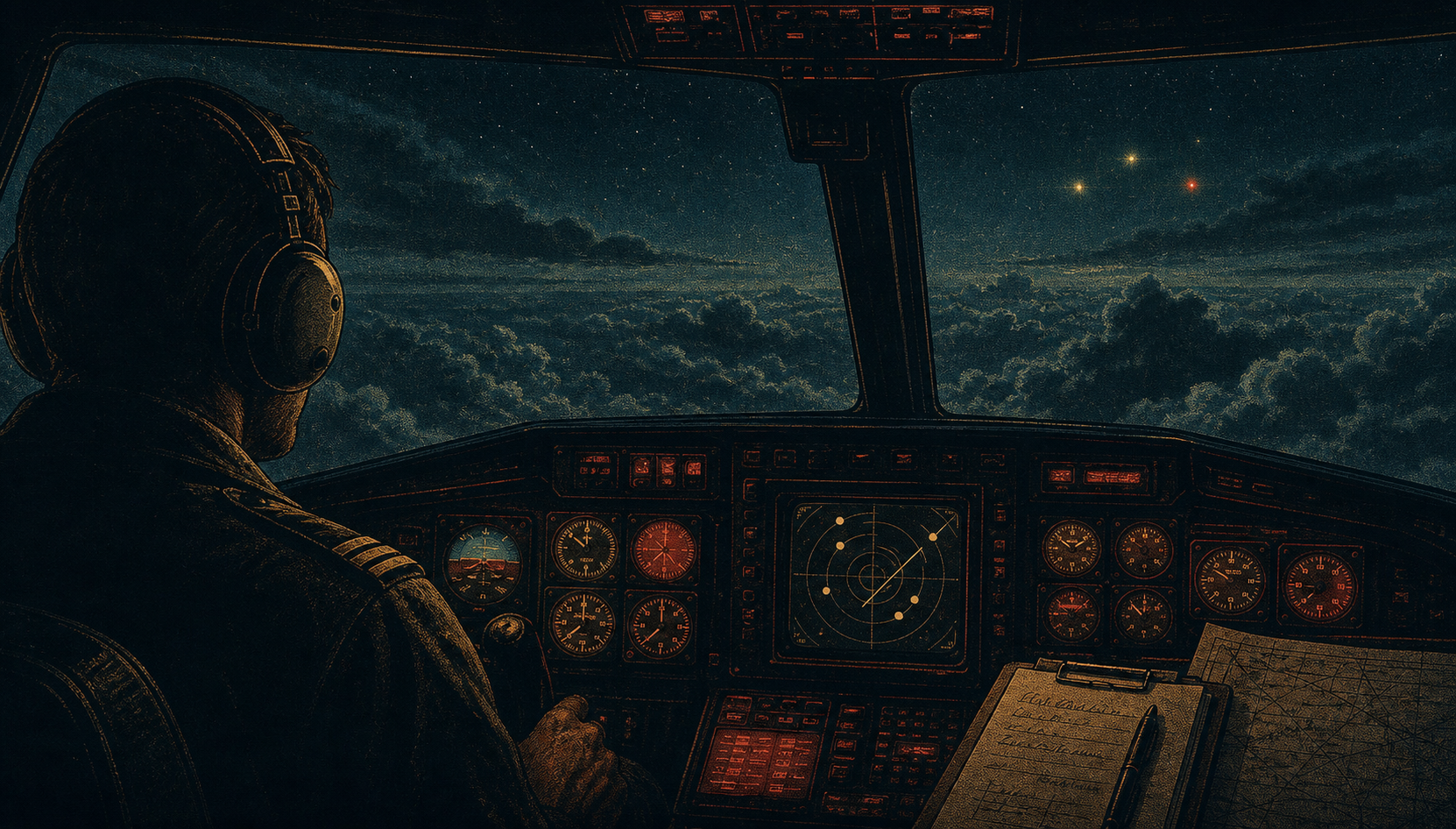
The crew’s visual report was real and professionally documented. Radar returns were intermittent and disputed, while darkness, cloud and uncertain distance made size estimates especially fragile.
Same primary topic · Shared theme: Witness & memory · Case fileKenneth Arnold: The Sighting That Named the Flying SaucerKenneth Arnold’s 1947 report helped launch the modern flying-saucer era. His observation was sincere and carefully timed, but distance and object identity were never independently secured.