Hauntings & Apparitions
The Rosenheim Poltergeist: Electrical Faults in a Bavarian Office
Rosenheim is remembered as an instrumented poltergeist case. Surviving reports document disruptive events and investigation, while gaps in control and opportunities for manipulation prevent a secure paranormal conclusion.
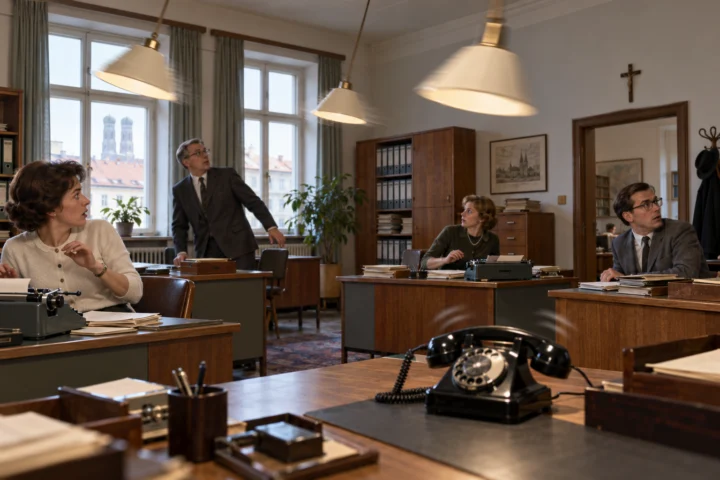
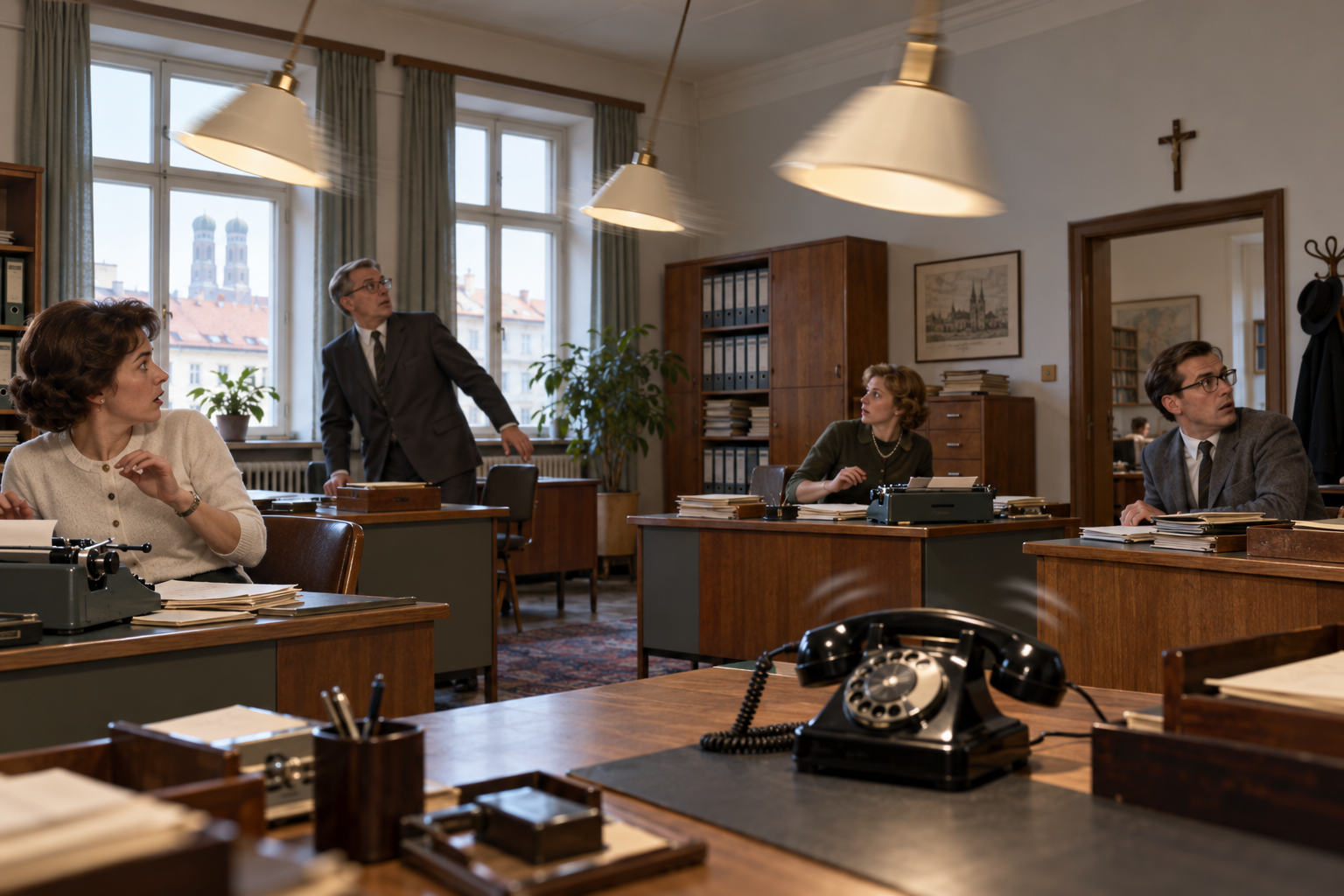
In late 1967, a law office in Rosenheim, Bavaria, experienced repeated electrical and telephone disturbances. Fluorescent tubes failed, fuses tripped and the office bill showed many calls to the speaking clock. Witnesses later reported hanging lamps swinging and pictures rotating. The disturbances became associated with a nineteen-year-old clerk, Annemarie Schneider.
Electricity supplier technicians installed monitoring equipment and replaced parts of the system. Physicist Friedbert Karger and parapsychologist Hans Bender investigated, publishing charts and descriptions. The case became famous because instruments appeared to move it beyond the usual collection of knocks and memories.
Instruments, however, record only what reaches them. The surviving publications document voltage or current events and unusual telephone accounting, but they do not continuously show every person, cable and object at the same moment. Investigators acknowledged that some later object movements could be produced by trickery; critics disputed the controls and interpretations.
Rosenheim can be read alongside the archive’s anatomy of a haunting report, the contested observations at Enfield, and the prolonged domestic narrative of the Battersea Poltergeist.
Claim, Context and Cautions
A workplace under strain
The first problems were practical: failed lights, damaged equipment and telephone charges. Their concentration in a functioning office brought in utilities and technicians before the story was wholly paranormal. Reports say disruptions clustered around Annemarie and diminished after she left employment.
Correlation with one person's presence can guide an investigation, but it does not identify a mechanism. Schedule, access, attention and reporting also follow that person and must be separated from an alleged psychokinetic effect.
What the instruments added
Monitoring offered timestamps and traces that ordinary witness recollection could not. Published charts were interpreted as abrupt electrical deviations, while checks reportedly found no adequate defect in the supply network. Telephone investigators examined the repeated number registrations.
Yet the published record is a selection assembled by interested investigators. Without continuous independent observation of the entire system, a chart cannot exclude local interference, undocumented operation or a fault that was missed. Measurement strengthens the event record more than it establishes causation.
Movement, observation and opportunity
Accounts expanded from electrical disruption to swinging lamps, displaced furniture and rotating pictures. Some events reportedly occurred before groups of visitors; others were reconstructed from staff testimony. Photographs show outcomes or motion blur, not an invisible force.
Critics argued that ordinary manipulation was possible and that attention centred on a troubled employee. Bender maintained that the central pattern could not be reduced to fraud while conceding suspect episodes. That mixed assessment is often lost when the case is advertised as either laboratory proof or complete exposure.
Why the cause remains unresolved
Rosenheim contains better documentation than many haunting stories, but it was an uncontrolled workplace, not a designed experiment. Investigators entered after disturbances began, equipment changed during inquiry, and the most spectacular claims did not yield a reproducible effect under conditions excluding human action.
A cautious verdict preserves three layers: reported experiences, instrumented irregularities, and the paranormal explanation offered for them. The first two have historical documentation. The third was never independently demonstrated. The case therefore remains uncertain, with technical faults, deliberate acts, expectation and investigator interpretation all relevant to the surviving record.
Contextual glossary
Terms used in this entry
Definitions are offered as reading aids, not as conclusions about the case.
- Poltergeist
- A cluster of reported noises, object movement or disruption traditionally attributed to an unseen agency. Cases require attention to household dynamics, access, building conditions and witness timing.
- Motion blur
- Smearing recorded when the camera or subject moves during an exposure. It can enlarge lights, erase outlines and turn an ordinary object into an unfamiliar shape.
- Correlation
- A pattern in which two things vary together. Correlation can suggest a question to investigate, but it does not show that one caused the other.
- Haunting
- A pattern of unusual experiences attributed to a place, including apparitions, sounds, movement or sensed presences. A location log is more informative than treating every incident as one cause.
Reference trail
Sources
- University of Pennsylvania, Poltergeist Phenomena: A Primer (opens in a new tab)Academic-hosted review discussing the evidential and methodological problems of poltergeist investigations, including Rosenheim.
- IGPP, Journal for Parapsychology and Border Areas of Psychology (opens in a new tab)Institutional index and publication history for the journal in which the contemporary case documentation appeared.
- Poltergeist Archive, Rosenheim 1967 (opens in a new tab)English access reproduction of Bender’s contemporary case account, used with the original journal archive and treated as an investigator narrative.
Case Book
Photographs, Maps and Supporting Images
Supporting images provide documentary, geographic or visual context. Read each caption for its date, source and evidential limits.

Continue researching
Follow the evidence, context and comparisons
Curated connections
Selected editorially for this entry.
A practical guide to separating atmosphere, testimony, memory, environment and possible causes in a reported haunting.
Curated connection · Case fileThe Enfield Poltergeist: Noise, Narrative and the Council House on Green StreetThe Enfield case remains famous because it was recorded, argued over and repeatedly reinterpreted, which makes it a perfect archive for uncertainty.
Curated connection · Case fileThe Battersea Poltergeist: Taps, Notes and a Long InvestigationFrom 1956, the Hitchings family reported household disturbances attributed to “Donald”. Investigator Harold Chibbett kept a large record, while ordinary access and weak controls left human agency unresolved.