Hauntings & Apparitions
The Drummer of Tedworth: A Restoration Haunting in Competing Texts
The Tedworth disturbances are preserved through partisan Restoration-era accounts rather than a neutral investigation. Noises were reported, but fraud, household performance and supernatural interpretation cannot now be separated decisively.
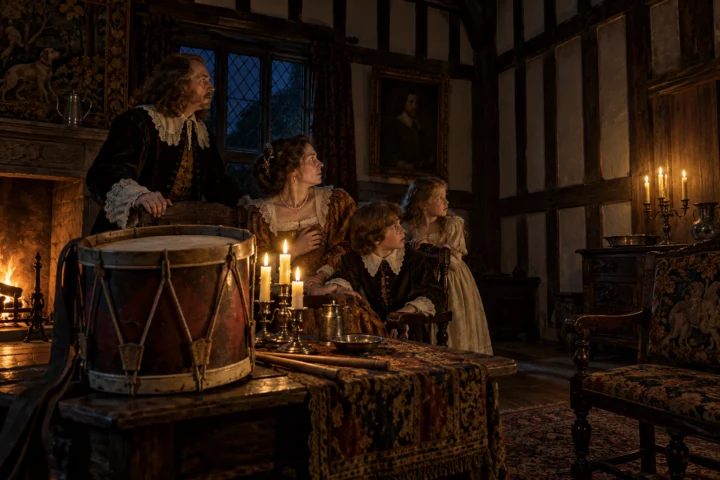
In 1662 magistrate John Mompesson acted against an itinerant drummer named William Drury and received the man’s confiscated drum. According to later accounts, Mompesson’s house at Tedworth soon filled with nocturnal drumming, scratching, bed movements and disturbances focused around the children.
Clergyman and natural philosopher Joseph Glanvill visited and published the case while defending the reality of spirits and witchcraft. He reported hearing scratching beneath a bed and presented the household as reluctant, respectable witnesses. His account made Tedworth one of England’s foundational poltergeist stories.
Glanvill was not a detached modern investigator. The case served an argument against religious and philosophical sceptics, and publication rewarded a coherent supernatural narrative. Earlier manuscript accounts located by historian Michael Hunter show changes in emphasis and a more contested response than the famous printed version suggests.
Drury was accused of causing the trouble by witchcraft, but the noises continued through shifting circumstances and no physical mechanism was established. Servants, children, visitors and household tensions supply possible routes for performance or misinterpretation without identifying one proven hoaxer.
Tedworth belongs beside Epworth Rectory’s family letters, the sound-making claims of the Fox Sisters, and the reporting framework in the anatomy of a haunting report.
Claim, Context and Cautions
The confiscated drum
The drum gives the story a memorable cause and a suspected agent. Yet possession of the object does not connect Drury physically to later noises, and an accusation of witchcraft in Restoration England carried legal and social assumptions unlike a modern causal test.
The narrative symmetry may be historical fact, later organisation or both: a drummer is punished, then invisible drumming punishes the magistrate.
What Glanvill observed
Glanvill described sounds during his visit but relied on the household for much of the longer sequence. Hearing scratching without locating its source is direct testimony to a noise, not direct observation of a spirit. His intellectual purpose encouraged him to treat credible testimony as evidence against materialist scepticism.
That context does not prove fabrication; it clarifies the inference he wanted readers to draw.
Conflicting early narratives
Archival manuscripts show that accounts circulated before the polished book and that attitudes evolved. Details added, disappeared or acquired stronger theological framing. Comparing versions is more informative than treating the latest and fullest text as automatically best.
The case therefore documents Restoration debates about providence, witchcraft and trust as clearly as it documents alleged household phenomena.
Fraud, noise and uncertainty
Wooden buildings transmit animal movement, plumbing, wind and activity from rooms in misleading ways. Deliberate knocking requires little equipment, especially when observers search separately. But no surviving demonstration assigns all reported effects to a named person.
Tedworth remains disputed because the sources are rich yet purpose-driven. They establish a celebrated claim, visits and a publication history. They cannot recover controlled conditions or decide whether every sound shared one natural, fraudulent or supernatural cause. The household's social hierarchy also matters. Children and servants could be questioned or accused without equal power to shape the printed account, while elite visitors controlled publication. Modern readers should therefore ask whose statements survive, who paraphrased them and which failed observations were omitted from the final narrative.
Contextual glossary
Terms used in this entry
Definitions are offered as reading aids, not as conclusions about the case.
- Primary source
- Material close to the event or subject, such as an original letter, photograph, recording, official file, object or firsthand account. “Primary” describes proximity, not guaranteed accuracy.
- Uncertainty
- The stated limit on what a measurement, reconstruction or body of evidence can establish. Describing uncertainty is not indecision; it prevents a result from appearing more precise than the evidence allows.
- Haunting
- A pattern of unusual experiences attributed to a place, including apparitions, sounds, movement or sensed presences. A location log is more informative than treating every incident as one cause.
- Poltergeist
- A cluster of reported noises, object movement or disruption traditionally attributed to an unseen agency. Cases require attention to household dynamics, access, building conditions and witness timing.
Reference trail
Sources
- Michael Hunter, New light on the Drummer of Tedworth (opens in a new tab)Peer-reviewed study of newly examined early texts and the case’s changing narratives.
- Glanvill, Saducismus Triumphatus, digitised volume (opens in a new tab)Public-domain scan of the influential primary printed source.
- Engole, Drummer of Tedworth source overview (opens in a new tab)Historical overview linking the 1668 and 1681 publications and identifying the primary printed sources.
Case Book
Photographs, Maps and Supporting Images
Supporting images provide documentary, geographic or visual context. Read each caption for its date, source and evidential limits.

Continue researching
Follow the evidence, context and comparisons
Curated connections
Selected editorially for this entry.
Epworth’s “Old Jeffrey” is unusually well documented through Wesley family correspondence, but the accounts remain household testimony copied and published later, with no independent test of the noises.
Curated connection · Case fileThe Fox Sisters: Rappings, Performance and the Sound of BeliefThe Fox sisters' spirit raps helped launch modern Spiritualism, then became a lesson in performance, grief, confession and belief that survives exposure.
Curated connection · ArticleThe Anatomy of a Haunting ReportA practical guide to separating atmosphere, testimony, memory, environment and possible causes in a reported haunting.