Disappearances & Unresolved Identities
The Sodder Children: Five Missing After the Fire
A Christmas-night fire destroyed the Sodder home in 1945. Five children were missing afterward; uncertain recovery work and disputed clues left death in the fire and removal from the house unresolved.
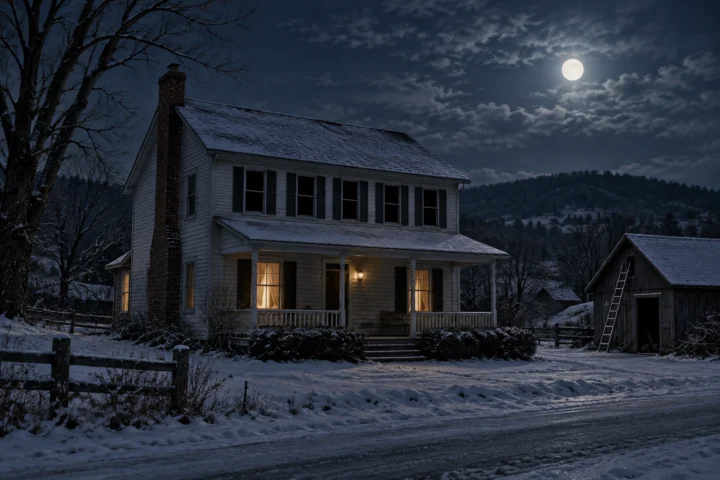
Shortly after midnight on Christmas 1945, fire consumed the Fayetteville, West Virginia, home of George and Jennie Sodder. The parents and four children escaped. Five others—Maurice, Martha, Louis, Jennie and Betty—were not seen again. Officials treated them as victims of the blaze, although the hurried search did not recover remains that could be identified as theirs.
The parents came to believe the children had been removed before or during the fire. They pointed to a telephone line found cut, vehicles that would not start, a missing ladder and later reports of sightings. Some details were documented only after the family’s theory had formed, and none established a route, captor or verified survival.
A 1949 excavation produced vertebrae. Smithsonian examination placed them above the likely age of the oldest missing child and found no signs of fire exposure; investigators concluded that the bones had probably arrived with fill dirt. That result removed one alleged answer without proving kidnapping.
The case belongs beside the archive’s discussion of evidence and testimony, the cold-weather disappearance record of the Yuba County Five, and the way press repetition shapes unresolved events.
Claim, Context and Cautions
A fire and an incomplete count
Nine Sodder children were home that night. Marion, John, George Jr. and the youngest child, Sylvia, escaped with their parents; five children who had been upstairs were missing. George tried to reach the upper floor, but the stairs were burning and the household ladder was not where he expected it.
The local fire response was slow by modern standards, and the scene was not preserved as a forensic site. That failure created uncertainty at the point when clear evidence mattered most.
Could a house fire leave so little?
The family doubted that an ordinary house fire could consume five bodies completely. Modern fire investigation cautions against absolute claims in either direction: severe fires can fragment and obscure remains, while recognisable material often survives. The 1945 search was neither systematic nor well documented enough to settle the question.
Absence of recovered remains is therefore important but not equivalent to evidence that the children left alive.
The details that changed meaning
A telephone repairman reportedly found the line cut rather than burned through. A ladder was later located away from the house, and the family's trucks failed when George tried to use them for rescue. These facts became parts of an abduction narrative.
Each also has evidential limits. Timing, handling and chain of custody were poorly recorded, and mechanical or household explanations were not eliminated under controlled conditions.
Bones from the 1949 excavation
The Sodders excavated the site with a private investigator and recovered several vertebrae. A Smithsonian assessment judged them to be from one person, probably aged about sixteen to twenty-two—older than fourteen-year-old Maurice—and noted no fire damage.
The excavation area had been filled with soil after the fire. The bones were reportedly traced to that fill, making them an introduced object rather than proof of a child at or away from the scene.
Sightings, photographs and pursuit
The family followed reported sightings across the United States and received an anonymous photograph in 1967 that they thought resembled an adult Louis. None of the claims produced an identification that could be independently tested. The roadside billboard kept the children's faces visible for decades and invited further reports.
Persistence demonstrates the family's conviction and loss. It does not raise unverified sightings to corroboration.
Two hypotheses, neither completed
Death in the fire remains the simplest explanation for five children last known to be in the house, weakened by the poor recovery and confused official response. Abduction can account for the missing remains only by adding an unobserved removal, motive and escape.
The responsible conclusion is narrower: five children were never reliably accounted for after the fire, and the investigation left too little secure evidence to decide how they disappeared.
Contextual glossary
Terms used in this entry
Definitions are offered as reading aids, not as conclusions about the case.
- Excavation
- The controlled removal and recording of archaeological deposits. Because digging destroys the original arrangement, plans, photographs, samples and layer records are as important as the objects recovered.
- Chain of custody
- The documented sequence showing who collected, stored, copied, tested and transferred an object or recording. Gaps make alteration, contamination or mistaken identity harder to rule out.
- Corroboration
- Independent information that supports part of an account, such as a record, trace or separately obtained observation. Repetition from a shared source is not independent corroboration.
- Uncertainty
- The stated limit on what a measurement, reconstruction or body of evidence can establish. Describing uncertainty is not indecision; it prevents a result from appearing more precise than the evidence allows.
Reference trail
Sources
- Smithsonian Magazine, “What Happened to the Sodder Children?” (opens in a new tab)Detailed historical reconstruction incorporating family accounts, contemporary reporting and the Smithsonian bone assessment.
- West Virginia Press Association, “Old Fayette County mystery draws new attention” (opens in a new tab)Local-history account of the missing children, the billboard and the case’s continuing West Virginia context.
- Anomaly Registry, “The Sodder Children” evidence dossier (opens in a new tab)Source-led chronology separating documented facts, the 1949 bone report and later claims; used cautiously as a secondary dossier.
- Newspapers.com topic archive: Sodder family fire coverage (opens in a new tab)Searchable contemporary and later newspaper record used to distinguish period reporting from retrospective retellings.
Case Book
Photographs, Maps and Supporting Images
Supporting images provide documentary, geographic or visual context. Read each caption for its date, source and evidential limits.

Continue researching
Follow the evidence, context and comparisons
Curated connections
Selected editorially for this entry.
A field guide to three words that often get tangled in mystery research.
Curated connection · Case fileThe Yuba County Five: A Road Into the SnowA disappearance case where winter road, confusion and delayed discovery created a mystery larger than any one clue.
Curated connection · ArticleThe Role of Newspapers in Spreading Strange TalesOld newspapers preserved remarkable local reports, but they also shaped them for appetite, humour and alarm.