UFOs & Aerial Phenomena
The Ariel School Sighting: Children at the Edge of the Playground
Children at Ariel School in Ruwa reported a strange object and figures on 16 September 1994. Drawings and interviews preserve their accounts, while chronology and interview method limit firm conclusions.
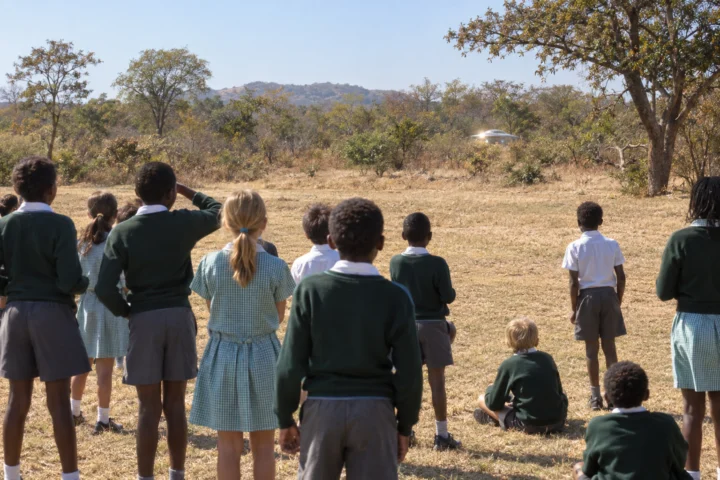
During morning break on 16 September 1994, children at Ariel School near Ruwa, Zimbabwe, reported seeing lights or an object and one or more small figures beyond the playground. No teacher or other adult is known to have watched the episode itself. The case rests on what pupils said, drew and later remembered.
That record is unusually extensive for a schoolyard sighting, but it is not a single account repeated dozens of times. Descriptions varied, and early questioning sometimes took place in groups after the children had talked among themselves. Later interviews by psychiatrist John Mack added detailed testimony but occurred about two months after the event.
The children’s evident seriousness deserves respect. It does not decide whether the stimulus was extraordinary, misunderstood, socially amplified or staged. Drawings document reports; they are not photographs of an object.
The archive’s guides to testimony and legend, recording strange experiences and perception under unusual conditions explain why sincerity and identification must remain separate questions.
Claim, Context and Cautions
Morning break beside the scrub
The reported event occurred while pupils were outside and most staff were in a meeting. Accounts generally place the stimulus in rough ground beyond the school's normal play area. Some children described a disc or craft; some described figures with large dark eyes; others saw less or nothing at all. Estimates of the number involved vary because the school population, those outside and those later interviewed are different groups.
The secure claim is that a substantial group reported a disturbing event. Numbers should not be converted into identical independent observations when pupils shared a location and discussed what had happened.
The earliest surviving record
Local UFO investigator Cynthia Hind visited soon afterwards and recorded children describing and drawing the event. These interviews are vital because they are closer in time than later documentaries. They also show methodological limitations: some questioning was conducted with children together, allowing details and reactions to circulate.
The surviving material contains both recurring motifs and disagreement about colour, shape, number, movement and position. Variation is expected in genuine witness reporting, but it prevents the accounts from serving as a precise composite measurement.
Drawings, interviews and memory
The children's drawings are often displayed as if their similarities prove a shared external object. They more securely show how individual pupils represented the story after the event. Similar images can arise from a common stimulus, peer conversation, familiar visual culture or a mixture of these.
Mack and Dominique Callimanopulos interviewed a smaller group about two months later. The recordings preserve detailed personal responses. Because they followed earlier discussion and media attention, they cannot restore an uncontaminated first statement.
The environmental message
Some later accounts emphasise telepathic warnings about environmental damage and technology. That theme appears strongly in certain interviews but should not be attributed uniformly to every child. It became one of the story's most memorable elements partly because it fit Mack's wider interpretation of encounter experiences.
A reported mental impression is evidence of what a witness remembered or understood. Without an independent message or contemporaneous record, it cannot establish communication from the beings the witness believed were present.
Competing explanations
Proposals include an unusual aerial event, misidentified people or objects, a prank, media priming and peer reinforcement. Southern Africa had recently experienced public UFO and fireball discussion, which may have supplied interpretive language without explaining the initiating stimulus. Conversely, an extraordinary-craft hypothesis must account for the absence of adult observation and independent physical records.
No single ordinary scenario has been demonstrated for every account. The evidence is better suited to analysing testimony formation than identifying the object with confidence.
Why the case remains difficult
Ariel endures because the children were articulate, emotionally affected and repeatedly willing to stand by what they remembered. Those qualities make the testimony historically and psychologically important. They do not remove the effects of group discussion, leading assumptions, time and retelling.
The balanced conclusion is deliberately limited: pupils reported something they found extraordinary, and investigators preserved part of that response. The public record does not provide a physical trace or interview sequence capable of distinguishing an alien encounter from a socially developed interpretation of an ambiguous event.
Contextual glossary
Terms used in this entry
Definitions are offered as reading aids, not as conclusions about the case.
- UFO
- Unidentified flying object, historically used for an aerial observation that remains unidentified at the time of reporting. In popular culture it often implies a spacecraft, which is a separate claim.
Reference trail
Sources
- John E. Mack Institute, “Exploring African and Other Alien Encounters” (1995) (opens in a new tab)First-person investigator account of Mack’s visit and interviews; valuable primary context but written from an encounter-advocacy perspective.
- WHYY, “Documentary explores the UFO sighting that changed the course of 62 children’s lives” (opens in a new tab)Public-media overview incorporating archival interview material and differing adult responses.
- Skeptical Inquirer, “A Closer Look at Encounters and the Ariel School Sighting” (opens in a new tab)Critical chronology of early investigation and group-interview problems; used as methodological analysis, not a neutral primary record.
- Scepticisme Scientifique 12 (2024), analysis of the Ariel School testimony (opens in a new tab)Review of child-witness literature and the possible effects of adult questioning and group discussion.
- Gideon Reid, “The influence of sci-fi media on Zimbabwe’s Ariel School UFO sightings” (The Skeptic, 2026) (opens in a new tab)Critical media-context analysis of prior UFO coverage, varying reports and the later emergence of the environmental-message theme.
Case Book
Photographs, Maps and Supporting Images
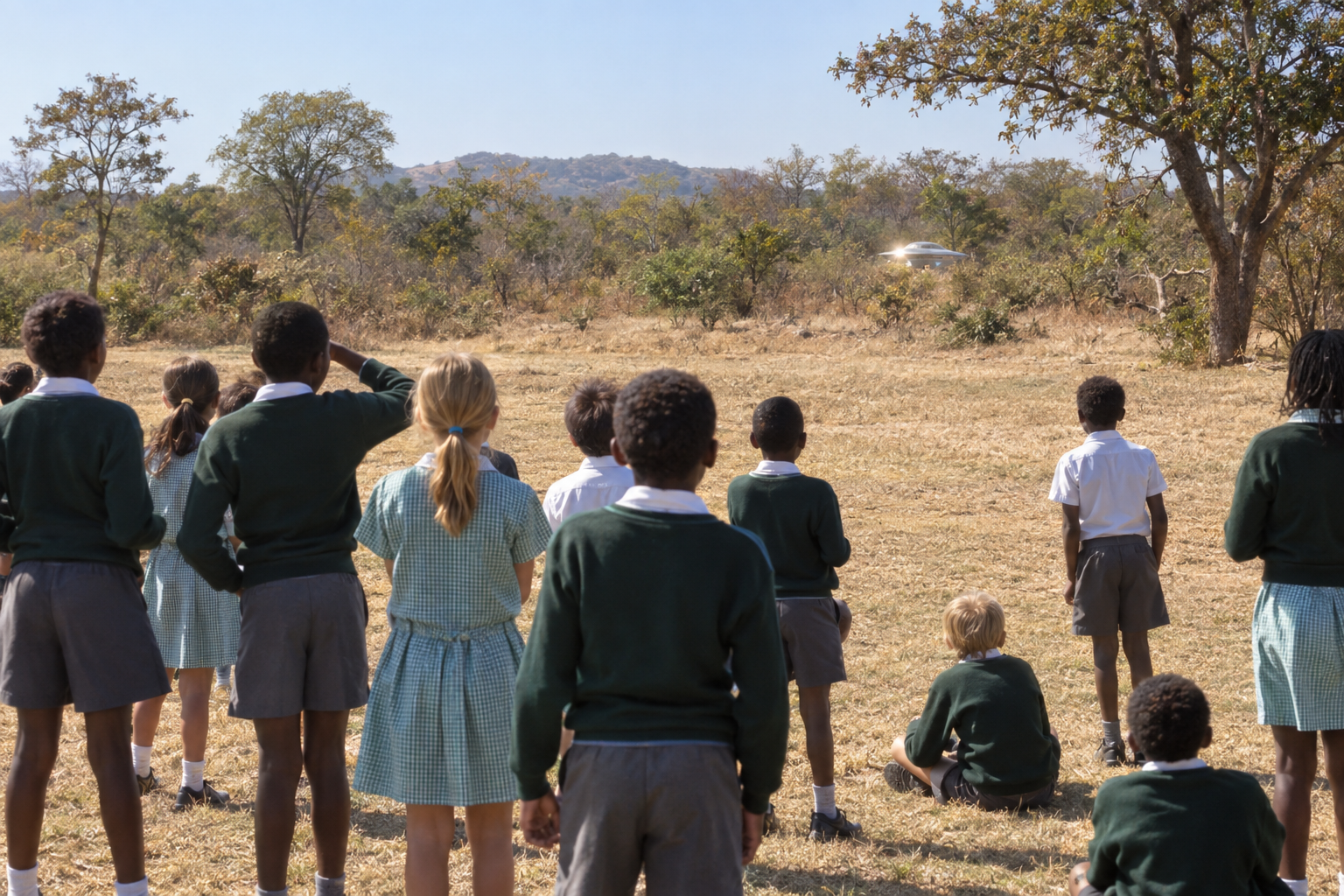
Supporting images provide documentary, geographic or visual context. Read each caption for its date, source and evidential limits.

Continue researching
Follow the evidence, context and comparisons
Curated connections
Selected editorially for this entry.
A field guide to three words that often get tangled in mystery research.
Curated connection · ArticleA Field Guide for Recording Strange Experiences ResponsiblyA calm checklist for writing down unusual events before memory, excitement and online feedback reshape them.
Curated connection · ArticlePilot Reports and the Problem of Expert PerceptionTrained observers matter, but expertise does not remove ambiguity from distance, speed, glare and surprise.
More through shared context
Additional routes based only on existing topics, themes and metadata.
The Belgian wave combined sincere observations, institutional openness and an ambiguous radar episode. It did not produce a verified craft, and its reports likely include multiple stimuli.
Same primary topic · Shared theme: Mass sightings, Witness & memory · Case fileThe Phoenix Lights: Two Events, One NightOn 13 March 1997, reports of a moving light formation crossed Arizona before a separate row of lights appeared near Phoenix. One event has a strong military-flare explanation; the other remains disputed.